What the Bible says about light and seed

The True Light "In him, (the Lord Jesus) was life, and that life was the light of men. The light shines in the darkness, but the darkness has not understood it. The true light that gives light to every man was coming into the world,…the world didn’t recognize him." John 1:4,9.

The Good Seed and the Weeds “The kingdom of heaven is like a man who sowed good seeds in his field. But while everyone was sleeping, his enemy came and sowed weeds among the wheat and went away. Matthew 13:24,25.

Monday, December 12, 2016

Strength at Wit's End

Reposted from RaySteadman.org

A daily devotion for December 12th
Read the Scripture: Hebrews 5:1-10
During the days of Jesus' life on earth, he offered up prayers and petitions with fervent cries and tears to the one who could save him from death, and he was heard because of his reverent submission. Son though he was, he learned obedience from what he suffered... Hebrews 5:7-8
How can Jesus sympathize, how does he understand our pressures, if he has never sinned? The answer to that leads us into the dark shadows of Gethsemane. There is no other incident in the gospels that fits the description of this passage where, with prayers and supplications, with loud cries and tears, he cried unto him who was able to save him from death.

Here we come face to face with mystery. Here is the total unexpectedness of unimagined agony to the Lord. In his anticipation of what he would be going through and his explanations of it to the disciples, he had never once mentioned Gethsemane, and there is no prediction of this in the Old Testament. There is much that predicts what he would go through on the cross; there is not one word of what he endured in the garden.

In the midst of his bafflement, puzzlement and distress of soul, he does an unusual thing. For the first time in his ministry he appealed to his own disciples for help. He asked them to bear him up in prayer as he went further into the shadows, falling first to his knees and then to his face, crying out before the Father. There he prayed three separate times and each prayer is a questioning of the necessity of this experience. Father, if it be possible, let this cup pass from me. He was beseeching the Father to make clear to him whether this was a necessary activity, so unexpected and deep was his suffering, so suddenly had it come upon him, baffling him, confusing him, bewildering him, just as sudden experiences and catastrophes come bewilderingly to us.

To deepen the mystery of this it is implied that the Lord Jesus faced the full misery which sin produces in the heart of the sinner while he is yet alive. All the naked filth of human depravity forced itself upon him and he felt the burning, searing shame of our misdeeds as though they were his. No wonder he cried to the Father, Father, if it be possible let this cup pass from me. Nevertheless, he adds, not my will, but thine, be done (Luke 22:42).

This explains the strange words, Although he was a Son, he learned obedience through what he suffered. He learned what it means to obey God when every cell in his body wanted to disobey. Yet, knowing this to be the will of God, he obeyed, trusting God to see him through. He learned what it feels like to hang on when failure makes us want to throw the whole thing over, when we are so defeated, so utterly despairing that we want to forget the whole thing. He knows what this is like, he went the whole way, he took the full brunt of it.

How did he win? He refused to question the Father's wisdom. He refused to blame God. He took no refuge in unbelief even though this agony came unexpectedly upon him. Instead, Jesus cast himself upon the Father's loving, tender care and looked to him to sustain him. When he did, he was brought safely through. So we read, Let us then with confidence draw near to the throne of grace, that we may receive mercy and find grace to help in time of need. No matter how deep, how serious that need may be, he can fully meet it, though we may be at wit's end.
Father, thank you that the Garden of Gethsemane was not a mere play acting upon a stage. The Lord Jesus did not come into the world to perform a role, he fully entered into life. He went the whole way, he bore the full brunt. Help me to trust in him.
Life Application: Jesus Christ entered into the full force of two of our lives' greatest mysteries: obedience and suffering. Where on the spectrum of obedience do we pray 'nevertheless, not my will but Thine be done?'
We hope you were blessed by this daily devotion.

From your friends at www.RayStedman.org

Saturday, December 10, 2016

On the Light Side from Mondon Translation

By Jean-Louis Mondon.

In the Old Testament, the children of Israel had to fight against the Anakim, the Emim, the Rephaim and the Zuzim, nowadays translators such as myself have to struggle with a remnant of those powerful individuals, the “Verbatim”.

Friday, December 9, 2016

The Seasons in the Life of a Christian- Brokenness - Grinding the grains - Chapter IV and Conclusion


The Seasons in the Life of a Christian- Brokenness - Grinding the grains - Chapter IV and Conclusion 

Written and posted by Jean-Louis Mondon. http://thelightseed.blogspot.com (To read the preceding and following chapters, click on the left lateral bar on the numbered chapters under the title "The Seasons in the Life of a Christian" - Brokenness.)

IV. GRINDING (Lord, It hurts)
Up until now, we had individual grains of wheat from individual stalks that require still a further process before there can be any bread making as such. Verse 28 of Isaiah 28 tells us that: “grain must be ground to make bread”. It is impossible to make bread that stays in one piece with individual kernels. The gluten, sticky substance that holds the loaf together is inherent to the wheat, but the individual grains of wheat have to be ground in order to provide the right consistency and the (glue-like), binding quality that causes the bread to hold together. The flour, ground product, still has everything that was contained in the individual separate grains of wheat, now unrecognizable as kernels because of the transformation process into a workable substance. In the same way, the loaf of bread baked from the flour contains every grain of wheat (minus the chaff) that has been submitted to the processes of grinding, mixing, kneading, rising and finally baking. 

Another insight from Oswald Chambers is that “Personality is the characteristic of the spiritual man as individuality is the characteristic of the natural man. Our Lord can never be defined in terms of individuality and independence, but only in terms of personality. “I and my Father are one”. Personality merges and you only reach your identity when you are merged with another person”. (See Oswald Chambers, My Utmost for His Highest. Dec. 12th. On Personality).

 
 Google image
 Paul in I Corinthians 10:16 speaks of the loaf of bread as a symbol for the body of Christ that was broken for us, but also of the Church, His body on earth in these terms, “the bread which we break, is it not the communion of the body of Christ? For we being many are one bread, and one body: for we are all partakers of that one bread”.

The following verse uses  an allegorical image of the spiritual, supernatural Love of God and brings it down to the physical expression of the binding quality of the gluten in the bread that was mentioned above.  
Bear with each other and forgive any complaint you may have against one another. Forgive as the Lord forgave you. And over all these virtues put on love, which is the bond of perfect unity. Let the peace of Christ rule in your hearts, for to this you were called as members of one body. And be thankful.… Colossians 3:14-15

Notice the way Paul illustrates the nature of love as the bond of perfect unity when he describes in a practical way what we can do in order to promote peace, forgiveness and bearing with one another´s burden.This is far from the word “Love” that is constantly used ad nauseam until it becomes devoid of real meaning, a love that is insipid, because it lacks the spiritual substance that  the Lord Jesus ascribes to it. Love in its essence expresses the sum of some of the virtues found in the person of the Lord Jesus-Christ who defines it thus:
No greater love has a man than he gives up his life for a friend.(John 15:13)
How far how we willing to go as His disciples in living  sacrificial lives for the benefit of others?

Because of His love for the multitude, Jesus multiplied the loaves of bread and that´s what Christians are commanded to do: multiply and bear good and lasting fruit, feeding the multitude with the Word of God for man shall not live by bread alone but by every word that comes out of the mouth of God. 

Now we have reached a point of extreme unsatisfied hunger as God has sent a famine of the hearing of the Word of God. "Because lawlessness is increased, most people's love will grow cold. The contrast is so evident to me; Could it be that there a famine because the church has substituted its spiritual mandate for a false gospel of social work and social justice and left a willing and consenting people hungry and thirsty for real food?
As Christians we are called to deny ourselves, pick up our cross daily and follow our Lord Jesus and be the servant of all. As out of His great love for us, He laid down His life we, in turn lay our lives down as an expression of love for the benefit of the body of Christ, so that individually and corporately, we will reflect the life and the glory of Christ for the praise of the Father. 

In all three examples of breaking, plowing the ground, threshing the wheat and grinding the flour, the farmer doing the breaking is using the help of an implement like the sharp edge of the plowshare, or an instrument such as a rod or a grinding wheel. In like manner God will allow into our lives a specific tool of His own choosing, a particular circumstance or person fit for the job. 

When it happens we have a tendency to look at the instrument and not beyond at our Master-Teacher who is using the instrument for our benefit. Are we able to say at this point, “ not my will, but thine be done”?
Check what Peter says in I Peter 1:7; I Peter 2:21; and what James says in James 1:2 about trials and testing as they relate to faith, perseverance and maturity.

V. CONCLUSION
Acceptance, willingness and obedience
What is most important is the spirit with which we receive the trials the Lord allows us to go through, and our reaction to the suffering they bring. Let us have the same attitude as David who said in Psalm 16:5,6 “The LORD is the portion of mine inheritance and of my cup: thou maintainest my lot. The lines are fallen unto me in pleasant places; yea, I have a goodly heritage”.

We want to live in the blessed presence of our Lord, don’t we? David poses a pertinent question when he asks in Psalm 15: “LORD, who may dwell in your sanctuary? (v.1), He who keeps his oath even when it hurts”(v.4b).
We, as disciples, have promised to follow Jesus no matter what happens, no matter where He takes us. Well, in John 12:26 Jesus says: “Whoever serves me must follow me and wherever I am, my servant will be also”.

Is our Lord grieving over the condition of His church and that of the lost people in the world He so dearly loves and died for? If so, we will be grieving with Him and be moved to obedient action directed by the Holy Spirit.

However, my brothers and sisters rejoice, for He also said to His disciples: “I tell you the truth, you will weep and mourn while the world rejoices. You will grieve but your grief will turn to joy”. And then, we can say like David:
“You turned my wailing into dancing, you removed my sackcloth and clothed me with joy, that my heart may sing to you and not be silent. O LORD my God, I will give you thanks forever”. (Psalm 30:11,12).

Remember also that Psalm 126: 3 declares:
“The LORD has done great things for us, and we are filled with joy. Restore our fortunes, O LORD, like streams in the Negev. Those who sow in tears will reap with songs of joy. He who goes out weeping, carrying seed to sow, will return with songs of joy, carrying sheaves with him” . Amen

“All this also comes from the LORD Almighty, wonderful in counsel and magnificent in wisdom”. (Isaiah 28:29).

Brother Jean-Louis. Thanksgiving day 1998.
Revised and corrected June 2007.Revised and Illustrated January 2013

Wednesday, December 7, 2016

DECEPTION Pastor, “Power, Prestige, and Wealth are all Yours if you just Tell Them What They Want to Hear”

Reposted from doctorwoodhead.com
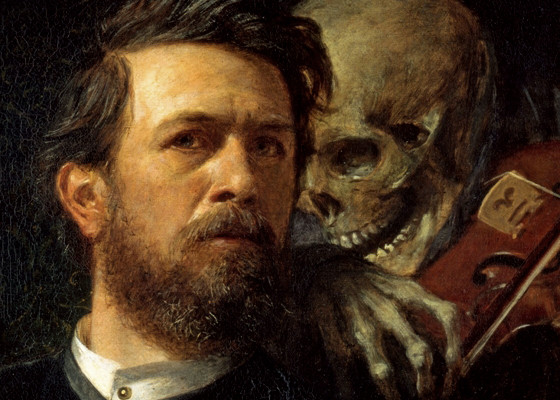
  Self-portrait with Fiddling Death, by Arnold Böcklin 1872

Self-portrait with Fiddling Death, by Arnold Böcklin 1872

 This is perhaps the most insidious of all the heretical deceptions to come upon biblical Christianity.  It is characterized by catering to the desires of the people. Instead of being inculcated with God’s Word and having our personal world view and behavior be patterned after God’s Word, the New Evangelicalism gives the people what they want.  One NT passage clearly predicts this reversal of worship of God to worshiping man.
Romans 1:25
Who changed the truth of God into a lie, and worshiped and served the creature more than the Creator, who is blessed for ever. Amen.

The idea with this new wave of apostasy is to soft-sell the Bible and salvation. It is not attempting to save anybody from the fires of Hell but from an aimless and meaningless life here on earth. Our experiences and quality of life here are more important than the total service to God and the blessed assurance that He will soon come to lift us out of this sinful decaying world. Salvation is given lip service and evangelism with real confrontation is thought to be too divisive. This apostasy does not want to upset anybody. There is never any mention of Hell and the outcome of an unsaved life.  They may say that they believe strongly but, their actions differ sharply from what they say.

Usually their Bible teaching is characterized by an over emphasis on application. This of course is the middle of the road approach. They avoid doctrine as too divisive.
Paul warned us that the end times would be characterized as a departure from sound doctrine and a departure from the truth.
II Timothy 4:3-4 
For the time will come when they will not endure sound doctrine; but after their own lusts shall they heap to themselves teachers, having itching ears; And they shall turn away [their] ears from the truth, and shall be turned unto fables.

With the divisiveness they believe that they will lose members of their congregation and therefore funds. Or they are concerned with money and man-made approaches to self-help. A total dependence on God for their resources is abandoned for “sound business” practices or “fundamental marketing techniques.”  Total reliance on God by elders through prayer and patience is exchanged for parliamentary procedure and schemes for man made self-advancement and career goals. The pastor is considered as a CEO, not the teacher of God’s Word. Mission statements and strategic plans are formulated to accommodate personal plans. The Bible is subordinated to man’s desires.

The thought of prophecy is anathema to the New Evangelical for they say it causes division. This division of course is between those non-literal Bible expositors and the literal Biblical expositors.  Some have characterized the New Evangelical as being seduced by the world spirit of this present age.
You can see it in the leaders who are popularized. Usually they have a high degree of prominence in the government or sports and their testimonies are sought after for paid speaking engagements and book endorsements.

You will never see a Sunday school teacher or poor inner city pastor held up by them as pillars of the faith. Christ went to the lowest members of society to bring the truth to the world. He did not go to the popular and prominent.

This is a spirit of disobedience and a mood of compromise. It is a rejection of many of the negative aspects of New Testament Christianity. It is an attitude of positivism. They would rather be diplomats not fighters, positive rather than militant, infiltrators rather than separatists. They would not be restricted by a separationist mentality. The New Evangelical would rather pursue dialog, intellectualism, and appeasement than Biblical Militantism. Psychology is fast becoming their guide.

The use of psychology is rapidly becoming the norm in Christian Schools and churches.
Our culture has become deeply and extensively psychological. The weakness and carnality of the church in recent decades has allowed this psychological mind-set of the world to flow into the church. This process has brought about a redefining of many foundational matters of the Christian faith. We used to correctly understand that man’s problem was sin and God’s remedy was His saving and transforming grace (Romans 5:12, 17). Now, the trouble is the disorder of codependency, and the solution is group therapy. Formerly, we understood that man tended to stray from God to follow his own self-willed path (Isaiah 53:6), and that he needed to deny himself, take up his cross, and follow Christ (Luke 9:23). Now, we think that man must esteem himself, affirm himself, and actualize himself. All of this new thinking is coming from psychological theory, which is primarily a philosophy of life. We are strongly warned in the word of the Lord not to be guided by the philosophy of the world.
Colossians 2:8
“Beware lest anyone take you captive through philosophy and empty deceit, according to the tradition of men, according to the basic principles of the world, and not according to Christ”

Beware of the leaven of the new-evangelicals.

Sunday, December 4, 2016

The Dictator and the Dissident


Reposted from nationalreveiw.comnationalreview.com
by Lee Habeeb November 28, 2016 1:33 PM

Armando Valladares’s story says more about Fidel Castro than any obituary could. It’s a part of the Fidel Castro story Michael Moore and Sean Penn won’t tell, or don’t know. It’s a story you certainly didn’t hear from the media as they endlessly opined about Castro’s “complicated” legacy. But it reveals so much more about the dictator than they ever could. 

The year was 1959. Castro, a young revolutionary, had seized Cuba’s imagination with talk of democracy and a new vision for its people. It didn’t take long, however, for one follower to discover Castro’s true nature, and for Castro to run up against the limits of his own earthly power. Armando Valladares may not have been the first man to challenge the Cuban dictator, but he eventually became the best known. By his own account, the young Valladares was an early supporter of Castro’s revolution, taking a job in the Office of the Ministry of Communications for the Revolutionary Government, where he worked as a postal clerk. 

But all of that changed when he was asked to put a communist slogan on his desk. It comprised three simple words: “I’m with Fidel.” He refused. A young artist and poet who also happened to be a Christian, Valladares understood the meaning of the request. What he did not know, and could not know, was how far his own government would go to bend him to its will. Soon after his refusal to comply, Valladares was arrested by political police at his parents’ home. Faced with trumped up charges of terrorism — a favorite tactic of the Castro regime for silencing dissent — he was given a 30-year sentence. Valladares would spend time in different prison camps for the next 22 years. 

The first, La Cabaña, forged some of the very worst memories. “Each night, the firing squad executed scores of men in its trenches,” he told the Becket Fund, which last year honored him with its Canterbury Prize, given annually to a person who embodies an unfailing commitment to religious freedom. “We could hear each phase of the executions, and during this time, these young men — patriots — would die shouting ‘Long live Christ, the King. Down with Communism!’ And then you would hear the gunshots. Every night there were shootings. Every night. Every night. Every night.” 

Years passed, and the communists fixated on enrolling prisoners in reeducation programs. Valladares, still early in his sentence, was offered the chance at “political rehabilitation” but refused to comply. He was sent to an even more brutal prison, and the government ramped up its efforts to break his spirit. Armando Valladares may not have been the first man to challenge the Cuban dictator, but he eventually became the best known. “I spent eight years locked in a blackout cell, without sunlight or even artificial light. I never left. I was stuck in a cell, ten feet long, four feet wide, with a hole in the corner to take care of my bodily needs. No running water. Naked. Eight years,” Valladares recalled. “All of the torture, all of the violations of human rights, had one goal: break the prisoner’s resistance and make them accept political rehabilitation. That was their only objective.”

After nearly a decade, prison officials adjusted their terms. If Armando would simply sign a document renouncing his beliefs and embracing Communism, he could return to his family. The choice was simple: physical freedom or spiritual liberty. “For many people, it wasn’t practical to resist. Better to sign the paper and leave,” Valladares said. “But for me, signing that paper would have been spiritual suicide.” So how did Valladares do it? How did his faith and spirit endure during those years alone in prison? “In the beginning, I embraced God perhaps for fear of losing my life, since I was in danger of being executed,” he told the National Association of Evangelicals in 1983. But hearing those men proclaim their love for Christ just prior to their executions moved him in ways he could not have imagined: I realized then that Christ could be of help. Not merely by saving my life, but also giving my life, and my death if that was the case, an ethical sense that would dignify them. I believe that it was at that particular moment, and not before, when Christianity, besides being a religious faith, became a way of life that in my own circumstances resulted in resistance — resisting torture, resisting confinement, resisting hunger, and even resisting the constant temptation to join the political rehabilitation and indoctrination programs that would end my predicament. The battle lines were drawn for Valladares: the material life versus the spiritual life. Castro and his earthly ambitions of a utopian dictatorship versus Christ and His promise of everlasting life for those who follow Him. 

RELATED: Armando Valladares, Witness to Truth Castro fought hard, desperate to strip Valladares of his most valuable possession: his sense of morality. But once again, his faith proved up to the task. “To be Christian under those circumstances meant that I could not hate my tormentors; it meant to maintain the belief the suffering was meaningful because if man gives up his moral and religious values, or if he allows himself to be carried by a desire to hate or for revenge, his existence loses all meaning,” he explained. Valladares noted often that he was not alone in his spiritual battle with Castro. His fellow Christians showed him the way: I saw dozens of Christians suffering and dying — committed, like myself, to maintaining their dignity and their richness of spirit beyond misery and pain. I remember with emotion Gerardo Gonzalez, a Protestant preacher, who knew by heart whole Biblical passages and who would copy them by hand to share with his brothers in belief. I cannot forget this man whom all of us called “Brother in Faith.” He interposed himself before a burst of machine-gun fire to save other prisoners who were beaten in what is known now as the Massacre of Boniato Prison. Gerardo repeated, before dying, the words said by Christ on the cross: “Forgive them, Father for they know not what they do.” And all of us, when the blood had dried, struggled with our consciences to attain something so difficult yet so beautiful: the ability to forgive our enemies. Valladares’s God, too, showed him the way and the light. “There are no impossibilities for those who love and seek God,” he said. “The more ferocious the hate of my jailers, the more my heart would fill with love and a faith that gave me strength to support everything; but not with the conformist or masochistic attitude; rather, full of joy, internal peace and freedom because Christ walked with me in my cell.” 

While in prison, Valladares began to write poetry denouncing his oppressors. Without paper or pen, he wrote on cigarette papers and onion skins, using his blood as ink. His wife, whom he met in prison, smuggled the poems to the outside world and they became his first book, From My Wheelchair, released in 1977.

 “There is nothing dictators fear more than artists, especially poets,” Valladares wrote. In “Life Was Not Enough,” dedicated to Pedro Luis Boitel, whom he called “an unforgettable brother,” he expanded on the thought:

Life was not enough for you in that torture chamber 
but there were rifle butts and  boots  to spare 
buckets of urine and excrement thrown in your face.
They could not forgive you 
your  labors of light and words 
they feared your smile
the eloquence of your hands 
they feared the fertility of your ideas 
and your manner of being silent 
they feared your life, Pedro,
and they murdered you.

Today, Valladares paints rather than writing poems. His pictures are not scenes of torture and darkness, but vibrant landscapes that depict his soul — the refuge where he survived Castro’s war on his body and his conscience. But in his speech last year to the Becket Fund, he stressed that his experience had taught him the need for vigilance in defense of freedom:  

Just as there is a very short distance between the U.S. and Cuba, there is a very short distance between a democracy and a dictatorship where the government gets to decide what to do, how to think, and how to live. And sometimes your freedom is not taken away at gunpoint but instead it is done one piece of paper at a time, one seemingly meaningless rule at a time, one small silencing at a time. Never allow the government — or anyone else — to tell you what you can or cannot believe or what you can and cannot say or what your conscience tells you to have to do or not do. Castro is dead, and there will be countless biographies dedicated to burnishing his legacy. But the best way to understand his life is to appreciate the life of one Cuban dissident he changed forever. 

Armando Valladares’s story may never be required reading in Cuban schools, but it needs to be read in every American school. Call it “The Dictator and The Dissident.” It’s quite a yarn. — Lee Habeeb is the vice president of content for Salem Radio Network. He is also the host of Our American Stories. He lives in Oxford, Miss. 

Read more at: http://www.nationalreview.com/article/442515/fidel-castro-brutal-dictatorship-armando-valladeres-cuban-dissidents-tortured?utm_source=nr&utm_medium=facebook%3Futm_content%3Dhabeeb%3Futm_campaign%3Dtorture

Monday, November 28, 2016

Civil War and the Coming New World Order

 Reposted from omegaletter.com
Witnessing Tools
Monday, November 28, 2016
Pete Garcia 


This is quite a difficult and sensitive topic being discussed here today. But I feel that it is warranted, given what we are seeing play out before us. I don’t have any particular scriptural basis for it, other than it being more of an observation of the times.  If anything, I would liken it to the condition Jesus laid out for His disciples when asked what the signs of the end would be when He said…

Nation (ethnos) would rise against nation (ethnos), kingdom (political power) against kingdom        (political power) …and the love of many will wax cold… (Matt. 24:7, 12)
There is a storm brewing in our land, and has been for some time.  Those dark, foreboding clouds have always been on the horizon, but now they are overhead and our grumbling like a Kansas thunderstorm laden with the potential for torrential rains, lightening, and tornados. While history is not everyone’s favorite subject, it should be something we reconcile frequently. Studying history helps illuminate the challenges and similarities that our ancestors faced and may help us recognize the challenges we face in our own day and of days yet to come. The reason for this is because although the times change and the technology changes--the human condition never does. We tend to make the same mistakes over and over because we are a fallen race riddled with sin…and given enough time, history tends to repeat itself without fail.

On November the 9th, 2016, quite possibly the largest political earthquake ever felt in the United States occurred in the wee hours of the morning with Republican Donald Trump’s victory over Democrat Hillary Clinton. So stunning was the loss for Clinton and the Democrats that the media, the glitterati, the newspapers, print journals, pundits, and comedians all had assumed that her victory was so certain, that the election itself was just a formality. But since that day, the stammering and speechlessness has turned increasingly vitriolic and toxic as the reality that Donald Trump really will be the next President of the United States.

Since then, we’ve been witness to an increasing number of “spontaneous” anti-Trump demonstrations along with a rash of growing anti-police violence. These protests are “spontaneous” in the same sense that Benghazi was a result of an ‘anti-Islamic’ video on YouTube. In all actuality, these protests are part of a greater concerted effort by uber-leftist/globalist groups like George Soros Incorporated and MoveOn.org, who are attempting to upend the system in the wake of their stunning political defeat.  So if they can’t win politically despite the rampant fraud and voter machine rigging, they will attempt it by funding and fomenting violence.

The attempt now by the media to link the ‘rise in white power groups’ to Trump’s victory, is another attempt to get him to backpedal. Their rise (neo Nazi’s and the like) are not a result of Trump’s election, but a reaction to the Black Lives Matter movement that have sprung up across the nation and have hijacked the narrative on race.

Along those same sentiments is a growing call for secession from the Union from more traditionally liberal states like California and Oregon as a more formal protest against a Trump presidency. In the past, conservative states like Texas have threatened secession due to President Obama’s federal overreach but it seemed more bark than bite. At the very least, things could get to the point where California itself divides between the liberal south and central, and the more conservative north. But one thing to watch here is the momentum of the movement at the state level and to what degree Governor Jerry ‘Moonbeam’ Brown supports it as an act of defiance over the ‘sanctuary city’ status they will maintain despite federal threats of financial penalties.

But in watching the ‘useful-idiot’ movement (and media) attempting to justify their actions of blocking traffic, destroying private property, killing cops, threatening to kill cops, and provoking random violence, it reminded me of the events leading up to the American Civil War. Let us recap:

1820: The Missouri Compromise-Allowed Missouri to be a slave state, but added Maine as a free state to balance out Congress. Also divided the slave territories along the 36 by 30 parallel.
1831: Nat Turner’s Rebellion-slave uprising killing 60 whites. Quelled after two days, 55 slaves, including Nat Turner, were executed, along with 200 more who were lynched.
1846-1850: Wilmot Proviso would have (it failed) outlawed slavery from expanding into the newly acquired territories at the end of the Mexican-American war, which gained the US much of the southwest including California.
1850: The Compromise of 1850-New western territories in the would be slave states, but compelled the northerners to abide by the Fugitive Slave Act, which required them to return fugitive slaves back to the South.
1852: Harriet Beecher Stowe’s “Uncle Tom’s Cabin” popular book on slavery conditions in the south, considered by the north shocking and horrifying, but disparaging to Southerners who viewed this as gross mischaracterization.
1854-1861: ‘Bleeding Kansas’ The Kansas-Nebraska Act of 1854 overturned parts of the Missouri Compromise, by allowing these states to determine whether or not to be free or slave. The both went free after a bloody, five year struggle.
1857: The Dred Scott Case-The Supreme Court ruled that slaves were property, further complicating the North’s opposition to slavery.
1859: John Brown’s Raid-White Southerners and freed black slaves raided ammunition arsenal and began arming other groups to rise up. Was captured and executed becoming a martyr to the Abolitionist movement.
1860: Election of Abraham Lincoln-The election of the Republican A. Lincoln was overwhelming, considering he was not even on the ballot in many southern states. His election was followed by the secession of South Carolina some 30 days after. Six more states would secede by the spring of 1861.
1861: Battle of Ft. Sumter-Following S. Carolina’s secession, Ft. Sumter suddenly found itself on foreign land. Lincoln decided to send supplies and was met with a Southern blockade. This sparked the start of the actual Civil War.
(Reference: http://www.civilwar.org/education/history/civil-war-overview/triggerevents.html)

Assessment
As you can see, the Civil War didn’t start because Republican Abraham Lincoln was elected as President. Lincoln’s election was simply the straw that broke the camel’s back. There were decades of unchecked grievances and emotions leading up to the election of 1860. Former President Thomas Jefferson made this forewarning upon hearing of the Missouri Compromise of 1820 on slavery. In it he…

“Considered it at once as the (death) knell of the Union. It is hushed indeed for the moment. But this is a reprieve only, not a final sentence. A geographical line, coinciding with a marked principle, oral and political, once conceived and held up to the angry passions of men, will never be obliterated; and every new irritation will mark it deeper and deeper.”
Thomas Jefferson saw slavery as an issue that would not simply go away by appeasement and compromise. It would continue to fester in the hearts and minds of Americans (both for and against), until it resolved itself in the bloodiest war ever waged by Americans. In regards to this concept of unchecked grievances, I would like to draw a parallel to the issues of our day. The battle over the hearts and minds of Americans has been over a century in the making, and is so ingrained into our culture that we no more think about our eroding liberties than a frog thinks about the water he is in warming up.

There would be no need to work for liberty were liberties not being lost. Most Americans are unaware of a decline in individual liberty, and the reason is obvious: the decline rarely takes the form of sudden personal deprivations but, instead, takes the form of unnoticed erosion, and thus we come, as do the Russians, to regard whatever state we are in as a normal condition.”    Leonard E. Reed, (1965)

The outrage by normal Americans over the past eight years has resulted in the loss of some 900 Democrat seats of power, the rise of the Tea Party movement, and culminated with the election of Donald Trump primarily because of Obama’s overreach. He didn’t do anything different than any other president before him, which was to create more bureaucracy, more overreach, and add to our burgeoning national deficit. Obama simply got too greedy, too fast. His federal abuse was too obvious and it awoken the silent majority much in the same way that the Japanese attack on Pearl Harbor awoke a largely isolationist-minded American public in the 1940s.

Understand that there has already been a soft coup in this nation going back a hundred years or more. This coup began with the varying ideological theories from people like: Karl Marx, Friedrich Engels, Charles Darwin, Herbert Spencer, Friedrich Nietzsche, Margaret Sanger, John Dewey, and many others who at their foundation, espouse a rabid anti-Christian, anti-American, and anti-Constitutionalist ideas. Although the aforementioned specialize in different areas (economics, science, eugenics, psychology, and education), they all feed off of each other and use each other as stepping stones to validate their own agendas.

Their goal, largely accomplished today, was to spread this infectious ideology first through European seminaries, universities, and then on to the rest of the world via public education and governance. This then would be reinforced through the relentless “consensus-mantra” beatings by media and pop culture on the average citizenry. Now those most indoctrinated by socialism (in its varying forms) are firmly embedded in most of the western governments. Their goal is a one-world system. But first they need to ‘divide and conquer’ which is why we see the parties (even within themselves) so divided over fiscal, social, and political issues we face today.

Although the swing left was greatly exacerbated during the Clinton and Obama administrations, Hillary’s third term was meant to be the icing on the cake. It was meant to usher in an avalanche of demographic change via massive, unchecked immigration that would change the electoral make up of this country forever, so that no Republican could ever win again. This is why this Trump win is such a stinging defeat. They (media, politicians, “experts”) were so sure it would happen that Clinton never even thought to write her concession speech. Such was the power of the media to distort the facts on the ground. Even now, you can see now how the media is already trying to shape what President Trump’s agenda should be. This is the same media that completely got the election wrong. They keep trying to shape the argument that what real American’s are angry about, is their talking points.

To set the record straight about the average American:
We aren’t angry over “climate change.”
We aren’t angry because men can’t use women’s restrooms.
We aren’t angry because we hate immigrants.

We are angry because the progressive-left has hijacked the Constitution and is trying to redefine it into something it was never intended to be-- a license for lawlessness leading to a global government.
We are angry about unchecked immigration, sanctuary cities, overwhelming national debt, global trade deals that would crush the US economy, and an overburdened, and under resourced military.
We are angry at the lawlessness and corruption permeating every facet of our society.
We are angry that the America we got the privilege to grow up in, will not exist for our children at the current rate.

Conclusion
Slavery is a system of both commerce and thought, and has been around as long as man has. It always seeks to put one class above the other. One works while the other reaps the benefit of that work. In the past centuries, the workers and reapers were determined by race and ethnicity. But as the west came to abandon the actual practice of slave holding, the concept remained. In the 20th-21st centuries, the class division wasn’t so much about race as it was political and religious ideology.

While slavery was the issue of the day back in the 1850’s and was rightly rejected by the Republican Party, the issue of slavery still holds sway over the world today. This new form of oppression in the west is more akin to the proletariat versus bourgeoisie of the communist revolutions that swept through places like Russia, China, Cuba, and Vietnam in the 20th century. This new form of oppression is between the haves and have nots, the elite and the ‘unwashed’ masses, between the enlightened and the ‘deplorables’, and between the media and the alternative watchdogs. The Democrat party never abandoned the idea of slavery, they just redefined it.

Lyndon B. Johnson’s “Great Society” wasn’t based on truly helping poor, minority communities, but enslaving them into systemic poverty and guaranteeing party loyalty for decades to come. Even the leftist Snopes ‘fact checking website’ has a very difficult time walking back his vehemently racist comments. But here is the greater proof, if the Democrat party truly had the best interest of minorities in mind, democratic strongholds like Detroit, Chicago, and Washington D.C. would be beacons of peace and prosperity. But those cities, like so many others, are markedly divided between the ‘go and no go’ zones of the rich and affluent and the poor and desperate.

But to the left, even racism and slavery are only means to an end, not the end itself. It is even somewhat disingenuous to claim on the left want globalism, because there are many so called Republicans who are also in the tank for a one-world system. Racism, sexism, ‘homophobia’, ‘islamophobia’, etc., are tools they use via Cultural Marxism to create ‘identity politics’ as a means to divide and conquer a nation. To this end, the left will never concede of their own volition to constitutional governance because they’ve already spent the last 100 years corrupting the system and have come too far. For them, the Constitution is only useful in how they can use it to destroy the entire system. Put in another way, they (globalist-left and right) want us to commit constitutional suicide. Since they will never yield, we are really only left with one option if we are to preserve our way of life (life, liberty, and the pursuit of happiness), and that is by making them bend to our will, not the other way around.


We should also accept the reality that mainstream media has become irrelevant. Their agenda, is not the American agenda. The Democrat party is in massive decline and implosion and in the process, have lost around 900 seats (governorships, congress, senate, etc.) since 2010. We can make a rather sobering assessment that the Democrat party itself will die, and out of the ashes will rise something between a mix of outright communism and Sharia Law.

They want an international system of socialism because in their heart of hearts, they truly believe that this is the only way in which man can solve all of his problems. That is why they are intent on destroying the very system that affords them the ability to even have thoughts of destroying it. And just as the Civil War didn’t start in 1820 with the Missouri Compromise, nor did it begin with Lincoln’s election, rather, it was a long series of steps that led straight to the battlefields of Antietam and Gettysburg, in which brother killed brother, and neighbor killed neighbor. We would be smart to remember the old axiom that Mark Twain once said…although history doesn’t repeat itself, it sure does rhyme.

About Pete Garcia

2016 11 27 John Haller Prophecy Update Really Speeding Up


Wednesday, November 23, 2016

The God Without … A Thanksgiving Message

The God Without

Reposted from gracethrufaith.com

A Thanksgiving Message by Jack Kelley
Shout for joy to the LORD, all the earth. Worship the LORD with gladness; come before him with joyful songs. Know that the LORD is God. It is he who made us, and we are his; we are his people, the sheep of his pasture.
Enter his gates with thanksgiving and his courts with praise; give thanks to him and praise his name.   For the LORD is good and his love endures forever; his faithfulness continues through all generations. (Psalm 100)


Each year on the 4th Thursday of November we celebrate Thanksgiving Day in the US.  It’s a holiday begun by the early settlers to express their gratitude to God for a bountiful harvest, and it’s patterned after the Jewish Feast of Tabernacles.

After the harvest, Israelites from all over the country would gather in Jerusalem for a week long celebration. This was to commemorate the time God had spent with them in the wilderness and to give thanks for another good harvest. All year they saved up their tithes, the first born of their flocks and herds, the first sheaves of grain, the first grapes, figs, olives and other fruit and vegetables and brought it all to Jerusalem in the fall where they cooked and ate everything in a national celebration of praise (Deut. 12:5-7).

After surviving a very difficult year in the new world, the Pilgrims of New England instituted a similar, though much smaller, thanksgiving feast, again with the intent of praising God.   This event finally became a national holiday in the US in 1863, but it took until 1941 to settle on the 4th Thursday of November as its official observance.

My parents made sure we never forgot that it was the Lord who provided for us and so Thanksgiving was a religious observance in our house. Prayers were offered and each family member gave thanks to the Lord for all the good things we had received.
You may say to yourself, “My power and the strength of my hands have produced this wealth for me.” But remember the Lord your God, for it is he who gives you the ability to produce wealth, and so confirms his covenant, which he swore to your forefathers, as it is today (Deut. 8:17-18).

We believed, as the Bible tells us, that even though my parents worked hard all year, it was the Lord who had given them their strength and ability and created opportunities for them. In these verses God reminded the Israelites (and us) not to forget that.  After all, lots of people work hard all their lives and never seem to get anywhere.   We weren’t well off, but we gave thanks for what we had because we knew where our blessings came from.

As an adult I got involved in the self-development field and began learning about the “god within”, an internal force I was told I could use to maximize my “creative potential” for success.  This appealed to my ego and made me seem like the master of my own fate. I forgot all about the Lord’s admonition to remember Him. When I was born again at age 40 I finally saw that this “god within” was only my own self determination. It was really the “God without” who had been blessing me all along even though I was taking all the credit.  In one of my first prayers for forgiveness, I asked the Lord to forgive me for giving myself credit for things that were gifts from Him. As I was praying about this, the phrase “God Without” kept repeating itself in my mind. What was the Lord trying to tell me?

I believe He was saying that the word “without” applies to lots of things where He is concerned, and as I continued to pray several of them came to mind.
If you’re looking for things to be thankful for (even if you live in a country where Thanksgiving isn’t celebrated) try some of these “withouts” the Lord brought to my mind.  I’m sure He will bring even more to yours as you focus on them.

Love Without LimitsFor God so loved the world that He gave His one and only Son, that whoever believed in Him would not perish but have everlasting life (John 3:16).
Forgiveness Without QuestionAsk and you will receive. Seek and you will find. Knock and the door will be opened to you.  For everyone who asks receives; he who seeks finds, and to him who knocks the door will be opened (Matt 7:7-8).  If we confess our sins, he is faithful and just and will forgive us our sins and purify us from all unrighteousness. (1 John 1:9)
Performance Without ExceptionAll that the Father gives me will come to me and whoever comes to me I will never drive away. And this is the will of Him Who sent me, that I shall lose none of all that He has given me, but raise them up on the last day (John 6:37, 39).
Promise Without EquivocationI make known the end from the beginning, from ancient times what is still to come. I say, “My purpose will stand, and I will do all that I please … what I have said, that will I bring about and what I have planned, that will I do” (Isaiah 46:10-11).
Blessings Without NumberYou will be blessed in the city and blessed in the country (wherever you are). The fruit of your womb will be blessed (your children), and the crops of your land and the young of your livestock-the calves of your herds and the lambs of your flocks (your work). Your basket and your kneading trough will be blessed (you’ll have plenty of food). You will be blessed when you come in and blessed when you go out (when you come home at night and when you leave in the morning) (Deut 28:3-6).
Mercy Without Measure …. It is because of the Lord’s mercies that we are not consumed, because his compassion fails not. They are new every morning: great is thy faithfulness (Lamentations 3:22-23).
Faithfulness Without FailingKnow therefore that the Lord your God is God; he is the faithful God, keeping his covenant of love to a thousand generations of those who love him and keep his commands (Deut. 7:9).  And we know that in all things, God works for the good of those who love Him, who have been called according to His purpose (Romans 8:28).
Redemption Without Retraction …  “Very truly I tell you, whoever hears my word and believes him who sent me has eternal life and will not be judged but has crossed over from death to life (John 5:24).  For my Father’s will is that everyone who looks to the Son and believes in him shall have eternal life, and I will raise them up at the last day” (John 6:40).

Salvation Without MeritBut when the kindness and love of God our Savior appeared, he saved us, not because of righteous things we had done, but because of his mercy. He saved us through the washing of rebirth and renewal by the Holy Spirit, whom he poured out on us generously through Jesus Christ our Savior, so that, having been justified by his grace, we might become heirs having the hope of eternal life (Titus 3:4-7).
Grace Without GuiltTherefore, if anyone is in Christ, he is a new creation; the old has gone, the new has come! All this is from God, who reconciled us to himself through Christ and gave us the ministry of reconciliation: that God was reconciling the world to himself in Christ, not counting men’s sins against them. (2 Corinthians 5:17-19)

So in a time when mankind has all but forgotten that the Lord is the Giver of every good and perfect gift, the Author of all our victories, who arranges every opportunity and fashions every blessing, these “withouts” might serve as good reminders to give thanks where thanks is due.
And now may “The LORD bless you and keep you; the LORD make his face shine upon you and be gracious to you; the LORD turn his face toward you and give you peace.” (Numbers 6:24-26) Happy Thanksgiving. 11-17-12