
Light is sown like seed for the righteous, and gladness for the upright in heart. Psalm 97:11
Showing posts with label Israel. Show all posts
Showing posts with label Israel. Show all posts
Thursday, February 19, 2026

Monday, May 6, 2024
Sunday, May 5, 2024
Friday, October 20, 2023
Sunday, June 14, 2020
Prophecy Preview: Amid Global Uncertainty, Record Numbers of Jews Return 'Home'
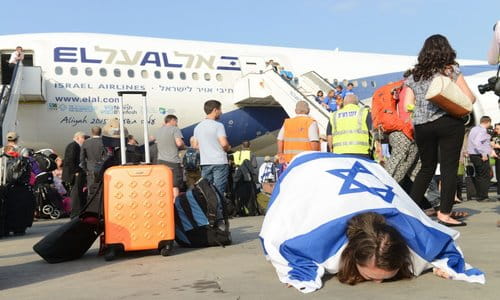
Prophecy Preview: Amid Global Uncertainty, Record Numbers of Jews Return 'Home'
By Deborah Fineblum/JNS.org June 09, 2020
In a time of darkness, a time of pandemic, pandemonium and power struggles, a thin ray of light can be seen in the Jewish world.
The
results are in: In May, the number of North Americans applying to make
aliyah was double what it was last year at this time (814 vs. 424). In
fact, last month was the biggest ever in the 19-year history of Nefesh
B'Nefesh, the nonprofit that with the help of Israel's government and
the Jewish Agency for Israel has already shepherded some 60,000 North
American Jews to new homes in Israel.
"We've
seen small bumps, but nothing like this," says Marc Rosenberg, Nefesh
vice president for Diaspora partnerships. "What we saw this past month
is absolutely remarkable. And while they may not be major numbers, they
are major increases."
With New York, California
and New Jersey leading the way, this spring's uptick in new immigrants
isn't limited to North Americans. Though no hard numbers were available
as of press time, Jewish Agency officials say they're seeing a "definite
rise in the number of aliyah applications around the world," especially
in North America, France (where unrest, economic woes and anti-Semitism
are increasingly the norm) and Mexico (now carrying one of the world's
highest COVID-19 rates).
Folks seem ready to make the move, even though it means
spending their first two weeks as newly minted Israeli citizens in
badood (Hebrew for "quarantine").
The jump of interest in the number of individuals and families begs the question: "Why now?"
For
Jay and Michal Brown of Los Angeles, this time in history was the push
they needed to realize a long-deferred dream. "COVID-19 gave us an
opportunity to slow down our lives and find out what's really important
to us," says Brown. "My wife is Israeli and was ready to go home, but
it's only these last few months that I've been asking myself, what am I
holding onto here?
"I realized I've been
chasing money like a chicken without a head," he adds. "So I said, 'No,
our kids are not going to grow up like this. They're 7 and 10, and need
to be raised with Jewish values. It was during COVID-19 that I
surrendered to all that. At 53, I realized I had to change, and that
doing what's best for my family was going to be best for me, too."
'You no longer have to sacrifice your comforts'
It's
something Rosenberg hears from many of the incoming olim. "This period
of staying home has given them a rare opportunity for intense reflection
on what their life is about, what's important to them at whatever stage
they are in life."
And many, especially those
who having gotten habituated to working remotely during the global
coronavirus pandemic, are now looking to bring their jobs with them to
Israel--from the radiologist who's set to analyze images thousands of
miles from his office to the human-resources manager planning to run her
department from her new home in Israel.
Others
submitting applications this spring include students and young
professionals, many attracted to both the allure of living in Israel and
the low-cost colleges, universities and graduate schools that offer a
future unencumbered by massive student debt. Others plan to serve two or
three years as lone soldiers in the Israel Defense Forces before
attending college or graduate school.
And though idealism still drives them eastward, Rosenberg
says many of today's incoming Jews see Israel as a place for both the
head and heart.
This appeal of Israel as a
quality place to live has turned the idea of aliyah on its head, says
Ruth Wisse, a historian, retired Harvard University professor, and
author of Jews and Power (2008).
"Historically,
the natural course of immigration is always to move from a poorer
environment to a richer one; it's human nature that nobody moves for
downward mobility," says Wisse, now Distinguished Senior Fellow at the
New York-based think-tank the Tikvah Fund. "So, during the early days,
aliyah was unnatural; you were moving to a poorer place then. But now
it's not that kind of aliyah anymore," she adds. "Today, you no longer
have to sacrifice your comforts to live as a proud Jew in the land of
Israel."
This represents what Rosenberg calls
"a dramatic shift for Diaspora Jews--from seeing Israel as simply a safe
haven for Jewish refugees to being a smart choice for building a life
and a family. And they see that Israel with its good schools, vibrant
Jewish community and flourishing lifestyle has also handled the virus
well. So all of a sudden, they're recalibrating what Israel can be for
them."
Israel has fared better than much of the
world in containing the virus, immediately going into emergency mode,
using intelligence, technological, medical and military resources to
grapple with the threat of widespread contamination.
To
date, there were more than 17,000 confirmed cases in the country, with a
total of 298 resulting deaths and some 15,000 people recovered from the
illness. They also put into place measures to assist the Palestinian
Authority and the leadership in the Gaza Strip to help them contain
potential spread as well.
New immigrants also
include empty-nesters, who see Israel as a viable, affordable and Jewish
place to spend their retirement, including the appeal of low-cost and
comprehensive health care.
Moshe and Shelly
Kamionski, also of Los Angeles, are retirees-in-process (she's finished
with her optician job; he's a semi-retired lawyer and a rabbi) with
three sons already living in Israel and a daughter, a recent "corona
bride," planning to follow soon.
"We have 14
grandchildren in Israel," says Moshe, who was born there 70 years ago to
a mother who came as a teenaged Polish halutzet ("pioneer") and a
father who fought in Israel's War of Independence in 1947-48. "It's nice
to see our grandchildren over FaceTime" he says. "But we can't hug them
or take them to school. I also feel safer in Israel than in LA now."
'We have to decide where we really belong'
What
we're seeing in this increase also is a shift the "someday" mindset to
hitting "send" on aliyah applications. So says Rabbi Menachem Penner,
the Max and Marion Grill dean of Yeshiva University's Rabbi Isaac
Elchanan Theological Seminary, or REITS. "Typically, the number of
people who actually go through with the process represents a tiny
percentage of all those who've been thinking of doing it for years," he
says.
Another factor moving folks from the latter group into
the former one, Penner maintains, is "that our existence in America
feels a bit more fragile than it did before. Rising anti-Semitism and
certainly COVID have shown us that the world can change in a day. And
when we realize we are living in historic times, we have to be open to
changing our lives accordingly as part of the tide that's turnin
What's
more, coronavirus-related travel restrictions mean that Diaspora Jews
can no longer get to Israel without making aliyah. "Many of us always
thought we can have one foot in America and the other in Israel," says
Penner. "But this has taught us that we can't have two homes--that at
the end of the day, we have to decide where we really belong."
And
he says, though his work at YU keeps him in New York for now, he's
"jealous of people whose purpose is now there, and I very much look
forward to when it's my time."
At 23, Sophie
(aka Shira) Hudes has already decided where she wants to build her
future. Starting with a move this summer to Beersheva where she's
enrolled in the medical school at Ben-Gurion University of the Negev.
"Living
in Israel has always been my dream," says the native New Yorker. Though
she was initially pursuing a student visa, "the pandemic reminded me of
what's important, and it pushed me to take action. I realized then that
I've always wanted to make aliyah someday, so why not just do it now?"
Zionism
and the love of Israel was something her late father transmitted to
her, says Hudes. And with her knowledge of Russian (her mother was born
in Georgia) and her rapidly improving Hebrew, as a future doctor, Hudes
is hoping to be able to communicate with Israeli patients in any of
three languages.
And, now that she's finally
made up her mind, she says, "I feel so much more connected to Israel.
When I'm there, I feel like I can breathe better, that everything is
clearer. Especially with what the world is going through now, Israel
feels like an anchor keeping me grounded amid the chaos."
Given
the challenges of the past few months, "this new wave of Jews seeking
to return to their homeland fills us with hope, energy and optimism,"
says Rabbi Yehoshua Fass, co-founder and executive director of Nefesh
B'Nefesh. "We look forward to welcoming each and every one of the olim
to their new home."
Do those in the field,
which includes the Jewish Agency for Israel, the Jewish National
Fund-Keren Hayesod, the International Fellowship for Christians and
Jews, and the International Christian Embassy in Jerusalem, think the
trend will continue?
It's too soon to tell for
certain, attests Rosenberg. "Whenever there's a paradigm shift, it's
hard to see it while it's going on, but this much I can tell you: The
people who preparing to come now, in addition to having their lives
enriched by living here, are going to be contributing so much to the
future of Israel."
Originally published at JNS.org - reposted with permission.
Monday, March 30, 2020
Israel and the demise of the global village
Israel's
ability to protect itself and adapt its economy to the new post-global
village reality will in large part determine how it survives and
prospers in the post-global village world now taking shape.
Last modified: 03-27-2020 11:25

How Israel deals with this dramatic turn of events today, and in the coming weeks, months and years will determine both how we emerge from the present crisis and how we manage in the new world now taking form.
Out of a total agricultural workforce of 70,000, 25,000 are migrant workers from Thailand and another 25,000 are from the Palestinian Authority. According to Agriculture Minister Tzachi Hanegbi, concerns over the coronavirus prevented 1,500 workers from Thailand scheduled to arrive at the beginning of the month from entering the country. The Palestinian workforce is down to 18,000 and dropping due to the quarantine the PA has placed on its population.
Three weeks ago, the HaShomer HaHadash organization began getting flooded with calls from farmers for help. HaShomer HaHadash is a volunteer agricultural support organization founded in 2007 to protect Israeli farmers from Arab and Bedouin criminal gangs who extort farmers and ranchers and carry out agricultural theft and sabotage on a massive level.
"These calls were different," explains HaShomer HaHadash's leader Yoel Zilberman. "We are used to receiving calls about sabotage, and extortion and sending our volunteers to guard and herd. These calls were about the harvest, the national food supply."
Zilberman and his colleagues realized the implications of the loss of a harvest for Israel's food supply and began drawing up a plan to help the distressed farmers. Two weeks ago, Zilberman approached Hanegbi and offered to organize a corps of volunteers to save the harvest. Comprised of the organization's roster of volunteers, cadets at pre-military leadership academies, youth movement alumni and from twelfth graders, Zilberman's volunteers would work in shifts in the fields. With government finance, Hashomer Hahadash would provide for all their needs. Hanegbi agreed.
Last week, the government approved an emergency order to organize the corps of volunteers. The first hundred young people arrived in the fields on Tuesday. Operating in compliance with Health Ministry guidelines, HaShomer HaHadash launched a smartphone application called "Sundo" where prospective volunteers can join the operation. Zilberman plans to expand his roll of volunteers to include foreign students stranded in Israel with nothing to do after the coronavirus caused their programs to be canceled. He assesses there are up to twenty thousand foreign youth in Israel who could potentially join in the effort.
To be sure, this initiative, which will hopefully enable Israel to surmount the coronavirus-induced international labor shortage, is intended to be a short-term fix. All parties to the initiative assume that once the crisis abates, labor flows will return to their pre-coronavirus levels. But there is no way to know whether this assessment is correct. The coronavirus-induced shortage in migrant, agricultural laborers points to a much wider phenomenon that is unlikely to disappear when the quarantines are over.
The coronavirus pandemic won't destroy global markets. But it will change them radically and reduce their size and scope. In the case of agriculture, the coronavirus has exposed large-scale vulnerabilities in both agricultural import models and domestic production. At the outset of the crisis, cargo ships laden with foodstuffs from China and Italy were laid up in the ports for weeks until port workers and the Health Ministry could develop protocols for safely offloading them. Dozens of shipments were diverted to Cyprus, at great cost to importers.
Who is to say that food supplies in China or other countries won't be compromised again in the future? And what happens in the event of war? Naval warfare can easily endanger food imports to Israel over a prolonged period. The model of dependence on foreign suppliers needs to be adapted in the face of what we are learning.
Continue reading: https://www.israelhayom.com/opinions/israel-and-the-demise-of-the-global-village/
Wednesday, March 20, 2019

Monday, August 22, 2016
'Politics' reason behind Israel's rhythmic gymnastics disappointment: coach

credits/photos
Note by this blogger: Talk about discrimination against Israel which properly named is
anti-semitism. In a venue that touts itself in being a catalyst for
peace and global brotherhood. Another example of phony progressive
hatred of the Jewish people. Don´t worry Israel your time is coming soon
to shine in your rightful place among all the nations of the world.
Israel's rhythmic gymnastics team
The team had represented Israel's best hope for a gold medal but eventually finished in sixth place
Israel's rhythmic gymnastics team, in whom
Israelis had placed high hopes for a gold medal in Rio, ended up going
home empty-handed after placing sixth in the finals on Sunday. The squad
finished with 34.549, far off from eventual winners Russia, who tallied
36.233 points.
The Israeli team's coach, Ira Vigdorchik, was unequivocal about what she saw as the reasons for their disappointing performance, the Times of Israel reports.
"I never expected to win a medal," she said in an interview on Channel 2. "Even if we were to do it without any mistakes there is no chance to bring back a medal from the Olympic games.
"There is a situation that happens only at the Olympics," Vigdorchik continued. "In every other competition the contest begins with every country bringing a judge, including us.
"As soon as all of the countries have a judge there is a neutralization of subjectivity, but as soon as we come to the Olympics and we don't have a representative we have a problem," she said.
"Spain has a judge in the International Gymnastics Federation, Bulgaria has a judge, Japan has a judge. These are strong countries and we have no way to deal with it," Vigdorchik added.
In a separate interview with Channel 10, Vigdorchik alleged that the Israeli team was made to train in a hot and humid tent while their competitors were placed in better facilities. At the same time, she hit out at the facilities available in Israel, saying that the conditions at Rio were no better than those at the Wingate Institute where the team trained for the Games.
"Thank you to the Wingate Institute that prepared us for sub-conditions," Vigdorchik said. "It was damp here like there. We trained in a wet tent for two hours, while all the other teams who finished above us trained here," she said, while in the main gymnastics facility at the Games.
Nonetheless, squad captain Ilana Koshbetzki praised the team's efforts.
"I can't describe what we have been through here," she told Walla, cited in the TOI. "We will never forget this experience. I am very proud of everything we did over the years, and especially here in Rio. We reached a great moment that we waited for for a long time.
"We did everything that we could. What happens, it seems, was what was supposed to happen."
Vigdorchik, who has previously been subject to reports that her squad complained about her punitive training methods, said that she would consider staying on as coach if asked, the TOI reports.
The Israeli team's coach, Ira Vigdorchik, was unequivocal about what she saw as the reasons for their disappointing performance, the Times of Israel reports.
"I never expected to win a medal," she said in an interview on Channel 2. "Even if we were to do it without any mistakes there is no chance to bring back a medal from the Olympic games.
"There is a situation that happens only at the Olympics," Vigdorchik continued. "In every other competition the contest begins with every country bringing a judge, including us.
"As soon as all of the countries have a judge there is a neutralization of subjectivity, but as soon as we come to the Olympics and we don't have a representative we have a problem," she said.
"Spain has a judge in the International Gymnastics Federation, Bulgaria has a judge, Japan has a judge. These are strong countries and we have no way to deal with it," Vigdorchik added.
In a separate interview with Channel 10, Vigdorchik alleged that the Israeli team was made to train in a hot and humid tent while their competitors were placed in better facilities. At the same time, she hit out at the facilities available in Israel, saying that the conditions at Rio were no better than those at the Wingate Institute where the team trained for the Games.
"Thank you to the Wingate Institute that prepared us for sub-conditions," Vigdorchik said. "It was damp here like there. We trained in a wet tent for two hours, while all the other teams who finished above us trained here," she said, while in the main gymnastics facility at the Games.
Nonetheless, squad captain Ilana Koshbetzki praised the team's efforts.
"I can't describe what we have been through here," she told Walla, cited in the TOI. "We will never forget this experience. I am very proud of everything we did over the years, and especially here in Rio. We reached a great moment that we waited for for a long time.
"We did everything that we could. What happens, it seems, was what was supposed to happen."
Vigdorchik, who has previously been subject to reports that her squad complained about her punitive training methods, said that she would consider staying on as coach if asked, the TOI reports.
Saturday, November 28, 2015
‘Syria is dead, Israel must prepare,’ top defense official warns
Amos Gilad says Bashar Assad’s grip on his country is failing and it has become ‘a land without rule’
November 28, 2015, 2:49 pm 60
Amos Gilad, head of the Defense Ministry’s political-security division. (Yossi Zamir/Flash 90)
The nation state of Syria has
collapsed, a fact that Israel must internalize about its northern
neighbor, a senior Israeli defense official said Saturday.
“Syria
is a dead state, and Israel must understand this and prepare
accordingly,” Amos Gilad, the director of the political-security
division in the Defense Ministry and a former senior Military
Intelligence official, told a cultural event in Beersheba.
“[Syrian President Bashar] Assad’s grip on the
country is faltering, it is a land without rule,” Gilad said, according
to Army Radio.
With swathes of Syria falling into the hands
of opposition forces, including jihadist groups, Assad has increasingly
relied on support from allies Iran and the Lebanon-based terror group
Hezbollah, both sworn enemies of Israel.
During a September meeting in Moscow, Prime
Minister Benjamin Netanyahu told Russian President Vladimir Putin in “no
uncertain terms” that Israel would not tolerate Tehran’s efforts to arm
its enemies in the region, and that Jerusalem has taken and will
continue to take action against any such attempts.
Netanyahu told Putin that Iran and Syria have
been providing Hezbollah with advanced weapons, thousands of which are
directed at Israeli cities. “At the same time, Iran, under the auspices
of the Syrian army, is attempting to build a second terrorist front
against us from the Golan Heights.”
The prime minister also said that Israel’s
policy is to prevent these weapons transfers “and to prevent the
creation of a terrorist front and attacks on us from the Golan Heights.”
Netanyahu came to the Kremlin to “clarify our policies, and to make
sure that there is no misunderstanding between our forces,” he said.
Russia is currently conducting air strikes in
Syria that, while ostensibly targeting the Islamic State group, have
also attacked Assad’s Western-backed foes. But a senior Israeli military official said Thursday that the Israel Air Force will still operate as normal in Syria, thanks to constant coordination between Tel Aviv and Moscow.
Unconfirmed Syrian media reports said Tuesday
that Israel carried out four airstrikes on Syrian regime and Hezbollah
positions in the area of Syria’s Qalamoun mountains on Monday night.
Seeking sanctuary
 Five years of fighting in Syria have also seen
a sharp increase in the number of Druze residents on the Golan Heights
seeking Israeli citizenship.
Five years of fighting in Syria have also seen
a sharp increase in the number of Druze residents on the Golan Heights
seeking Israeli citizenship.
In contrast to the only two requests filed in
2010, the number of Golan Druze seeking citizenship rose to 80 so far in
2015, Channel 1 reported earlier this month.
Illustrative:
Druze march in support of Syrian President Bashar Assad in the town of
Majdal Shams on the Golan Heights. (Tsafrir Abayov/Flash90/File)
According to the report, the majority of the
applications have been filed by Druze youths, whose connection to Syria
has likely been marred by the violence there.
The marked increase in applications could be
an indication that the community’s 45-year-long loyalty to its Syrian
homeland has become fractured by the raging war across the border.
In addition to disillusioned youth, some Golan
Heights Druze are embracing Israeli citizenship out of a fear of
widespread persecution in Syria if Assad’s regime — a government that
protected the minority group — falls, or is forced out of power.
Tamar Pileggi contributed to this report
Tuesday, November 3, 2015
For the first time since 1948, Egypt votes for Israel at UN
Reblogged from www.doamuslims.org/
Egypt’s representative at United Nations voted on Friday in support of Israel’s bid for membership of the UN Committee on the Peaceful Uses of Outer Space Affairs (UNOOSA), Israeli media reported.
Since the creation of the state of Israel in 1948 and its acceptance to membership of the UN, Egypt had never voted in its favour at the UN before last Friday.
One hundred and seventeen countries voted in favour of Israel, 21 abstained, while only Namibia voted against the decision. Countries that abstained include: Qatar, Tunisia, Syria, Mauritania, Morocco, Saudi Arabia, Yemen, Kuwait, Iraq and Algeria.
Israeli sources said that they were accepted to this UN committee after “intensive diplomatic efforts” exerted at different levels.
Prior to the vote, spokesman for the Egyptian ministry of foreign affairs Ahmed Abu Zeid refused to comment on the matter. However, in the face of fierce domestic criticism, he said that voting for Israel was necessary in order to secure the membership of a number of Arab countries to the committee.
Egyptian politicians and activists widely rejected this move and severely criticised Egyptian Military President Abdul-Fattah al-Sisi.
In 1973, Egypt and Syria started a war against Israel that paved the way for peace talks between Egypt and Israel. It ended up with a peace treaty in 1979 that ended state of war between the two sides, reciprocal recognition and normalisation of ties.
Egypt’s representative at United Nations voted on Friday in support of Israel’s bid for membership of the UN Committee on the Peaceful Uses of Outer Space Affairs (UNOOSA), Israeli media reported.
Since the creation of the state of Israel in 1948 and its acceptance to membership of the UN, Egypt had never voted in its favour at the UN before last Friday.
One hundred and seventeen countries voted in favour of Israel, 21 abstained, while only Namibia voted against the decision. Countries that abstained include: Qatar, Tunisia, Syria, Mauritania, Morocco, Saudi Arabia, Yemen, Kuwait, Iraq and Algeria.
Israeli sources said that they were accepted to this UN committee after “intensive diplomatic efforts” exerted at different levels.
Prior to the vote, spokesman for the Egyptian ministry of foreign affairs Ahmed Abu Zeid refused to comment on the matter. However, in the face of fierce domestic criticism, he said that voting for Israel was necessary in order to secure the membership of a number of Arab countries to the committee.
Egyptian politicians and activists widely rejected this move and severely criticised Egyptian Military President Abdul-Fattah al-Sisi.
In 1973, Egypt and Syria started a war against Israel that paved the way for peace talks between Egypt and Israel. It ended up with a peace treaty in 1979 that ended state of war between the two sides, reciprocal recognition and normalisation of ties.
Tuesday, October 6, 2015
Column one: Israel’s risk aversion problem

Reacting to the administration’s humiliation, Republican Sen. John McCain said, “This administration has confused our friends, encouraged our enemies, mistaken an excess of caution for prudence and replaced the risks of action with the perils of inaction.”
McCain added that Russian President Vladimir Putin had stepped “into the wreckage of this administration’s Middle East policy.”
While directed at the administration, McCain’s general point is universally applicable. Today is no time for an overabundance of caution.
The system of centralized regimes that held sway in the Arab world since the breakup of the Ottoman Empire nearly a century ago has unraveled. The shape of the new order has yet to be determined.
The war in Syria and the chaos and instability engulfing the region are part and parcel of the birth pangs of a new regional governing architecture now taking form. Actions taken by regional and global actors today will likely will influence power relations for generations.
Putin understands the opportunity of the moment.
He views the decomposition of Syria as an opportunity to rebuild Russia’s power and influence in the Middle East – at America’s expense.
Russia isn’t the only strategic player seeking to exploit the war in Syria and the regional chaos. Turkey and Iran are also working assiduously to take advantage of the current absence of order to advance their long term interests.
Turkish President Recep Tayyip Erdogan is exploiting the rise of Islamic State in Syria and Iraq to fight the Kurds in both countries. Erdogan’s goal is twofold: to prevent the establishment of an independent Kurdistan and to disenfranchise the Kurds in Turkey.
As for Iran, Syria is Iran’s bulwark against Sunni power in the Arab world and the logistical base for Tehran’s Shi’ite foreign legion Hezbollah. Iranian dictator Ali Khamenei is willing to fight to the bitter end to hold as much of Syrian territory as possible.
Broadly speaking, Iran views the breakup of the Arab state system as both a threat and an opportunity.
The chaos threatens Iran, because it has radicalized the Sunni world. If Sunni forces unite, their numeric advantage against Shi’ite Iran will imperil it.
The power of Sunni numbers is the reason Bashar Assad now controls a mere sixth of Syrian territory. To prevent his fate from befalling them, the Iranians seek to destabilize neighboring regimes and where possible install proxy governments in their stead.
Iran’s cultivation of alliances and proxy relationships with Hamas, the Muslim Brotherhood and al-Qaida, and its phony war against Islamic State all point to an overarching goal of keeping Sunni forces separated and dependent on Tehran.
The Iranian regime also fears the prospect of being overthrown by its domestic opponents. To counter this threat the regime engages in large-scale and ever escalating repression of its perceived foes.
Iran’s nuclear program also plays a key role in the regime’s survival strategy. As Khamenei and his underlings see things, nuclear weapons protect the regime in three ways. They deter Iran’s external foes. They increase domestic support for the regime by enriching Iran which, no longer under international sanctions, sees its diplomatic and economic prestige massively enhanced due to its nuclear program.
Finally, there is Iran’s war with Israel and the US. A nuclear-armed Iran is a direct threat to both countries.
And this, too, is a boon for the mullacracy. From the regime’s perspective, fighting Israel and the US serves to neutralize the Sunni threat to the regime. The more Iran is seen as fighting Israel and the US the more legitimate it appears to Sunni jihadists.
This then brings us to the Americans. Like the Russians, the Turks and the Iranians, President Barack Obama and his associates are strategic players. Unlike those powers however, the administration is moved not by raw power calculations but by ideological dictates.
Obama and his advisers are convinced that the instability and radicalization of states and actors throughout the region is the consequence of the actions of past US administrations and those of America’s regional allies – first and foremost, Israel and Egypt. The basis for this conviction is the administration’s post-colonial ideological underpinnings.
Because his strategy is based on ideological beliefs rather than power calculations rooted in reality, Obama’s position cannot be swayed by evidence, even when evidence shows that his administration’s policies endanger US national security.
This brings us to Israel.
Israel has limited power to influence regional events.
It cannot change its neighbors’ values or cultures. Israel can however limit its neighbors’ ability to harm it and expand its ability to deter would be aggressors by among other things, using its power judiciously to influence now forming power balances between various regional and world actors.
Israel has followed this model in Syria with notable success.
At an early stage of the war our leaders recognized that aside from the Kurds, who have no shared border with us, there are no viable actors in Syria that are not dangerous to Israel. As a result, Israel has no interest in the victory of one group against others.
The only actor in Syria that Israel has felt it necessary to actively rein in is Hezbollah. So it has acted repeatedly to prevent Hezbollah from using its operational presence in Syria as a means for augmenting its offensive capabilities in Lebanon.
The problem with this strategy is that it has ignored the fact that from Hezbollah’s perspective, there is no operational difference between Lebanon and Syria.
The war in Syria spread to Lebanon years ago.
Now, with Iranian and Russian assistance, Hezbollah is beginning to develop the industrial capacity to bypass Israel and independently produce advanced weapons inside Lebanon. This rapid industrialization of Hezbollah’s military capabilities requires Israel to end its respect for the all-but-destroyed international border and take direct action against Hezbollah’s capabilities in Lebanon.
This brings us to Hezbollah’s boss, Iran. For the past several years, the same caution that has led Israel to grant de facto immunity to Hezbollah forces in Lebanon has led to Israel’s passivity and deference to the Obama administration in relation to Iran’s nuclear program.
With regard to Iran’s nuclear installations, the strategy of passivity has largely been forced onto an unwilling political leadership by Israel’s military leaders.
For the past several years, the IDF’s General Staff has refused to support the government’s position on Iran’s nuclear program.
Our military leaders have justified their insubordination by arguing that if Israel takes independent action against Iran’s nuclear program it will undermine its bilateral relations with the US, which they consider more important than preventing Iran from acquiring nuclear weapons.
Although under the best of circumstances, the IDF’s position would be unacceptable from the perspective of democratic norms of governance, since the ideologically driven Obama administration took power seven years ago, the military’s position has imperiled the country.
So long as Obama – or the ideology that informs his actions – remains in power in Washington, US security guarantees towards Israel will have no credibility.
The IDF’s assessment that ties to the US are more important than preventing Iran from becoming a nuclear power will remain incorrect, and dangerously so.
Today is Israel’s opportunity to shape the future of the Middle East by not only preventing Iran from becoming a nuclear power, but by preventing a regional nuclear arms race.
The closer Iran comes to emerging as a nuclear power, the more Sunni regimes, including Islamic State, will seek their own nuclear capabilities. It goes without saying that the more regional actors have nuclear weapons, the more dangerous the region becomes for Israel, and indeed for the world as a whole.
For many Israelis, the story of the week wasn’t Russia’s air strikes against US-allied forces in Syria. It was PLO chief and Palestinian Authority President Mahmoud Abbas’s speech at the UN General Assembly.
Leftists expressed horror in the face of Abbas’s threat to end the PLO’s adherence to the agreements it signed with Israel in the 1990s (and has stood in material breach of ever since). The government insisted, for its part that the reason the peace process has not brought peace is because Abbas and his PLO refuse to negotiate with Israel.
Unfortunately, both sides’ responses to Abbas’s speech indicate that Israel has lost all semblance of strategic purpose in regard to the Palestinians.
Fifteen years ago this week, on September 28, 2000, the Palestinians opened their terrorist war against Israel. Ever since it has been clear that no Palestinian faction is interested in living at peace with Israel.
Despite this, for the past 15 years, Israel has refused to reconsider its strategic allegiance to the false notion that it has the ability to influence the hearts and minds of the Palestinians and bend them in the direction of peace.
This delusional thinking is what caused the IDF’s General Staff to convene immediately after Operation Protective Edge ended and try to figure out how to rebuild Gaza.
Ever since the cease-fire came into force, Hamas has diverted all the assistance it has received from Israel and the international community not to rebuild Gaza, but to rebuild its military capacity to harm Israel. And yet, from the IDF’s perspective, ever since the war ended our most urgent task has been to save Hamas and the Palestinians alike from reckoning with the price of their aggression.
Likewise, Israel continues to insist that we have a strategic interest in peace with the PLO. Even if this is true in theory, chances are greater that unicorns will fall from the sky and prance through Jerusalem’s Old City than that the PLO will agree to make peace with Israel.
Our continued defense of the PLO as a legitimate actor harms our ability to secure other strategic interests that are achievable and can improve Israel’s regional position. These interests include securing transportation arteries in Judea and Samaria and strengthening Israel's military and political control over the areas. These interests have only grown more acute in recent years with the rise of jihadist forces throughout the region and among the Palestinians themselves.
This brings us back to McCain and his strategic wisdom.
Israel must not allow the risks of action to lure us into strategic paralysis that imperils our future.
The more Israel allows other actors to determine the nature of the emerging regional order, the less secure Israel will be. The more willing we are to take calculated risks today the greater our ability will be to influence the future architecture of regional power relations and so minimize threats to our survival in the decades to come.
www.CarolineGlick.com
Wednesday, August 12, 2015
Our World: The anti-peace administration - Opinion by Caroline Glick

The US has striven to achieve peaceable relations between the states of the Middle East for nearly 70 years. Yet today, US government is disparaging the burgeoning strategic ties between the Sunni Arab states and Israel.
In a briefing to a delegation of visiting Israeli diplomatic correspondents in Washington last week, a senior Obama administration official sneered that the only noticeable shift in Israel-Arab relations in recent years is that the current Egyptian government has been coordinating security issues “more closely” with Jerusalem than the previous one did.
“But we have yet to see that change materialize in the Gulf.”
If this is how the US views the state of Israel’s relations with the Arabs, then Israel should consider canceling its intelligence cooperation with the US. Because apparently, the Americans haven’t a clue what is happening in the Middle East.
First of all, to characterize the transformation of Israeli-Egyptian relations as a mere question of “more closely” coordinating on security issues is to vastly trivialize what has happened over the past two years.
Before then Egyptian defense minister Abdel Fattah el-Sisi overthrew the US-backed Muslim Brotherhood regime headed by Muhammad Morsi in July 2013, there was a growing sense that Morsi intended to vacate Egypt’s signature to the peace deal with Israel at the first opportunity. Just a month after Morsi ascended to power in January 2013, the Muslim Brotherhood began threatening to review Egypt’s continued commitment to the peace treaty.
The main reason Morsi did not cancel the peace deal with Israel was that Egypt was bankrupt. He needed US and international monetary support to enable his government to pay for imported grain to feed Egypt’s destitute population of 90 million.
During his year in power, Morsi used Hamas as the Brotherhood’s shock troops. He embraced Iran, inviting president Mahmoud Ahmadinejad to visit Cairo in February 2013.
If Morsi were still in power today, with its $150 billion in sanctions relief Iran would have been in a position to support Egypt’s economy. So it is possible that if Morsi were still president, he would have felt he had the financial security to walk away from the peace treaty.
In happy contrast, under Sisi, Israeli-Egyptian ties are closer than they have ever been. Just last week Egyptian diplomats told Al Ahram that Israel’s support was critical for building administration support for Sisi.
Over Ramadan, Egyptian television broadcast a pro-Jewish mini-series.
Israel is closely working with the Egyptians on defeating the growing threat of Islamic State, Hamas and other Islamic terrorist groups waging a bloody insurgency against the regime in Sinai.
Last summer, it was due to the close coordination between Sisi and Israel that the US failed to force Israel to accept Hamas’s cease-fire terms, as those were represented by the Islamist regimes of Qatar and Turkey.
In part due to Israel’s critical support for Sisi’s government, and in part owing to their opposition to Iran’s rise as a regional hegemon armed with nuclear weapons, Saudi Arabia, the UAE and Jordan have all joined Egypt in viewing Israel as a strategic partner and protector.
Last year Saudi Arabia together with the UAE and Jordan supported Israel and Egypt in opposing Hamas and its American, Turkish and Qatari defenders. Had it not been for this massive Arab support, it is very likely that Israel would have been forced to accept the US’s demands and grant Hamas control over Gaza’s international borders.
In June, as negotiations between the US and the other five powers and Iran were moving toward an agreement, the Council on Foreign Relations in New York hosted a meeting between then incoming Foreign Ministry director general Dore Gold and retired Saudi General Anwar Eshki, a former advisor to the Saudi ambassador to the US. The two revealed that over the previous 18 months, they had conducted five secret meetings to discuss Iran.
Although President Barack Obama harangued Israel in his speech at American University last Wednesday, claiming that the Israeli government is the only government that has publicly opposed his nuclear deal with the Iranians, Monday US congressmen now shuttling between Egypt and Israel told Israeli reporters that Egypt opposes the nuclear deal.
As for the Gulf states, according to the US media, last week they told visiting US Secretary of State John Kerry that they support the nuclear deal.
Kerry addressed his counterparts in the Gulf Cooperation Council.
But the fact is that the only foreign minister who expressed such support was Qatari Foreign Minister Khaled al-Attiyah. To be sure, Attiyah was charged to speak for all of his counterparts because Qatar holds the GCC’s rotating chairmanship. But given that Qatar has staked out a pro-Iranian foreign policy in stark contrast to its neighbors and GCC partners, Attiyah’s statement is impossible to take seriously without the corroboration of his colleagues.
As for Qatar’s statement of support, Qatar has worked for years to cultivate good relations with Iran. It might have been expected therefore that Attiyah’s endorsement of the deal would have been enthusiastic. But it was lukewarm at best.
In Attiyah’s words, Kerry promised that the deal would place Iran’s nuclear sites under continuous inspections. “Consequently,” he explained, “the GCC countries have welcomed on this basis what has been displayed and what has been talked about by His Excellency Mr. Kerry.”
The problem of course is that Kerry wasn’t telling the truth. And the Arabs knew he was lying. The deal does not submit Iran’s nuclear sites to a rigorous inspection regime. And the GCC, including Qatar, opposes it.
In his briefing with Israeli reporters, the high-level US official rejected the importance of the détente between Israel and its Arab neighbors because he claimed the Arabs have not changed their position regarding their view of a final peace deal between Israel and the Palestinians.
But this is also nonsense. To be sure, the official position of the Saudis and the UAE is still the so-called Arab peace initiative from 2002 which stipulates that the Arabs will only normalize relations with Israel after it has ceded Jerusalem, Judea, Samaria and the Golan and allowed millions of foreign-born Arabs to freely immigrate to the shrunken Jewish state. In other words, their official position is that they will only have normal relations with Israel after Israel destroys itself.
But their official position is no longer their actual position. Their actual position is to view Israel as a strategic ally.
The senior official told the Israeli reporters that in order to show that “their primary security concern is Iran,” then as far as the Arabs are concerned, “resolving some of the other issues in the region, including the Palestinian issue should be in their interest. We would like to see them more invested in moving the process forward.”
In the real world, there is no peace process. And the Palestinian factions are fighting over who gets to have better relations with Iran. Monday we learned that PA leader Mahmoud Abbas wishes to visit Iran in the coming months in the hopes of getting the money that until recently was enjoyed by his Hamas rivals.
Hamas for its part is desperate to show Tehran that it remains a loyal client. So today, no Palestinian faction shares the joint Israeli-Saudi-Egyptian interest in preventing Iran from becoming a nuclear armed regional hegemon.
The administration showed its hand in that briefing with the Israeli reporters last week. For all their talk about Middle East peace, Obama and his advisors are not at all interested in achieving it or of noticing when it has been achieved.
Sunday, May 17, 2015
Wednesday, December 10, 2014
Israel indicts American over plot to bomb Muslim holy sites
Reblogged from

Oct.
5, 2014: Palestinians from Gaza pray in front of the Dome of the Rock
during their visit at the compound known to Muslims as Noble Sanctuary
and to Jews as Temple Mount in Jerusalem's Old City. (Reuters)
Adam Everett Livix, 30, was identified by the Israeli Police and the Justice Ministry. Livix faces drug charges in the U.S. and that he once turned down an offer from a Palestinian to assassinate President Obama during a visit to Israel in 2013.
The Justice Ministry said the man they identified as Livix underwent a psychiatric evaluation Tuesday after his indictment Monday on charges of illegal weapon possession and overstaying his visa by more than a year. Operating in cooperation with Israel's Shin Bet security service, police went to arrest Livix last month at his 7th-floor apartment, the ministry said, but he initially tried to escape by leaping down to a patio on the floor below.
Livix, posing as an ex-Navy SEAL, was asked by a Palestinian to assassinate Obama with a sniper rifle in March 2013 when Obama was making a trip to the region, Israeli police spokesman Mickey Rosenfield said. Livix did not go through with it and the FBI ended up investigating the matter.
Later that year, Livix entered Israel, the Justice Ministry said, and told Israeli friends he had strong anti-Arab sentiments. The ministry said Livix later cooperated with his roommate, a serving soldier in the Israeli military, to obtain 3 pounds of explosive material to blow up the unidentified Jerusalem holy sites. The ministry said police discovered the plot in October.
Livix's indictment comes at a time of rising tensions in Jerusalem, mostly over a disputed holy site known to Muslims as the Noble Sanctuary and Jews as the Temple Mount. It is the third holiest site in Islam and the holiest in Judaism.
As members of the Israeli government demand that Jews be allowed to pray at the Muslim-run site, Palestinians fear it is a pretext to a Jewish takeover.
This isn't the first time there have been allegations of a foreigner threatening a holy site in Jerusalem. In 1969, an Australian Christian started a fire at the complex's Al-Aqsa Mosque in hopes that it would hasten the second coming of Jesus Christ. The man, Denis Michael Rohan, was subsequently committed to a mental institution.
Tuesday, December 9, 2014
Iran developed 2.000 kms range missiles and equipped Hezbollahwith 300 kms range missiles.
Middle East Media Reasearch Institute
| Inquiry & Analysis Series Report |
|


 Source: Multimedia.tasnimnews.com/Media/Gallery/560065.
Tuesday, November 25, 2014
Op-Ed: Israel is the Crucial Border of Western Civilization
Reblogged from: Israel National News
 Giulio Meotti
Europe's
moral equivalence between terrorists and Israel.Why hasn’t the European
Parliament ever convened to condemn the killing of Jews at the hands of
an Arab terrorist?
Published: Monday, November 24, 2014 9:43 AM
Giulio Meotti Israel is to blame by its very being, for everything. Even for its own blood, spilled by barbarians.The European chancelleries have already pulled the form letter they dispatch when Jews are murdered by various Arab terrorists from their files, and have expressed their condolences.
But in Europe, there was no real grief for the pogrom in Har Nof, but manifestations of moral and political equivalence between the Israeli civilians and the Arab terrorists. Like the Jews, the Jewish State is a pain in the neck, and the world would feel relieved without it.
Sweden, UK, France and Spain are all voting these days to recognize the “Palestinian State”. The same entity which holds major responsibility for the massacre in Jerusalem.
Meanwhile, the European Union's new foreign policy chief Federica Mogherini just visited Gaza and Ramallah, where she embraced the Har Nof terrorist goal: the division of Jerusalem and the establishment of a Palestinian State.
Of course, for Europe, Israel is to blame by its very being, for everything. Even for its own blood, spilled by barbarians.
The European Union will not stop funding the Palestinian Arabs media: radios, tv, newspapers and educational programs which are publicly inciting to slaughter the Jews.
Why hasn’t the European Parliament ever convened to condemn the killing of a single Jew at the hands of an Arab terrorist?
In Rome, these days, I saw posters asking for the liberation of the Palestinian terrorist Ahmed Saadat, the maths teacher currently held in an Israeli prison. Saadat is the current leader of the Popular Front of Liberation of Palestine, the group which took responsibility for the killings in Har Nof.
In the French city of Valenton, France, a street has just been named after Marwan Barghouti, the terrorist leader who recently called to spill Israeli blood in Jerusalem. In Palermo, the souther Italian city, Barghouti has just been named an “honorary citizen”.
The former UK foreign minister, Baroness Sayeeda Warsi, just tweeted a message that implied equivalence between the Har Nof terrorists and Jews protesting over Temple Mount.
In Turin, Italy, there is a museum hosting a UNWRA exposition saying that the Sabra and Shatila massacre was committed by the Israeli army and demonizing the Israeli fence which helped stop the suicide bombers.
During the Six Day War in 1967, then Italy’s senator Giovanni Spadolini, one of the very few pro Israeli figures, wrote that was “a census of consciences”. Most of Europe stood with Egypt’s Nasser and the Arab dream to throw the Jews into the Mediterranean. Today there is another census of consciences, where most of the Europeans stay supporting the Palestinian Arab cousins who shouted “Allah Akbar” and exterminated four wonderful rabbis praying to the God of Israel, prayer which is stronger than lies and hatred.
Open any European daily newspaper these days: you will not find a single commentator writing that what happened in Har Nof has nothing to do with “occupation” (the killers had Israeli ID cards and did not have to pass checkpoints).
But it is armed Nazi-like anti-Semitism which the world must condemn, stating that Jews have the right to keep Jerusalem united under their control and that the State of Israel is the most important border of Western civilization.
Monday, November 24, 2014
Exclusive: Cornered but unbound by nuclear pact, Israel reconsiders military action against Iran
WASHINGTON – Historic negotiations with Iran will reach an
inflection point on Monday, as world powers seek to clinch a
comprehensive deal that will, to their satisfaction, end concerns over
the nature of its vast, decade-old nuclear program.But reflecting on the
deal under discussion with The Jerusalem Post on the eve of the
deadline, Israel has issued a stark, public warning to its allies with a
clear argument: Current proposals guarantee the perpetuation of a
crisis, backing Israel into a corner from which military force against
Iran provides the only logical exit.
Continue reading via Exclusive: Cornered but unbound by nuclear pact, Israel reconsiders military action against Iran.
Continue reading via Exclusive: Cornered but unbound by nuclear pact, Israel reconsiders military action against Iran.
Subscribe to:
Posts (Atom)