
Light is sown like seed for the righteous, and gladness for the upright in heart. Psalm 97:11
Showing posts with label Ecumenism. Show all posts
Showing posts with label Ecumenism. Show all posts
Monday, October 23, 2017

Thursday, July 6, 2017
Pastor Lauds Liberation Theology by Bashing Atonement
Reposted from juicyecumenism.com
The Middle East has always been an excellent place to examine the explosive relationship of competing political interests and religious identities. Specifically, it makes an excellent case study in examining how competing convictions influence or interfere with one’s interpretation of Scripture.
On April 21, 2017, Pastor Mitri Raheb, the Palestinian Senior Pastor of a Lutheran church in Bethlehem, spoke at St. Olaf College on the relationship between religion and politics in the Middle East. His comments indicate the growing danger of letting identity politics (manifest under the guise of liberation theology) determine one’s interpretation of Scripture.
During his talk, Raheb primarily focused on interpreting recent Israeli/Palestinian events and Bible passages through the Liberation Theology point of view. Liberation theology misconstrues Scripture and the surrounding world by emphasizing the pursuit of political ends and means to achieve complete social equity.
Contextualizing his lecture, Pastor Raheb began by comparing the Jewish government to Saddam Hussein’s authoritarian dictatorship in Iraq. He accused Israel of using religious texts to secure domestic sovereignty and feign legitimacy in the international community. He then proceeded to label fellow Christians as “Zionists” who were “sent” by the Jews to defend their state under the pretext of horrifically misguided eschatology while they callously ignore the plight of the Palestinian people.
Turning then to Scripture, Raheb offered his own interpretation of Jesus’ death on the cross (emphasis added):
Paul was very clear in Romans 6:3-7 when he stated that the cross was meant to liberate God’s people from the tyranny of sin and death. Or again in Romans 8:3, “By sending his own Son in the likeness of sinful flesh and concerning sin, he condemned sin in the flesh,” implying that the cross was the ultimate defeat of eternal slavery to sin.
Raheb concluded his defense of liberation theology by interpreting the Pentecost story in Acts 2 as a celebration of diversity because the disciples were able to speak in visitors’ native tongues. A simple glance over this passage shows that this assertion is simply not true. The disciples were given the ability to speak in many different languages (in the first case of multilingual evangelism) to the Jews who had not yet heard the good news. The Jewish people with their different languages and nationalities were united under their common ethnic and religious background. There is no normative indication anywhere in the passage that would indicate that “diversity is strength,” as Rahab argues.
I agree with Mitri Raheb’s approach to observe modern conflict in a political and religious light. One cannot and should not separate the two for fear of oversimplifying, misunderstanding, and misdiagnosing one of the longest running conflicts in human history. But Mr. Raheb’s identity politics and liberation theology have done just that.
Raheb wove an implicit line of logic throughout the whole lecture: because modern Jewish people are not the ancient Israelites of the Bible, they have no “spiritual” claim over contested Palestinian land. And since ancient Israel’s only purpose was to prepare for the Messiah, there is no need for a Jewish state anymore. Any argument to preserve a physical Jewish state would, therefore, be a Zionist misinterpretation of prophecy and an act of oppression to the Palestinian people.
Pastor Raheb has allowed his political identity as a Palestinian to precede and outweigh his identity as a Christian. This became evident in how he blatantly ignores huge portions of Scripture and facts to support his case for liberation theology.
I will not waste the readers’ time in recounting the “New Zionist” position, but rather direct them to a better defense of it than I could provide in this limited space (or a fascinating read if they so desire). Without dissecting the details, Israel, and more importantly, the Jewish people remain an integral part of God’s redeeming plan for the world, but without implying that the Lord is waiting on us to immanentize the eschaton.
Several facts stand in defiance of Pastor Raheb’s assertions. First, geneticists have revealed evidence that modern Jewish people are in fact descendants of the ancient Israelites of the Bible. Distinct Jewish people groups from all over the world share genetic legacy (not just cultural or religious identity) originating in the Middle East dating back 2,000 years.
And if one believes in the inerrancy and timelessness of Scripture, it would be hard to ignore the numerous passages that indicate that the second coming of Christ will involve a unified Jewish state (Zech. 12:5-9, Luke 13:34-35, and Romans 9 & 11 to name a few).
It is only through God’s outpouring and overflowing of grace onto the Jewish people that Gentiles are also given grace by extension (Romans 1:16). The same grace available to the Jews is available to the Palestinians. Yet Pastor Raheb seems to be so caught up in idolizing his own primary identity as a Palestinian that his view and reception of grace have been warped.
That is the greatest danger of identity politics. Though identities are personally meaningful and powerful in shaping worldviews, they are immaterial in the eternal light of salvation. Liberation theology, specifically, seeks to undermine salvation and spiritual needs by replacing them with material needs and social vendetta.
The relationship between religion and politics is a tangled one. It is often hard to define where one stops and the other starts (or whether the two ought to be mixed at all). But what is undeniable is that if you’re going to claim Christianity as your religion, it must be your first and most important identity. Any party identity, political belief, or doctrinal interpretation must always be filtered through the ultimate and omniscient authority found in the Holy Bible. There will never be a characteristic that can outshine the salvation bestowed by grace alone.
The Middle East has always been an excellent place to examine the explosive relationship of competing political interests and religious identities. Specifically, it makes an excellent case study in examining how competing convictions influence or interfere with one’s interpretation of Scripture.
On April 21, 2017, Pastor Mitri Raheb, the Palestinian Senior Pastor of a Lutheran church in Bethlehem, spoke at St. Olaf College on the relationship between religion and politics in the Middle East. His comments indicate the growing danger of letting identity politics (manifest under the guise of liberation theology) determine one’s interpretation of Scripture.
During his talk, Raheb primarily focused on interpreting recent Israeli/Palestinian events and Bible passages through the Liberation Theology point of view. Liberation theology misconstrues Scripture and the surrounding world by emphasizing the pursuit of political ends and means to achieve complete social equity.
Contextualizing his lecture, Pastor Raheb began by comparing the Jewish government to Saddam Hussein’s authoritarian dictatorship in Iraq. He accused Israel of using religious texts to secure domestic sovereignty and feign legitimacy in the international community. He then proceeded to label fellow Christians as “Zionists” who were “sent” by the Jews to defend their state under the pretext of horrifically misguided eschatology while they callously ignore the plight of the Palestinian people.
Turning then to Scripture, Raheb offered his own interpretation of Jesus’ death on the cross (emphasis added):
“We have for too long tried to spiritualize the notion of liberation in the Bible. We’ve replaced liberation with salvation and the cross became nothing but atonement. I think we have to put the cross in its original context of political and religious violence…. The cross is a permanent reminder of the millions of people who are persecuted either by the state or by the religious establishment because they raise their prophetic critique to an unjust ruler or to a corrupt form of religion.”It’s not often that a self-proclaimed Christian uses the phrase “nothing but atonement” with a pejorative connotation. Atonement by Jesus Christ was the single greatest act of self-sacrificial love the world has ever known. It satisfied around four thousand years of prophecy and a covenant made by the living infinite God who chose to make Himself known to a fallen, finite creation. Thinkers, writers, and philosophers alike have pontificated on atonement for hundreds of years. Jesus died a humiliating, excruciating death on the cross at the hands of both Jewish and Roman people because that was how it was prophesied in the Old Testament (e.g., Psalm 22:16-18, Isaiah 53).
Paul was very clear in Romans 6:3-7 when he stated that the cross was meant to liberate God’s people from the tyranny of sin and death. Or again in Romans 8:3, “By sending his own Son in the likeness of sinful flesh and concerning sin, he condemned sin in the flesh,” implying that the cross was the ultimate defeat of eternal slavery to sin.
Raheb concluded his defense of liberation theology by interpreting the Pentecost story in Acts 2 as a celebration of diversity because the disciples were able to speak in visitors’ native tongues. A simple glance over this passage shows that this assertion is simply not true. The disciples were given the ability to speak in many different languages (in the first case of multilingual evangelism) to the Jews who had not yet heard the good news. The Jewish people with their different languages and nationalities were united under their common ethnic and religious background. There is no normative indication anywhere in the passage that would indicate that “diversity is strength,” as Rahab argues.
I agree with Mitri Raheb’s approach to observe modern conflict in a political and religious light. One cannot and should not separate the two for fear of oversimplifying, misunderstanding, and misdiagnosing one of the longest running conflicts in human history. But Mr. Raheb’s identity politics and liberation theology have done just that.
Raheb wove an implicit line of logic throughout the whole lecture: because modern Jewish people are not the ancient Israelites of the Bible, they have no “spiritual” claim over contested Palestinian land. And since ancient Israel’s only purpose was to prepare for the Messiah, there is no need for a Jewish state anymore. Any argument to preserve a physical Jewish state would, therefore, be a Zionist misinterpretation of prophecy and an act of oppression to the Palestinian people.
Pastor Raheb has allowed his political identity as a Palestinian to precede and outweigh his identity as a Christian. This became evident in how he blatantly ignores huge portions of Scripture and facts to support his case for liberation theology.
I will not waste the readers’ time in recounting the “New Zionist” position, but rather direct them to a better defense of it than I could provide in this limited space (or a fascinating read if they so desire). Without dissecting the details, Israel, and more importantly, the Jewish people remain an integral part of God’s redeeming plan for the world, but without implying that the Lord is waiting on us to immanentize the eschaton.
Several facts stand in defiance of Pastor Raheb’s assertions. First, geneticists have revealed evidence that modern Jewish people are in fact descendants of the ancient Israelites of the Bible. Distinct Jewish people groups from all over the world share genetic legacy (not just cultural or religious identity) originating in the Middle East dating back 2,000 years.
And if one believes in the inerrancy and timelessness of Scripture, it would be hard to ignore the numerous passages that indicate that the second coming of Christ will involve a unified Jewish state (Zech. 12:5-9, Luke 13:34-35, and Romans 9 & 11 to name a few).
It is only through God’s outpouring and overflowing of grace onto the Jewish people that Gentiles are also given grace by extension (Romans 1:16). The same grace available to the Jews is available to the Palestinians. Yet Pastor Raheb seems to be so caught up in idolizing his own primary identity as a Palestinian that his view and reception of grace have been warped.
That is the greatest danger of identity politics. Though identities are personally meaningful and powerful in shaping worldviews, they are immaterial in the eternal light of salvation. Liberation theology, specifically, seeks to undermine salvation and spiritual needs by replacing them with material needs and social vendetta.
The relationship between religion and politics is a tangled one. It is often hard to define where one stops and the other starts (or whether the two ought to be mixed at all). But what is undeniable is that if you’re going to claim Christianity as your religion, it must be your first and most important identity. Any party identity, political belief, or doctrinal interpretation must always be filtered through the ultimate and omniscient authority found in the Holy Bible. There will never be a characteristic that can outshine the salvation bestowed by grace alone.
Thursday, September 1, 2016
Ecumenical Movement Tries To Push Catholic & Protestant Churches Together
Republished from prophecynewswatch.com
image: http://www.prophecynewswatch.com/images/recent/ecumenicalsept012016.jpg

By Tom Olago September 01, 2016
Share this article:
Are there fundamental differences between Protestantism and Roman
Catholicism? Do any such differences matter at all? Historical events
demonstrate that Protestant belief was in fact birthed out of a major
protest or rebellion against theological doctrines held by the Catholic
Church that were considered heretical.
Heather Clark for ChristianNews.net recently narrated a
summary of the historical chronology of events that led up to the
current split. Clark recounted that the Protestant Reformation, which
resulted in the Counter-Reformation by the Jesuits, was sparked by a
monk and scholar named Martin Luther, who served the Roman Catholic
Church in Wittenberg, Germany.
"I think I've
found the truth at last," the classic film "Martin Luther" depicts
Luther as stating to a Church official. "By faith man lives and is
righteous, not by what he does for himself, be it adoration of relics,
singing of masses, pilgrimages to Rome, purchase of pardon for his sins,
but by faith in what God has done for him already through His Son."
Following
the revelation, Luther began to challenge the doctrines of the Roman
Catholic Church, compiling a list of '95 theses' where he asserted that
Catholic doctrine contradicted the Scriptures. He was later summoned to
appear before a meeting of the Church and was declared a heretic and
excommunicated.
Yet today there is a drive to
re-unite the two major but opposite theological camps in an ecumenical
exercise that emphasizes unity irrespective of significant doctrinal
difference and conflicting Biblical interpretations with regards to the
Christian tenets of faith.
In one such example,
Clark reported that the Evangelical Lutheran Church in America (ELCA)
recently voted overwhelmingly to approve a declaration of unity with the
Roman Catholic Church in an endeavor to "enumerate the many points of
agreement between Lutherans and Catholics"--a move that some state is
contrary to Biblical Christianity.
Coincidentally,
the ELCA and Roman Catholicism both teach 'replacement theology', i.e.
that the church has replaced Israel and become the heir of all covenants
made with her. This could explain the two anti-Israel resolutions
passed at the recent ELCA assembly.
The
"Declaration on the Way" was approved 931-9 in New Orleans. It "seeks to
make more visible the unity we share by gathering together agreements
reached on issues of church, Eucharist, and ministry." However, it is
called "on the way" because "dialogue has not yet resolved all the
church-dividing differences on these topics."
"Dear
sisters and brothers, let us pause to honor this historic moment," ELCA
Presiding Bishop Elizabeth Eaton said in an address to the assembly.
"Though we have not yet arrived, we have claimed that we are, in fact,
on the way to unity. After 500 years of division and 50 years of
dialogue, this action must be understood in the context of other
significant agreements we have reached, most notably the 'Joint
Declaration on the Doctrine of Justification' in 1999."
While
this month's ELCA declaration calls out points of agreement between
evangelical Lutherans and Roman Catholics, it also outlines several
areas where differences remain between the two entities:
"
Roman Catholics believe in transubstantiation, while Lutherans do not
believe that communion is transformed "into the [actual] substance of
the body and blood of Christ."
" Lutherans question the global papacy, which Roman Catholics assert is of the succession of Peter.
Mike
Gendron, a former Roman Catholic who now leads Proclaiming the Gospel
Ministries, an organization dedicated to evangelizing Catholics, said
that the ECLA is in error in seeking to find common ground with Roman
Catholicism despite these doctrinal disparities.
"By
seeking unity with the Catholic religion they are departing from the
Biblical faith of the Reformers," he told Christian News Network. "They
need to know that there can never be Biblical unity between Roman
Catholics and denominations which uphold the Gospel of God."
He noted several other integral and fundamental differences between evangelicals and Roman Catholics:
"
The Bible teaches justification by faith; Catholicism condemns with
anathema those who believe justification is by faith alone (Romans 4);
"
The Bible teaches we are born again by the sovereign work of the Holy
Spirit; Catholicism teaches regeneration is by water baptism (John 3);
"
The Bible teaches we are purified of sin by the blood of Jesus;
Catholicism teaches purification is by the fires of purgatory (1 John
1:7);
" The Bible teaches that Jesus is the one
Mediator between God and man; Catholicism offers many mediators
including Mary and its priests (1 Timothy 2:5).
Gendron said that unity simply for the sake of religious unity is contrary to the Scriptures.
Yet
another clear bone of contention is the role of Mary, the mother of
Jesus Christ who holds an elevated and revered position in Roman
Catholicism. Clark in a separate report stated that Pope Francis
recently prayed for Mary to intercede for the oppressed.
The
Pope recently urged the thousands gathered to observe what is known as
the Roman Catholic "Feast of the Assumption" that Mary had been "assumed
into Heaven body and soul."
"To the Queen of
Peace, who we contemplate today in heavenly glory, I wish to entrust
once again the anxieties and sufferings of the people who, in many parts
of the world, are innocent victims of persistent conflict," he said.
The Pope also led those gathered in the Magnificat and a recitation of
the Angelus Domini.
Gendron held this belief
about Mary to be un-Biblical. "The dogma that celebrates the assumption
of Mary's body into Heaven is closely tied to another Catholic dogma,
which is, the immaculate conception of Mary," he explained. "In 1854,
Pope Pius IX declared Mary was conceived free from original sin and she
remained free of every personal sin throughout her entire life
(Catechism of the Catholic Church, para 491, 493)."
"Two thousand years ago the Pharisees
nullified the word of God with their ungodly traditions and were soundly
rebuked and called hypocrites by the Lord Jesus (Mark 7:6-14). Catholic
bishops have made the same fatal error by rejecting and opposing God's
word," Gendron said.
He noted that the Bible
clearly states that all have sinned--including Mary, who Catholics
declare to have been conceive immaculately, i.e. without inherited sin,
and therefore received into Heaven bodily.
"In
Romans 3:10-12, 23, we read, 'None is righteous, no, not one...All have
turned aside; together they have become worthless; no one does good, not
even one ... all have sinned and fall short of the glory of God.'
Gotquestions.com
explains that Mary herself understood this fact, as she declared in
Luke 1:47, ". . . and my spirit rejoices in God my Savior. . ." Mary
recognized that she needed the Savior. The Bible never says that Mary
was anyone but an ordinary human whom God chose to use in an
extraordinary way.
Despite these stark
differences on critical aspects of doctrine, the ecumenical movement
continues to seek unity at any cost. Early June, Clark reported on an
event featuring Hillsong United, Lecrae, Michael W. Smith, Josh
McDowell, Ravi Zacharias, Francis Chan and other prominent evangelical
and Catholic speakers and musicians that took place in Washington, D.C.
Worship
leader, Matt Maher, who identifies as a Roman Catholic, has declared at
other ecumenical events, that he believes it is his calling to work
toward to the unification of Christians and Catholics.
"We've
never seen a unified church before in the history of the church since
the Reformation. We don't even know what it looks like," he said at
OneThing 2015. "I think what the work of unity starts with [is]: It
starts with us praying together. It starts with us fellowshipping
together. It starts with us having a common respect for each other, a
love for each other."
"Together 2016" was
convened with the unity agenda in mind. The ecumenical event was held on
July 16 at the National Mall in Washington, and sought to unite those
of various backgrounds to "stand together for Jesus." Both Christians
and Catholics alike were featured at the prayer and worship event.
"Together
2016 is about laying aside what divides us to lift up Jesus who unites
us," organizer Nick Hall of PULSE told Christian News Network. "We are
coming together in historic unity to pray for a reset for our nation."
Pope Francis also delivered a video message to those in attendance.
"We
are humbled and honored by his involvement and are eager to share his
message with the crowd that gathers at Together 2016," Hall told the
Christian Post. "That His Holiness would choose to speak into this
historic day is a testament to the urgency and the need for followers of
Jesus to unite in prayer for our nation and our world."
Gendron
begged to differ, saying that Jesus Himself came to divide with truth,
and prayed that His Church would be sanctified by that truth.
"It
was the Lord Jesus Christ who came to divide: He divides with His word
and His gospel. He divides mother against daughter, father against
son--and we must remain sanctified and not united with any who are not
born again," he explained. "More than ever, we must maintain the
exclusivity of the Gospel of Christ. What hope does an unbelieving world
have unless we maintain the purity of the Gospel?"
Gendron
also stated that he is concerned about the message that it will send
when Christians see evangelical leaders involved with an event that
validates Roman Catholicism and therefore does not view those in that
religion as a mission field.
"This is going to
put the Gospel off-limits to many Roman Catholics who are there, so it
will also confuse the evangelical Church," he said.
According
to gotquestions.com, confusion is already rampant in this regard. The
site teaches that a key distinction between Catholics and Christians is
the view of the Bible. Catholics view the Bible merely as having equal
authority with the Church and tradition while Christians view the Bible
as the supreme authority for faith and practice.
A
second key difference between Catholics and Bible Christians is the
understanding of how we can approach God. Catholics tend to approach God
through intermediaries, such as Mary or the saints. Christians approach
God directly, offering prayers to no one other than God Himself. The
Bible proclaims that we ourselves, through Christ our High Priest, can
approach God's throne of grace with boldness. (Hebrews 4:16)
There
is no need for mediators or intermediaries, as Christ is our one and
only Mediator (1 Timothy 2:5), and both Christ and the Holy Spirit are
already interceding on our behalf (Romans 8:26-27; Hebrews 7:25).
Gotquestions.com
adds that the most crucial difference between Catholics and Bible
Christians is on the issue of salvation. Catholics view salvation almost
entirely as a process, while Christians view salvation as both a
completed status and a process.
Catholics see themselves as "being saved," while Christians view themselves as "having been saved."
The
Bible presents salvation as a gift that is received the moment a person
places faith in Jesus Christ as Savior (John 3:16) and that salvation
is an accomplished work, purchased by the atoning sacrifice of Jesus
Christ (1 John 2:2). Hebrews 7:27 says, "He sacrificed for their sins
once for all when He offered Himself."
The
Catholic viewpoint is that salvation is received by faith, but then must
be "maintained" by good works and participation in the Sacraments.
In
the light of all these critical and undeniable differences, should
Christians and Catholics still be uniting ecumenically without
addressing these major issues, pretending that they don't exist or are
not of any consequence?
Should unity be had at
the expense of Biblical truth? Should traditions take precedence over
the revealed will of God? As Jesus aptly stated: "Howbeit in vain do
they worship me, teaching for doctrines the commandments of men" (Mark
7:7).
Yes, both groups should have a mutual
love for each other. However, the scriptures still admonish Bible
believers not to be "unequally yoked" with non-believers (2 Corinthians
6:14) but to rather "come out from among them" (2 Corinthians 6:14) and
to avoid fellowship with those not in agreement with the infallibility
and final authority of the Scriptures.
Read more at http://www.prophecynewswatch.com/article.cfm?recent_news_id=608#pARJ3GTjXxYDx8ci.99
Monday, June 13, 2016
DRESS REHEARSAL FOR A FALSE REVIVAL? – Evangelical, Charismatic, Emerging Leaders, & Pope Francis Unite for “Together 2016” in Washington, DC
 June 13th, 2016
|
June 13th, 2016
|  Author:
photo: from a still shot from video on Reset 2016 site; used in accordance with the US Fair Use Act
Nick Hall, the organizer of the event who hopes to draw one million people to the National Mall on July 16th, stated: “Together 2016 is about laying aside what divides us to lift up Jesus who unites us.”1 Hall told one news source, “We are coming together in historic unity to pray for a reset for our nation.”2
It’s been over fifteen years since contemplative pioneer Richard Foster shared his vision of Catholics and evangelicals coming together3 and over two decades since Chuck Colson helped author a document titled “Evangelicals/Catholics Together.”4 It’s been over a decade since Rick Warren announced his hopes to bring about a second reformation that would include people of different religions.5 In more recent days, evangelical leaders such as Beth Moore,6 Franklin Graham,7 and Kenneth Copeland8 have played their parts in helping to remove the barriers between the evangelical/Protestant church and the Roman Catholic Church (something the Catholic Church calls the New Evangelization program9).
According to the Bible, we know a time is coming when a global one-world religion will serve alongside a global one-world government, both of which will reject Jesus Christ as the Messiah and Lord. Whether they realize it or not, the leaders and musicians participating in Together 2016 are helping to make that global religion a reality as they participate in this ongoing relay race of breaking down the walls that divide different faiths in the name of unity at all costs.
Right now, in America, evangelical and charismatic leaders are calling for a nation-wide revival. But will their revival be a revival from God; or will it be a false revival? And is Together 2016 nothing more than a dress rehearsal for this false revival?
Saturday, June 11, 2016
Coexistence and the Gospel - In Defense of the Faith
Republished from omegaletter.com
Friday, June 10, 2016
Alf Cengia
We've all seen the Coexist car bumper stickers. It's still considered cool to have one. Just don't tell anyone displaying the sticker that the T at the end is The Only Truth.
Each letter symbolizes a religious faith or ideology. There are different versions, but common interpretations of the symbols are: C for Islam; O for Wiccan Pentacle (also peace); E for male-female (or scientific equation); X for Judaism; I again for paganism; S for yin-yang (New Age) and T (t) for Christianity.
COEXIST has its own website promoting global harmony. It's a noble ideal. They may have to come up with another word and letter to include the new narrative - "intersex." But that's another story.
Notice that there's no letter "F" in the word "Coexist." F is for fundamentalism. Coexist cannot exist with fundamentalism. What does the word fundamentalism mean? I know what it means to me. As a Christian, I relate my fundamentalism to an uncompromising position regarding the gospel and God's word.
But I'm more concerned with how leading global religious leaders - who call for "Interfaith Dialogue" - define Christian fundamentalism. The problem is that clear definitions are rare. Comments denouncing fundamentalism are generally ambiguous.
In 2015 Pope Francis said that fundamentalism is a sickness found in all religions. In that context, he said we should be "living together in friendship" with other religions. He noted that;
Who wouldn't agree that we should respect and love people of other faiths - even the faithless? If the pope is talking about loving those who disagree with us, then we (Christian fundamentalists) agree with him. The real issue concerns the truth of the gospel and our Christian commission.
The National Catholic Reporter article informs us that:
We may see through a dark glassy in some areas, but Scripture makes it abundantly clear that salvation is through faith in Christ alone (Matt 7:13; John 3:16-17, 14:5-6; 1 Cor 15:3-4). We are clearly told that the wages of is death (Rom 6:23).
Good works cannot replace faith. The kindest work the pope (or anyone) can do for his Muslim friends is to humbly lead them to Christ. Was Christ's death on the cross for our sins just a divine afterthought? If this wasn't such an important issue then why did the Father bother to send His Son to die for us?
If one denies the role of faith in Christ for salvation, then one denies Christ. Deny Christ's relationship to the Father and you deny Christ (Luke 12:8; 1 John 2:22-23).
Please don't think I'm witch-hunting the pope. He's got plenty of company. It's just that he's at the forefront of the interfaith movements. These movements focus on getting along with other faiths in order to address the world's social problems. Proselytizing has no place in interfaith dialogue.
There are many Protestant denominations which downplay the cross in favor of attracting crowds. The popular American Emergent church movement hasn't gone away. It may resist classification but its ideas have gained traction among millennial Christians. Its leaders and writers reject the idea that the Bible can be used to proclaim all truth.
We're often advised to avoid "idolizing the Bible" and the word "humble" is used liberally in their writings. They claim one should be humble as one cannot know if the entire Bible is valid. This agnosticism extends to Christ's penal substitution. The idea of the cross is considered repugnant or "child abuse" by the Father. Their litmus test of biblical truth is whether it aligns with contemporary cultural thinking and social justice issues.
Being humble and proclaiming biblical truth regarding salvation aren't incompatible concepts. In fact, we're commanded to make disciples of all nations (Matt 28:19). God's word was given as a standard for all men, not for men to set the standard.
At the end of their book which addresses the Emergent Movement, Why We're Not Emergent, DeYoung and Kluck appropriately include a chapter on the seven letters to the churches in Revelation. I don't know about you but I get nervous reading through those letters. Jesus seems to expect much more from us than many of our religious leaders do.
I see a disturbing development where prominent Christian leaders are discouraging Christians from rocking the boat by proselytizing. We've seen the eradication of Christianity from public institutions. Perhaps the question isn't whether the gospel can coexist among pagan faiths. Rather, will the Great Commission be tolerated by a unified faith system?
In his book, A Testimony Of Jesus Christ, Tony Garland cites Alva McClain:
Are we currently seeing movements aimed at amalgamating religious faiths with governments in an attempt to solve problems such as climate change, terrorism, and hunger? Will this process pave the way to a global faith system?
Any system focusing on coexistence cannot tolerate the proclamation of the rigid gospel of the cross to a world which has rejected God. Jesus Christ is a dividing line. The gospel gets in the way of unification.
What do you think that will mean?
Maranatha!
Friday, June 10, 2016
Alf Cengia
We've all seen the Coexist car bumper stickers. It's still considered cool to have one. Just don't tell anyone displaying the sticker that the T at the end is The Only Truth.
Each letter symbolizes a religious faith or ideology. There are different versions, but common interpretations of the symbols are: C for Islam; O for Wiccan Pentacle (also peace); E for male-female (or scientific equation); X for Judaism; I again for paganism; S for yin-yang (New Age) and T (t) for Christianity.
COEXIST has its own website promoting global harmony. It's a noble ideal. They may have to come up with another word and letter to include the new narrative - "intersex." But that's another story.
Notice that there's no letter "F" in the word "Coexist." F is for fundamentalism. Coexist cannot exist with fundamentalism. What does the word fundamentalism mean? I know what it means to me. As a Christian, I relate my fundamentalism to an uncompromising position regarding the gospel and God's word.
But I'm more concerned with how leading global religious leaders - who call for "Interfaith Dialogue" - define Christian fundamentalism. The problem is that clear definitions are rare. Comments denouncing fundamentalism are generally ambiguous.
In 2015 Pope Francis said that fundamentalism is a sickness found in all religions. In that context, he said we should be "living together in friendship" with other religions. He noted that;
"In the Catholic church we have some - many - who believe they possess the absolute truth and they go on sullying others through slander and defamation and this is wrong. Religious fundamentalism must be combated." (Emphasis mine)As an example, the pope has mentioned his friendship with a Muslim. He affirmed that their values were the same and that they both prayed. This is in keeping with previous comments by the pope asserting that Muslims and Christians worship the same God. In fact, the pope's Muslim friend would deny that Christ is the God-man who came to die for our sins (Phil 2:5-9).
Who wouldn't agree that we should respect and love people of other faiths - even the faithless? If the pope is talking about loving those who disagree with us, then we (Christian fundamentalists) agree with him. The real issue concerns the truth of the gospel and our Christian commission.
The National Catholic Reporter article informs us that:
"It [religion] is about what God does for us: his mercy, his love, his care for us. Religion is not about doctrine. Fundamentalists often become rigid and demand strict orthodoxy, yet even most Catholics often don't know well the details of their own religious doctrine."The writer suggests we don't know enough to condemn elements of faith others subscribe to. We don't have a "corner on the truth" and we "see through a glass darkly" (1 Cor 13:12).
We may see through a dark glassy in some areas, but Scripture makes it abundantly clear that salvation is through faith in Christ alone (Matt 7:13; John 3:16-17, 14:5-6; 1 Cor 15:3-4). We are clearly told that the wages of is death (Rom 6:23).
Good works cannot replace faith. The kindest work the pope (or anyone) can do for his Muslim friends is to humbly lead them to Christ. Was Christ's death on the cross for our sins just a divine afterthought? If this wasn't such an important issue then why did the Father bother to send His Son to die for us?
If one denies the role of faith in Christ for salvation, then one denies Christ. Deny Christ's relationship to the Father and you deny Christ (Luke 12:8; 1 John 2:22-23).
Please don't think I'm witch-hunting the pope. He's got plenty of company. It's just that he's at the forefront of the interfaith movements. These movements focus on getting along with other faiths in order to address the world's social problems. Proselytizing has no place in interfaith dialogue.
There are many Protestant denominations which downplay the cross in favor of attracting crowds. The popular American Emergent church movement hasn't gone away. It may resist classification but its ideas have gained traction among millennial Christians. Its leaders and writers reject the idea that the Bible can be used to proclaim all truth.
We're often advised to avoid "idolizing the Bible" and the word "humble" is used liberally in their writings. They claim one should be humble as one cannot know if the entire Bible is valid. This agnosticism extends to Christ's penal substitution. The idea of the cross is considered repugnant or "child abuse" by the Father. Their litmus test of biblical truth is whether it aligns with contemporary cultural thinking and social justice issues.
Being humble and proclaiming biblical truth regarding salvation aren't incompatible concepts. In fact, we're commanded to make disciples of all nations (Matt 28:19). God's word was given as a standard for all men, not for men to set the standard.
At the end of their book which addresses the Emergent Movement, Why We're Not Emergent, DeYoung and Kluck appropriately include a chapter on the seven letters to the churches in Revelation. I don't know about you but I get nervous reading through those letters. Jesus seems to expect much more from us than many of our religious leaders do.
I see a disturbing development where prominent Christian leaders are discouraging Christians from rocking the boat by proselytizing. We've seen the eradication of Christianity from public institutions. Perhaps the question isn't whether the gospel can coexist among pagan faiths. Rather, will the Great Commission be tolerated by a unified faith system?
In his book, A Testimony Of Jesus Christ, Tony Garland cites Alva McClain:
"Various astute rulers in the long history of human government, rightly estimating the tremendous power of religion over the minds of men, have been greatly intrigued with the idea of some kind of union between church and state, in which the government would establish and support some widely accepted religion and this religion in turn would lend its influence to the state. All such alliances thus humanly originated have been based on selfish motives and opportunist policies on both sides, and hence must always break down in the end." ~ The Greatness of the KingdomThe Bible speaks of a future Harlot system (Revelation 17) which seems to fit the description. While the identity the Harlot has been debated by scholars, its treatment of the saints is not in dispute (Rev 17:6, 19:2).
Are we currently seeing movements aimed at amalgamating religious faiths with governments in an attempt to solve problems such as climate change, terrorism, and hunger? Will this process pave the way to a global faith system?
Any system focusing on coexistence cannot tolerate the proclamation of the rigid gospel of the cross to a world which has rejected God. Jesus Christ is a dividing line. The gospel gets in the way of unification.
What do you think that will mean?
Maranatha!
And God will wipe away every tear from their eyes; there shall be no more death, nor sorrow, nor crying. There shall be no more pain, for the former things have passed away. Rev 21:4About Alf Cengia
Friday, June 10, 2016
Move of God or Movements of Men . . . Connecting the Dots
Commentary by Roger Oakland
Understand The Times International: Roger Oakland Ministries
www.understandthetimes.org
1.800.689.1888
Understand The Times International: Roger Oakland Ministries
www.understandthetimes.org
1.800.689.1888
Throughout my life, I
have seen God work in many supernatural and natural ways. God is a God
of wonders, and there are many times I wonder at the things He does to
help me connect the dots in order so I can understand the times.
Someone once said that
connecting dots in order to make a meaningful drawing or picture is
easy. All one has to do is use a pencil or pen to join one number to
another. Now, while this may sound easy, in the confusing world we
presently live in, connecting dots is not so simple.
My calling has been to
connect dots in order to help believers, and unbelievers, understand
what the Bible has to say about the times in which we live. The Bible
helps us to understand the past, the present, and the future and is of
paramount importance as it is given to us by the inspiration of God for
our benefit. For example, we read in 2 Timothy 3:16-17:
All scripture is given
by inspiration of God, and is profitable for doctrine, for reproof, for
correction, for instruction in righteousness: That the man of God may be
perfect, thoroughly furnished unto all good works.
Now, for the point of
this commentary. First, let me start with John 6. This is the story of
where Jesus miraculously multiplied fish and bread to feed the multitude
that had come to hear him preach. Afterward, the men whom he fed said,
“This is of a truth that prophet that should come into the world” (vs.
14). The chapter goes on:
When Jesus therefore
perceived that they would come and take him by force, to make him a
king, he departed again into a mountain himself alone. (vs 15)
Later in the chapter, it explains that the multitude found him
and began questioning him as to where he had gone. But rather than
answering their question, He brought to their attention the motives of
their hearts:
Jesus answered them and
said, Verily, verily, I say unto you, Ye seek me, not because ye saw the
miracles, but because ye did eat of the loaves, and were filled. (vs.
26)
Jesus had used the
miracle of the loaves and fishes to show them that He was God. But they
didn’t see that—in essence, they only saw how they benefited from what
He had done. They missed the entire point of what God was trying to show
them and do in their lives.
Similarly, this happens
today in so-called movements of God. It may even be that God has
begun to move, but so often man takes over, sees how he can gain from
such a move, and now it becomes a movement of man rather than a move of
God.
For instance, during the
’60s and ’70s, the “Jesus Movement” was occurring, and thousands of young
people (many of them hippies) were coming to the Lord.
I don’t doubt that many
of these were true conversions, but I have always wondered if what
started out as a move of God in thousands of young people’s
hearts across the globe became more of a movement of man where the
precedence became more about following men (and sometimes women) than
following Jesus Christ. Before you get upset and write me off, please
hold your fire and take a moment to check out Scripture. Following
anyone or anything other than following the Good Shepherd Jesus Christ
is always a mistake.
John the Baptist is a
perfect example of someone who was a part of a move of God and
determined to keep it that way. Jesus said of him: “Among those that are
born of women there is not a greater prophet than John the Baptist: but
he that is least in the kingdom of God is greater than he” (Luke 7:28).
John the Baptist performed no miracles and healed no one and never drew
attention to himself, but many came to hear him preach repentance as he
prepared the way for the Messiah. Then when Jesus arrived, he pointed
them to the Christ and not himself. His words were, “. . . this my joy
therefore is fulfilled. He [Christ] must increase, but I must decrease .
. . he that is of the earth is earthly, and speaketh of the earth: he
that cometh from heaven is above all” (John 3:29b-31). John would not
allow his charisma to get in the way of what God was doing, and what
started as a move of God remained a move of God.
Biblical history and
man’s history are full of examples that show what takes place when men
follow men. They may think they are following God when often they are
not. Satan is a very clever deceiver as he can act as an angel of light.
He is also like a roaring lion, seeking whom he can devour. Christians,
if they knew better, would stay out of his way. Unfortunately, so many
sleeping undiscerning Christians are misled by false teachers and
prophets who masquerade in sheep’s clothing and drive the sheep to the
market, which actually can be the pit of hell.
As you can see, this
topic I am dealing with today is multi-faceted and may seem a bit
confusing. Rather than covering all the bases, we will continue to
examine the topic of the Jesus Movement of the ‘60s and ‘70s for now and
come back to the question of whether a move is of God or of man later.
First of all, I want to
point out that during that time period of the Jesus Movement, there were
young people turning to Jesus from all over the globe. A high percentage
of these youth were hippies. But while many of these young people were
involved with Chuck Smith’s Calvary Chapel movement, there were also
youth completely unrelated to Calvary Chapel who were being converted.
Knowing this tells me that there was a move of God taking place that was
affecting untold numbers of young people far and wide.
In this commentary,
however, I want to focus on what took place in Southern California that
became known as The Jesus Movement. In actuality, there was a move of
God throughout the earth touching the lives of many young people. And
part of that spawned the Jesus Movement of Southern California,
attributed to being started by Calvary Chapel. I hope you can see the
distinction. This is not to say that the move of God did not influence
the Jesus Movement.
If you know anything
about the Southern California Jesus Movement, the name Lonnie Frisbee
will be very familiar to you. In order to develop this topic properly in
this commentary, it would take a book full of documentation. For now,
based on what has been written, I believe you will be able to connect
your own dots and formulate an opinion. In case you still don’t follow
me, let me give you a clue and ask you one question.
Lonnie Frisbee was a
hippie in the ‘60s who was converted to Christianity in 1967. He had
been living in the
Haight-Ashbury district of San Francisco. From there, he ended up in
Southern California and ultimately met Chuck Smith (founding pastor of
Calvary Chapel). Pastor Chuck invited Frisbee to be part of that group
and help reach out to the hippies who were on the beaches in S.
California. Frisbee’s presence at the church drew thousands of young
people to Chuck Smith’s church. Few would argue that Frisbee had a
strong influence in and largely symbolized the Southern California Jesus
Movement.
But by 1971, Frisbee and Smith had parted ways, yet Frisbee’s influence
and “charisma” had made its mark on Calvary Chapel. Many of today’s
Calvary Chapel pastors were brought to Christianity via Lonnie Frisbee.
Much of Lonnie’s emphasis had become centered around the “baptism of the
Holy Spirit” and supernatural experiences; people like Katherine Kuhlman
and John Wimber (of the Vineyard movement) were enamored with the young
converted hippie, who would later die in 1993 at the age of 44 from
AIDS.
It is clear that from
the earliest years of Calvary Chapel’s history, men were placed in
positions of high honor and respect, and put in situations where they
would be followed by masses of people. Lonnie was the first one, but
many others would follow. While I know there are Calvary Chapel pastors
in the history of the Calvary Chapel movement that have put God’s Word
first and have not allowed themselves to be followed but pointed their
students and congregations to the Scriptures and to Jesus Christ, it is
clear that others have not followed down that same path and became part
of movements of men veering from a move of God.
How can we know if
something is not a move of God? In today’s church, there are two
significant signs that can be looked at to answer this question. They
are summed up in these two words: The Pope and Kundalini. The Pope is
providing not only the road to Rome but also the road to a
one-world religious body that will eventually include all faiths except
biblical faith. Kundalini represents what 2 Corinthians 11:3-4 describes
as another spirit, another gospel, and another Jesus. Sometimes all
three can be convoluted and intertwined in such a fashion that it is
very difficult to discern the times.
With those two signs in
mind, we must ask, where is the evangelical church (and many Calvary
Chapels) presently heading? It is clearer today than ever before—into
the arms of Rome and ultimately an ecumenical global religion; and this
will occur through a pseudo spirit (i.e., the false god of this world’s
kundalini spirit). What I am saying is not crazy, and it is easy to
plainly observe. Pay attention! When you hear that something is of the
Holy Spirit and when you hear that God’s “Presence” is in a move, ask
yourself, is this really the Holy Spirit of God, and is this really His
presence, or could this be another spirit, another gospel, and another
Jesus?
Even though Lonnie
Frisbee has been dead for many years, we must ask some hard questions:
Why was Lonnie Frisbee buried in the former Schuller Crystal Cathedral
Mausoleum? What about the Paul Crouch family burial site that was
located in that same location but is no longer there today? Why was the
name of this location changed from Crystal Cathedral to Christ Cathedral
and taken over by new management with headquarters in Rome?
Stay with me. More
information will help connect additional dots in the future. There is a
method, using the Bible, that will clear up the picture. Let me leave
you with this. John the Baptist was a forerunner preparing the way for
Jesus Christ. The Bible says that as we approach the end of the age,
there are two “Christs” coming: one, Jesus Christ, our Lord who has
promised to return; and two, the Anti-Christ described in the Book of
Revelation. Each has forerunners preparing the way for his coming.
Today, there are many forerunners for the Anti-Christ, some even within
the church (wolves); in contrast, there are some preparing the way for
the return of Jesus Christ. You must ask yourself—which ones are you
listening to?
Monday, July 6, 2015
Former Hillsong Worship ‘Pastor’ Darlene Zschech Now Leading Followers To Rome
Reblogged from http://www.nowtheendbegins.com/blog/?p=33942
Darlene Zschech started out as a “worship pastor” at Hills Christian Life Centre, Sydney, Australia, and has published many popular worship albums under the Hillsong Music label. She is also associated with Integrity Music and the Hosanna label. She and her husband, Mark, are now senior “pastors” of Hope Unlimited Church in New South Wales.

Last week, she performed on stage as a headliner at the Vatican’s Renewal of the Holy Spirit rally. On her Facebook page, Zschech breathlessly gushed “The prep has begun in Rome. I can feel the prayers. Honoured to be singing this week, with Andrea Bocelli, Don Moen (Praise & Worship Leader), Noa (Achinoam Nini) with Pope Francis and thousands of worshippers gathering in St. Peter’s Square at the Vatican. This is a celebration of unity and peace in the Renewal of the Holy Spirit. Amazing days for the Body of Christ.”
As a former Catholic for 28 years, I can assure you that the Catholic Church is not part of the Body of Christ. When I went through 12 years of private Catholic school indoctrination, we never called ourselves “Christians”, we always referred to ourselves as Catholics. Now obviously I believe that Catholics can be saved, but I do not think it is possible for that to happen within the Catholic system. Bible doctrine and Catholic doctrine are indeed at odds with each other, I never met a priest or a nun who could tell me for sure that they were going to Heaven when they died. Because unlike the Bible, Catholic doctrine teaches that you cannot know for sure. That’s why they teach the false doctrines of Sacraments, Purgatory, Saint Worship, and pray to Mary, because they are trying to build up as many “good works” as they can to outweigh their bad on Judgment Day. And that is why the vast majority of Catholics will wind up in Hell because they were never saved in the first place.
“For by grace are ye saved through faith; and that not of yourselves: it is the gift of God: Not of works, lest any man should boast.” Ephesians 2:8,9 (KJV)
In all the endless hours of sermonizing and talking put in by Pope Francis, can you show me a 5 minute presentation of Gospel on how to be saved? No, you can’t because he doesn’t talk about those things. So what, I wonder, did Darlene Zschech and the other Laodicean “evangelicals” have to discuss with the Catholics when they arrived starry-eyed in the City of Babylon to pay homage to the Pope? I think that’s a pretty good question. From the looks of things, they just performed Christian rock music, got everyone all hyped up on emotion, and had you fall down and pray to their “generic Jesus” who judges nothing, loves all, and supports same-sex marriage.
Darlene Zschech is a prominent voice in the contemporary praise movement
“Wherefore come out from among them, and be ye separate, saith the Lord, and touch not the unclean thing; and I will receive you,” 2 Corinthians 6:17 (KJV)Darlene Zschech started out as a “worship pastor” at Hills Christian Life Centre, Sydney, Australia, and has published many popular worship albums under the Hillsong Music label. She is also associated with Integrity Music and the Hosanna label. She and her husband, Mark, are now senior “pastors” of Hope Unlimited Church in New South Wales.
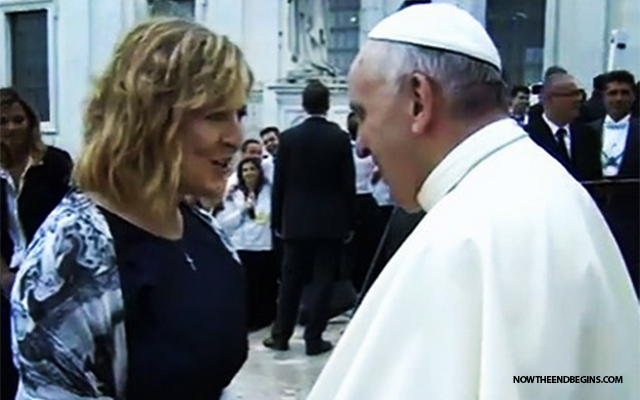
About meeting the Pope, Zschech said “What a day. All honour and praise to our Father in Heaven. Thank You, Thank You, Jesus.”
As a former Catholic for 28 years, I can assure you that the Catholic Church is not part of the Body of Christ. When I went through 12 years of private Catholic school indoctrination, we never called ourselves “Christians”, we always referred to ourselves as Catholics. Now obviously I believe that Catholics can be saved, but I do not think it is possible for that to happen within the Catholic system. Bible doctrine and Catholic doctrine are indeed at odds with each other, I never met a priest or a nun who could tell me for sure that they were going to Heaven when they died. Because unlike the Bible, Catholic doctrine teaches that you cannot know for sure. That’s why they teach the false doctrines of Sacraments, Purgatory, Saint Worship, and pray to Mary, because they are trying to build up as many “good works” as they can to outweigh their bad on Judgment Day. And that is why the vast majority of Catholics will wind up in Hell because they were never saved in the first place.
“For by grace are ye saved through faith; and that not of yourselves: it is the gift of God: Not of works, lest any man should boast.” Ephesians 2:8,9 (KJV)
In all the endless hours of sermonizing and talking put in by Pope Francis, can you show me a 5 minute presentation of Gospel on how to be saved? No, you can’t because he doesn’t talk about those things. So what, I wonder, did Darlene Zschech and the other Laodicean “evangelicals” have to discuss with the Catholics when they arrived starry-eyed in the City of Babylon to pay homage to the Pope? I think that’s a pretty good question. From the looks of things, they just performed Christian rock music, got everyone all hyped up on emotion, and had you fall down and pray to their “generic Jesus” who judges nothing, loves all, and supports same-sex marriage.
Darlene Zschech has a lot in common with another famous Laodicean imposter:
Christian, in these last days as we watch denomination after denomination falling under the spell of Mother Rome, you would do well to guard your walk with the Lord and have nothing to do with these Laodicean, prosperity preaching imposters. If you ever get the chance to have an audience with Pope Francis, why don’t you tell him how to get saved? Because Darlene Zschech certainly didn’t tell him that when she had her chance.Thursday, December 4, 2014
Subscribe to:
Posts (Atom)