What the Bible says about light and seed

The True Light "In him, (the Lord Jesus) was life, and that life was the light of men. The light shines in the darkness, but the darkness has not understood it. The true light that gives light to every man was coming into the world,…the world didn’t recognize him." John 1:4,9.

The Good Seed and the Weeds “The kingdom of heaven is like a man who sowed good seeds in his field. But while everyone was sleeping, his enemy came and sowed weeds among the wheat and went away. Matthew 13:24,25.

Monday, December 26, 2016

The Eternal Spring of Joy, Peace and Hope from the Heart of God - A Christmas reflection


Written and Posted by Jean-Louis Mondon.
As people celebrate Christmas with all its symbols, regardless of what they think the exact time and year of God's divine condescension among us  are, this is what this season represents to me as a spiritual reality.

As I was reflecting upon the incarnation of our Savior Christ Jesus as the supreme gift of our Heavenly Father to mankind, I could not help but think of the limited perspective that we sometimes have of the infinite measure of all of God’s aattributes and works in the vast universe He created but also in each of our lives.


The first thing I consider when I ponder the miracle of the supernatural birth of Jesus-Christ is that God chose to manifest His presence in the flesh as a seed of the Holy Spirit in the chosen womb of Mary.


Imagine a little! The creator and sustainer of the endless universe becoming a frail human being Himself subject to the natural law of human birth and physical existence.

What is amazing is that as we follow the course of His birth, life, death, resurrection, ascension and His coming back to take His own faithful ones to reign with Him, the same characteristic stages apply to us who have experienced the second spiritual birth and have passed from death to life, from the kingdom of darkness into His marvelous light.

 As the mature tree is essentially contained in the seed just waiting to develop through the different stages of growth, so was the life of the Lord Jesus and so is every one of our lives.

 
An illustration from the sharing of presents on Christmas day comes to mind. Imagine one of the present being a huge box with someone’s name on it. The person feverishly tears off the paper hoping to discover a big present that will provide a level of satisfaction commensurate to his perceived size. But as the box reveals another smaller box hidden under the packing peanuts, he suspects someone is playing a joke on him as he realizes from the sheer weight of the box.

As he keeps on opening another box, then another one, he finally opens the last tiny box and no matter what the value of the present, it leaves him or her with a sense of unfulfilled expectation and diminished satisfaction. Here in brief is how the acquiring and enjoying of material things which are supposed to fulfill our lives from the cradle to the grave end up being a great disappointment and a snare in the end. Not so with the present from our God, the free gift of salvation available to anyone willing to accept and receive it.  


Conversely, imagine that you received the gift of God, salvation by grace in a small box. After receiving and opening the gift, once your life is changed by that spiritual tiny seed, you realize that as you grow, the gift keeps on growing as you learn and mature into eternal everlasting life, the box of our life, so to speak, getting bigger and bigger.


Now considering another angle to giving and sharing presents.

Jesus talking about greed said that life doesn’t consist in the abundance of things. Luke 12:15.And He told the people to “not lay up for yourselves treasures upon earth where moth and rust destroy and where thieves break in and steal, but lay up for yourselves treasures in heaven…for where your treasure is, there your heart will be also.” Matthew 6:19-21.

Jesus is not only talking about treasures, but incorruptible treasures! What is He talking about? He is talking about treasures that have their beginning as an intangible seed beginning here on the earth and continuing in Heaven and/or enjoying all the stages of the growth of the seed in two dimensions simultaneously, in the physical body while at the same time in the invisible realm of the spirit.


He means treasures like the Christian virtues, generosity of spirit, goodness, mercy, humility, faith, wisdom, spiritual knowledge, love, patience, fruits of the Spirit, all intangible, but whose effects are felt when translated into good works and service to our brothers, sisters and fellow man. And of course, included are all the material gifts that he has blessed us with in superabundance to share with those less fortunate than us and to provide the means to advance the Kingdom of God, through preaching of the Gospel through gifts to missions throughout the world. Everything that will become the stones building the foundation of our sphere of influence in the coming Kingdom.


In I Timothy 6: 18, Paul tells Timothy to "Command those who are rich in this present world... to put their hope in God who richly provide us with everything for our enjoyment. Command them to do good, to be rich in good deeds, and to be generous and willing to share. In this way, they will lay up for themselves a firm foundation for the coming age so that they may take hold of the life that is truly life". It is obvious that one can build a house or a building only as tall and as large as the dimensions of the foundation supporting it, otherwise the building collapses.


In the Bible we can find several mentions of this manifestation of life as encapsulated in the title of Our Lord who is the Alpha, the beginning and Omega, the end and of course everything in between.


We can find the image of the seed in I Peter 1:23. “For you have been born again not of seed which is perishable but imperishable, that is through the living and abiding Word of God.” Isaiah 9:6-7 promise of the coming Messiah follows this development: "for a child will be born to us, a son will be given to us, and the government will rest upon His shoulders … there will be no end to the increase of His government or of peace."


Salvation, knowledge and wisdom are part of the incorruptible treasures that Christ talks about in Matthew. Talking about Christ, Isaiah 33:6 declares:He will be a sure foundation for our times, a rich store of salvation and wisdom and knowledge: The fear of the Lord is the key to this treasure.”
 
This passage becomes clearer in the light of Isaiah 11:1-5 where we can find the three aspects of knowledge, salvation and the fear of the Lord exemplified by the Savior himself growing out of the germination stage up to the maturity of the fruit of the Spirit: Then a shoot will spring from the stem of Jesse, And a branch from his roots will bear fruit. The Spirit of the Lord will rest on Him, The spirit of wisdom and understanding, The spirit of counsel and strength, The spirit of knowledge and the fear of the Lord. And He will delight in the fear of the Lord,There is also the parallel passage  which mirrors Isaiah 11 with little difference, the former describing the internal dynamic and influence of the Holy Spirit and the latter in the external application in action at the beginning of Jesus´ earthly ministry when he reads the Isaiah manuscript in the synagogue.  The harmony of  the Old and the New testament is demonstrated at the announcement of Jesus´ birth and the way the Father willed to accomplish it when the angel Gabriel announced to Mary: The Holy Spirit will come upon you, and the power of the Most High will overshadow you; and for that reason the holy Child shall be called the Son of God. Luke 1:35
This salvation which starts as a spiritual seed planted by the Holy Spirit Himself in the hearts of men who have received Him on His terms is ever expanding and revealing the loving heart of our Heavenly Father at this time of the year and all year long. "And hope does not disappoint us, because God has poured out his love into our hearts by the Holy Spirit, whom he has given us". Romans 5:5

Paul prays for the Ephesians in Ephesians 3:14-17 that: "He would grant you according to the riches of His glory to be strengthened with power through His spirit in the inner man so that Christ may dwell in your hearts through faith and that you being rooted and grounded in love, may be able to comprehend with all the saints what is the breadth and length and height and depth, and to know the love of Christ which surpasses knowledge that you may be filled up to all the fullness of God." This is also my prayer for all of us today and for the coming year.


Contrary to the philosophy of this passing and dying world, the present of eternal life in Christ Jesus started as a tiny seed, first the human seed inherited form our natural father and then the Holy Spirit seed  that contained all that is necessary to fulfill the purpose for which our Father and Creator put us on this earth. See I Corinthians 15:45-49:
So also it is written, “The first man, Adam, became a living soul.” The last Adam became a life-giving spirit.  However, the spiritual is not first, but the natural; then the spiritual. The first man is from the earth, earthy; the second man is from heaven.  As is the earthy, so also are those who are earthy; and as is the heavenly, so also are those who are heavenly. Just as we have borne the image of the earthy, we will also bear the image of the heavenly.

So this Christmas season until the beginning of 2017 and beyond, I invite you to remember with grateful and humble hearts, that the tiniest and most humble manifestation of life, a human seed, a tiny baby in his or her mother's womb is infinitely precious and worthy of protection and nurturing because it was made in God’s image. Psalm 139.

I invite you also to let your hearts and minds expand onto other amazing dimensions of life and consider all the stages of the life of the Savior in His birth, His death, His resurrection, His going back into the glory of Heaven and His coming back to give us glorified bodies, for we have already been resurrected (spiritually)  if we have been born again, starting as a tiny seed wrapped up in a small and fragile package that we all are, as pilgrims on this earth. 


This season Jesus offers us hope, joy and peace in a world sadly lacking theses blessings.

May the God of hope fill you with all joy and peace as you trust in Him so that you may overflow with hope by the power of the Holy Spirit. Romans 15:13.

Lord God, our loving Heavenly Father, we thank you and praise you fo the gift of life present and eternal in Our Lord Jesus-Christ.

Thursday, December 22, 2016

Equality - Love Unveils


As a Muslim woman I’m considered inferior. My value is less than a man’s.
According to the Qur’an, men are considered above women.
And they (women) have rights similar to those (of men) over them in kindness, and men are a degree above them” Sura 2:228 (Pickthall)

 Men are in charge of women.
Men are in charge of women, because Allah hath made the one of them to excel the other…” Sura 4:34 (Pickthall)

 My testimony is worth half of a man’s.
“…And bring to witness two witnesses from among your men. And if there are not two men [available], then a man and two women from those whom you accept as witnesses – so that if one of the women errs, then the other can remind her.” Sura 2:282 (Sahih International)
 The Prophet Muhammad said as a woman my mind is deficient.
The Prophet said, ‘Isn’t the witness of a woman equal to half of that of a man?’ The women said, ‘Yes.’ He said, ‘This is because of the deficiency of a woman’s mind.’” Sahih al-Bukhari 2658

A man gets twice as much inheritance over a woman.
Allah instructs you concerning your children: for the male, what is equal to the share of two females.” Sura 4:11 (Sahih International)

The hadith also says the majority of those in hell are women.
The Prophet said, “I looked at Paradise and saw that the majority of its residents were the poor; and I looked at the (Hell) Fire and saw that the majority of its residents were women.” Sahih al-Bukhari 5198
                                                   ----------------------------
 There is equality in Christianity.
Before Muhammad was even born Jesus of the New Testament elevated the status of women.

Jesus’ first miracle was in response to a request by his mother.
“…there was a wedding in Cana…And when they ran out of wine, the mother of Jesus said to Him, ‘They have no wine’. Jesus said to her, “Woman, what does your concern have to do with Me? My hour has not yet come. His mother said to the servants, ‘Whatever He says to you, do it.’ …Jesus said to them, ‘Fill the waterpots with water.’ And they filled them up to the brim. …When the master of the feast had tasted the water that was made wine…he said to him, ‘You have kept the good wine until now!’ John 2:1-11

 Jesus first revealed Himself as the Messiah to a woman.
“The woman said to Him, ‘I know that the Messiah is coming’ (who is called Christ). ‘When He comes, He will tell us all things.’ Jesus said to her, ‘I who speak to you am He.’ John 4:25-26

 One of His greatest miracles was at the request of women.
“…the sisters [Mary and Martha] sent to Him, saying, ‘Lord, behold he [Lazarus] whom You love is sick.’ …Now Jesus loved Martha and her sister and Lazarus. So when He heard that he was sick, He stayed two more days in the place where He was. …So when Jesus came, He found that he had already been in the tomb four days. …Now Martha said to Jesus, “Lord if You had been here, my brother would not have died. …Jesus said to her, ‘Your brother will rise again.’ Martha said to Him, ‘I know that he will rise again in the resurrection at the last day.’ Jesus said to her, ‘I am the resurrection and the life. He who believes in Me, though he may die, he shall live. And whoever lives and believes in Me shall never die.’ …He cried with a loud voice, ‘Lazarus, come forth!’ And he who had died came out bound hand and foot with graveclothes, and his face was wrapped with a cloth. Jesus said to them, ‘Loose him, and let him go.’” John 11:1-44

Women were included as disciples.
“There were also women…who also followed Him and ministered to Him when He was in Galilee, and many other women who came up with Him to Jerusalem.” Mark 15:40-41
After His resurrection Jesus first appeared to a woman.
“…Mary stood outside by the tomb weeping, and as she wept she stopped down and looked into the tomb. And she saw two angels in white sitting, one at the head and the other at the feet, where the body of Jesus had lain. Then they said to her, “Woman, why are you weeping?” Now when she had said this, she turned around and saw Jesus standing there, and did not know that it was Jesus. Jesus said to her, ‘Woman, why are you weeping? Whom are you seeking?’ She, supposing Him to be the gardener, said to Him, ‘Sir, if You have carried Him away, tell me where You have laid Him, and I will take Him away.’ Jesus said to her, ‘Mary!’ She turned and said to Him, ‘Rabboni!’ (which is to say, Teacher). John 20:1-16

So how can I know the truth?  
أسئلة من الكتاب المقدس وأجوبتها Bible Answers in Arabic


Friday, December 16, 2016

A Better Priest

Reposted from raystedman.org

A daily devotion for December 16th
Read the Scripture: Hebrews 7:1-25
Now if perfection was through the Levitical priesthood (for on the basis of it the people received the Law), what further need was there for another priest to arise according to the order of Melchizedek, and not be designated according to the order of Aaron? For when the priesthood is changed, of necessity there takes place a change of law also. For the one concerning whom these things are spoken belongs to another tribe, from which no one has officiated at the altar. For it is evident that our Lord was descended from Judah, a tribe with reference to which Moses spoke nothing concerning priests. And this is clearer still, if another priest arises according to the likeness of Melchizedek, who has become such not on the basis of a law of physical requirement, but according to the power of an indestructible life. Hebrews 7:11-16
One thing clearly marked the fact that the old priesthood was no longer acceptable as help for men. It was the appearance of a new priest with a different address and a different ancestry. If the old priesthood went, the Law had to go too. This new priest had a quite different address; he came from the tribe of Judah instead of the tribe of Levi. Judah was not a priestly tribe at all, but a kingly tribe. The new priest was a king. If God recognizes Christ as a priest, then the Law which was part of the old priesthood has been set aside.

Also, the new priest has a different ancestry. It was not necessary for him to trace his genealogy back to Abraham. No, as a priest he has no genealogy, he ministers in the power of an endless life. He had no beginning and no ending. Therefore the Law, which is only temporary, must go. It had an inherent weakness in that it could not supply what the flesh in its frailty lacked. Every priest, every psychiatrist, every counselor, whether he realizes it or not, is continually working with the Law. How? By seeking to relate people to reality. That is what the Law is, the revelation of reality. It is the way things are. Any knowledgeable counselor tries to help the people who come to see things as they are, but that is sometimes a very difficult help to render.

Under the old order, a man would take a sacrifice to the priest and the priest would offer it, thus for the moment at least, removing the guilt of the act. Though the problem remained, the guilt from it was removed. That is what the modern counselor does. He attempts to dispel guilt by helping his client see his problem in a different light. If he is a Christian counselor, to help him to see that God has already forgiven him in Christ and thus to remove guilt. But the basic problem essentially remains, if resolving guilt is all that is done. The psychiatrist may rearrange the problem so it does not grate so strongly upon others, but the problem remains. As C. S. Lewis puts it, No clever arrangement of bad eggs will ever make a good omelet.

Self-discovery is the end of the line as far as the human counselor can go. But what lies beyond that? If you do not go any further, eventually, despair! This is what Paul reflects in Romans 7, Oh, wretched man that I am! Who can set me free from this body of death? (Romans 7:24) That is where this word of Hebrews comes in. There is a Priest who can go further. What the law could not do in that it was weak through the flesh, God, sending his own Son in the likeness of sinful flesh and for sin, judged sin in the flesh, that the righteousness that the law demanded might be fulfilled in us, who walk not after the flesh but after the Spirit (Romans 8:3-4). That which is worthless, weak, and useless, has been set aside and a new hope introduced which brings us near to God.
Thank you, Father, that what I could not do in myself, and what no counselor or priest could do for me, you have accomplished through your Son.
Life Application: What inherent weaknesses in the Levitical Law are met in the Priesthood of Jesus? How can we move beyond the futility of mere self-discovery to inner conflict resolution? Are we led in the triumphal procession of Jesus Christ, both Priest and King?
We hope you were blessed by this daily devotion.

From your friends at www.RayStedman.org

Monday, December 12, 2016

What Really Happened at Christmas?


what-really-happened-at-christmas


A Bible Study by Jack  Kelley
In the past I’ve explained why I believe Jesus probably was born sometime in September. If that’s the case then what really happened in December?  Is Christmas just the result of overlaying Christian beliefs on a formerly pagan holiday as some believe, or is there more to it?

Happy Hanukkah

To find the answer we begin with a look at the Jewish Feast of Hanukkah.   Maybe you’ve heard the story of Hanukkah, but if not here’s a brief summary.  In 165 BC, during the time of the Maccabean Revolt, the Jews recaptured their desecrated Temple from Syrian dictator Antiochus Epiphanes and undertook a rebuilding and cleansing process to make it fit for worship again. (Angry with the Jews and defiant toward God, Antiochus had captured the Temple, sacrificed a pig on the altar, and erected a statue of the Greek god Zeus in the Holy Place requiring everyone to worship it on pain of death. This outrageous act rendered the Temple unclean and became known as the Abomination of Desolation.)

Jewish tradition holds that when they prepared to cleanse the Temple to make it fit for use again, the priests could not find enough Holy Oil to keep the Temple Menorah, a large 7 branched oil lamp, lit for  the required 8 day purification ritual. They only had enough for one day.  But they went ahead in faith and God multiplied that small supply so that it lasted for the full eight days making the Temple Holy again.

Since then, this miracle has been commemorated in the Feast of Hanukkah, an eight day celebration that includes the use of a special 9 branched candlestick called a Hanukkiah, short for Hanukkah menorah. The Hanukkiah  has a single elevated branch, representing the available supply of oil, and 8 additional branches, one for each day of the purification ritual.  Each day of the celebration an additional candle is lit, always using the flame of the elevated candle, until on the final day all the candles are burning. This reminds them that the light for each day came from the single day’s supply of oil they began with.  

Hanukkah is also referred to as the Festival of Lights for this reason.
By the way this Abomination of Desolation is an act destined to be repeated and will again trigger a revolt, this time involving the whole world.  When you see a Temple in Jerusalem you will know the time is near, and when you see the Abomination of Desolation standing in the Holy Place you will know that 3 1/2 years of the most terrible time man has ever known have begun (Matt 24:15-21). Whether you see this from Earth or Heaven will be determined by whether you’ve previously accepted the Lord’s death as payment for your sins.

What Day Is This?

As you know Hanukkah takes place around Christmas so I’m going to use the proximity of the two events to make what some would call an outrageous claim. I believe there’s a theological connection between Hanukkah and Christmas that does nothing less than state God’s position on the beginning of life.

In Happy Birthday Lord Jesus I demonstrated that in all probability John the Baptist was conceived in what would have been mid to late June on our calendar and born the following March.  John’s mother and father were Elizabeth  and Zechariah. According to Luke 1:36 Mary conceived in the 6th month of Elizabeth’s pregnancy. That means that our Lord was conceived in late December and born the following September.  Because the calendars are different the exact dates vary from year to year, but each year Hanukkah takes place in close proximity to Christmas.  Jesus is called “the True Light that gives light to every man” (John 1:9).  Was Jesus, “The Light of the World” conceived during the Festival of Lights?  Are we unknowingly celebrating His conception at Christmas instead of His birth?  If that’s the case do you realize what God is telling us?

When Did Christmas Begin?

The fact that Jesus is God incarnate is amply supported in Scripture.  But when did He become God and why did He choose to come into the world the way He did? Jeremiah 1:4-5, Psalm 51:5 and 139:13-16 all allude to the fact that God knew us from the moment of our conception.  He knew all the details of our lives and considered us human from that time. To merely be with us in human form Jesus could have arrived as a fully grown man but He came as an embryo because that’s the way all humans begin their life.

Christmas began at the moment of divine conception. God the Father planned it, God the Holy Spirit planted the fertile seed in Mary, and at that moment God the Son took on human form in the womb of a virgin. From that first moment of conception Jesus was very much alive, very much human, very much God.  He didn’t become the Incarnate God somewhere along the path of His life, or even when He emerged from Mary’s womb. He had been such from the moment of conception (Luke 1:35). God could not have made any stronger statement about the sanctity of pre-born life.

As a poor, unwed teen-aged girl about to be ostracized from family and society, Mary met all the modern criteria for a therapeutic abortion. But had she and Joseph sought one, it would have been just as much the murder of the Messiah as was His death on the cross 33 years later.  So the life of the Christ child really did begin at Christmas. And now you know the adult version of the Christmas story. 12-14-12

Strength at Wit's End

Reposted from RaySteadman.org

A daily devotion for December 12th
Read the Scripture: Hebrews 5:1-10
During the days of Jesus' life on earth, he offered up prayers and petitions with fervent cries and tears to the one who could save him from death, and he was heard because of his reverent submission. Son though he was, he learned obedience from what he suffered... Hebrews 5:7-8
How can Jesus sympathize, how does he understand our pressures, if he has never sinned? The answer to that leads us into the dark shadows of Gethsemane. There is no other incident in the gospels that fits the description of this passage where, with prayers and supplications, with loud cries and tears, he cried unto him who was able to save him from death.

Here we come face to face with mystery. Here is the total unexpectedness of unimagined agony to the Lord. In his anticipation of what he would be going through and his explanations of it to the disciples, he had never once mentioned Gethsemane, and there is no prediction of this in the Old Testament. There is much that predicts what he would go through on the cross; there is not one word of what he endured in the garden.

In the midst of his bafflement, puzzlement and distress of soul, he does an unusual thing. For the first time in his ministry he appealed to his own disciples for help. He asked them to bear him up in prayer as he went further into the shadows, falling first to his knees and then to his face, crying out before the Father. There he prayed three separate times and each prayer is a questioning of the necessity of this experience. Father, if it be possible, let this cup pass from me. He was beseeching the Father to make clear to him whether this was a necessary activity, so unexpected and deep was his suffering, so suddenly had it come upon him, baffling him, confusing him, bewildering him, just as sudden experiences and catastrophes come bewilderingly to us.

To deepen the mystery of this it is implied that the Lord Jesus faced the full misery which sin produces in the heart of the sinner while he is yet alive. All the naked filth of human depravity forced itself upon him and he felt the burning, searing shame of our misdeeds as though they were his. No wonder he cried to the Father, Father, if it be possible let this cup pass from me. Nevertheless, he adds, not my will, but thine, be done (Luke 22:42).

This explains the strange words, Although he was a Son, he learned obedience through what he suffered. He learned what it means to obey God when every cell in his body wanted to disobey. Yet, knowing this to be the will of God, he obeyed, trusting God to see him through. He learned what it feels like to hang on when failure makes us want to throw the whole thing over, when we are so defeated, so utterly despairing that we want to forget the whole thing. He knows what this is like, he went the whole way, he took the full brunt of it.

How did he win? He refused to question the Father's wisdom. He refused to blame God. He took no refuge in unbelief even though this agony came unexpectedly upon him. Instead, Jesus cast himself upon the Father's loving, tender care and looked to him to sustain him. When he did, he was brought safely through. So we read, Let us then with confidence draw near to the throne of grace, that we may receive mercy and find grace to help in time of need. No matter how deep, how serious that need may be, he can fully meet it, though we may be at wit's end.
Father, thank you that the Garden of Gethsemane was not a mere play acting upon a stage. The Lord Jesus did not come into the world to perform a role, he fully entered into life. He went the whole way, he bore the full brunt. Help me to trust in him.
Life Application: Jesus Christ entered into the full force of two of our lives' greatest mysteries: obedience and suffering. Where on the spectrum of obedience do we pray 'nevertheless, not my will but Thine be done?'
We hope you were blessed by this daily devotion.

From your friends at www.RayStedman.org

Saturday, December 10, 2016

On the Light Side from Mondon Translation

By Jean-Louis Mondon.

In the Old Testament, the children of Israel had to fight against the Anakim, the Emim, the Rephaim and the Zuzim, nowadays translators such as myself have to struggle with a remnant of those powerful individuals, the “Verbatim”.

Friday, December 9, 2016

The Seasons in the Life of a Christian- Brokenness - Grinding the grains - Chapter IV and Conclusion


The Seasons in the Life of a Christian- Brokenness - Grinding the grains - Chapter IV and Conclusion 

Written and posted by Jean-Louis Mondon. http://thelightseed.blogspot.com (To read the preceding and following chapters, click on the left lateral bar on the numbered chapters under the title "The Seasons in the Life of a Christian" - Brokenness.)

IV. GRINDING (Lord, It hurts)
Up until now, we had individual grains of wheat from individual stalks that require still a further process before there can be any bread making as such. Verse 28 of Isaiah 28 tells us that: “grain must be ground to make bread”. It is impossible to make bread that stays in one piece with individual kernels. The gluten, sticky substance that holds the loaf together is inherent to the wheat, but the individual grains of wheat have to be ground in order to provide the right consistency and the (glue-like), binding quality that causes the bread to hold together. The flour, ground product, still has everything that was contained in the individual separate grains of wheat, now unrecognizable as kernels because of the transformation process into a workable substance. In the same way, the loaf of bread baked from the flour contains every grain of wheat (minus the chaff) that has been submitted to the processes of grinding, mixing, kneading, rising and finally baking. 

Another insight from Oswald Chambers is that “Personality is the characteristic of the spiritual man as individuality is the characteristic of the natural man. Our Lord can never be defined in terms of individuality and independence, but only in terms of personality. “I and my Father are one”. Personality merges and you only reach your identity when you are merged with another person”. (See Oswald Chambers, My Utmost for His Highest. Dec. 12th. On Personality).

 
 Google image
 Paul in I Corinthians 10:16 speaks of the loaf of bread as a symbol for the body of Christ that was broken for us, but also of the Church, His body on earth in these terms, “the bread which we break, is it not the communion of the body of Christ? For we being many are one bread, and one body: for we are all partakers of that one bread”.

The following verse uses  an allegorical image of the spiritual, supernatural Love of God and brings it down to the physical expression of the binding quality of the gluten in the bread that was mentioned above.  
Bear with each other and forgive any complaint you may have against one another. Forgive as the Lord forgave you. And over all these virtues put on love, which is the bond of perfect unity. Let the peace of Christ rule in your hearts, for to this you were called as members of one body. And be thankful.… Colossians 3:14-15

Notice the way Paul illustrates the nature of love as the bond of perfect unity when he describes in a practical way what we can do in order to promote peace, forgiveness and bearing with one another´s burden.This is far from the word “Love” that is constantly used ad nauseam until it becomes devoid of real meaning, a love that is insipid, because it lacks the spiritual substance that  the Lord Jesus ascribes to it. Love in its essence expresses the sum of some of the virtues found in the person of the Lord Jesus-Christ who defines it thus:
No greater love has a man than he gives up his life for a friend.(John 15:13)
How far how we willing to go as His disciples in living  sacrificial lives for the benefit of others?

Because of His love for the multitude, Jesus multiplied the loaves of bread and that´s what Christians are commanded to do: multiply and bear good and lasting fruit, feeding the multitude with the Word of God for man shall not live by bread alone but by every word that comes out of the mouth of God. 

Now we have reached a point of extreme unsatisfied hunger as God has sent a famine of the hearing of the Word of God. "Because lawlessness is increased, most people's love will grow cold. The contrast is so evident to me; Could it be that there a famine because the church has substituted its spiritual mandate for a false gospel of social work and social justice and left a willing and consenting people hungry and thirsty for real food?
As Christians we are called to deny ourselves, pick up our cross daily and follow our Lord Jesus and be the servant of all. As out of His great love for us, He laid down His life we, in turn lay our lives down as an expression of love for the benefit of the body of Christ, so that individually and corporately, we will reflect the life and the glory of Christ for the praise of the Father. 

In all three examples of breaking, plowing the ground, threshing the wheat and grinding the flour, the farmer doing the breaking is using the help of an implement like the sharp edge of the plowshare, or an instrument such as a rod or a grinding wheel. In like manner God will allow into our lives a specific tool of His own choosing, a particular circumstance or person fit for the job. 

When it happens we have a tendency to look at the instrument and not beyond at our Master-Teacher who is using the instrument for our benefit. Are we able to say at this point, “ not my will, but thine be done”?
Check what Peter says in I Peter 1:7; I Peter 2:21; and what James says in James 1:2 about trials and testing as they relate to faith, perseverance and maturity.

V. CONCLUSION
Acceptance, willingness and obedience
What is most important is the spirit with which we receive the trials the Lord allows us to go through, and our reaction to the suffering they bring. Let us have the same attitude as David who said in Psalm 16:5,6 “The LORD is the portion of mine inheritance and of my cup: thou maintainest my lot. The lines are fallen unto me in pleasant places; yea, I have a goodly heritage”.

We want to live in the blessed presence of our Lord, don’t we? David poses a pertinent question when he asks in Psalm 15: “LORD, who may dwell in your sanctuary? (v.1), He who keeps his oath even when it hurts”(v.4b).
We, as disciples, have promised to follow Jesus no matter what happens, no matter where He takes us. Well, in John 12:26 Jesus says: “Whoever serves me must follow me and wherever I am, my servant will be also”.

Is our Lord grieving over the condition of His church and that of the lost people in the world He so dearly loves and died for? If so, we will be grieving with Him and be moved to obedient action directed by the Holy Spirit.

However, my brothers and sisters rejoice, for He also said to His disciples: “I tell you the truth, you will weep and mourn while the world rejoices. You will grieve but your grief will turn to joy”. And then, we can say like David:
“You turned my wailing into dancing, you removed my sackcloth and clothed me with joy, that my heart may sing to you and not be silent. O LORD my God, I will give you thanks forever”. (Psalm 30:11,12).

Remember also that Psalm 126: 3 declares:
“The LORD has done great things for us, and we are filled with joy. Restore our fortunes, O LORD, like streams in the Negev. Those who sow in tears will reap with songs of joy. He who goes out weeping, carrying seed to sow, will return with songs of joy, carrying sheaves with him” . Amen

“All this also comes from the LORD Almighty, wonderful in counsel and magnificent in wisdom”. (Isaiah 28:29).

Brother Jean-Louis. Thanksgiving day 1998.
Revised and corrected June 2007.Revised and Illustrated January 2013

Wednesday, December 7, 2016

DECEPTION Pastor, “Power, Prestige, and Wealth are all Yours if you just Tell Them What They Want to Hear”

Reposted from doctorwoodhead.com
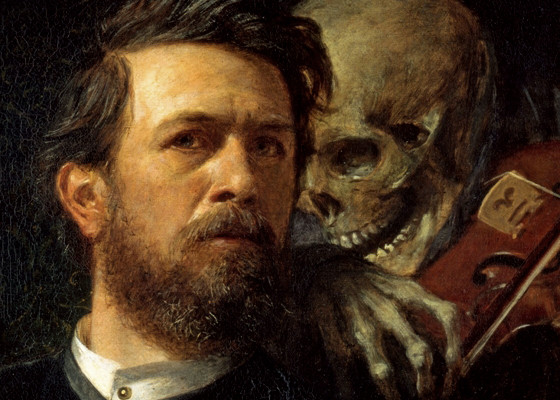
  Self-portrait with Fiddling Death, by Arnold Böcklin 1872

Self-portrait with Fiddling Death, by Arnold Böcklin 1872

 This is perhaps the most insidious of all the heretical deceptions to come upon biblical Christianity.  It is characterized by catering to the desires of the people. Instead of being inculcated with God’s Word and having our personal world view and behavior be patterned after God’s Word, the New Evangelicalism gives the people what they want.  One NT passage clearly predicts this reversal of worship of God to worshiping man.
Romans 1:25
Who changed the truth of God into a lie, and worshiped and served the creature more than the Creator, who is blessed for ever. Amen.

The idea with this new wave of apostasy is to soft-sell the Bible and salvation. It is not attempting to save anybody from the fires of Hell but from an aimless and meaningless life here on earth. Our experiences and quality of life here are more important than the total service to God and the blessed assurance that He will soon come to lift us out of this sinful decaying world. Salvation is given lip service and evangelism with real confrontation is thought to be too divisive. This apostasy does not want to upset anybody. There is never any mention of Hell and the outcome of an unsaved life.  They may say that they believe strongly but, their actions differ sharply from what they say.

Usually their Bible teaching is characterized by an over emphasis on application. This of course is the middle of the road approach. They avoid doctrine as too divisive.
Paul warned us that the end times would be characterized as a departure from sound doctrine and a departure from the truth.
II Timothy 4:3-4 
For the time will come when they will not endure sound doctrine; but after their own lusts shall they heap to themselves teachers, having itching ears; And they shall turn away [their] ears from the truth, and shall be turned unto fables.

With the divisiveness they believe that they will lose members of their congregation and therefore funds. Or they are concerned with money and man-made approaches to self-help. A total dependence on God for their resources is abandoned for “sound business” practices or “fundamental marketing techniques.”  Total reliance on God by elders through prayer and patience is exchanged for parliamentary procedure and schemes for man made self-advancement and career goals. The pastor is considered as a CEO, not the teacher of God’s Word. Mission statements and strategic plans are formulated to accommodate personal plans. The Bible is subordinated to man’s desires.

The thought of prophecy is anathema to the New Evangelical for they say it causes division. This division of course is between those non-literal Bible expositors and the literal Biblical expositors.  Some have characterized the New Evangelical as being seduced by the world spirit of this present age.
You can see it in the leaders who are popularized. Usually they have a high degree of prominence in the government or sports and their testimonies are sought after for paid speaking engagements and book endorsements.

You will never see a Sunday school teacher or poor inner city pastor held up by them as pillars of the faith. Christ went to the lowest members of society to bring the truth to the world. He did not go to the popular and prominent.

This is a spirit of disobedience and a mood of compromise. It is a rejection of many of the negative aspects of New Testament Christianity. It is an attitude of positivism. They would rather be diplomats not fighters, positive rather than militant, infiltrators rather than separatists. They would not be restricted by a separationist mentality. The New Evangelical would rather pursue dialog, intellectualism, and appeasement than Biblical Militantism. Psychology is fast becoming their guide.

The use of psychology is rapidly becoming the norm in Christian Schools and churches.
Our culture has become deeply and extensively psychological. The weakness and carnality of the church in recent decades has allowed this psychological mind-set of the world to flow into the church. This process has brought about a redefining of many foundational matters of the Christian faith. We used to correctly understand that man’s problem was sin and God’s remedy was His saving and transforming grace (Romans 5:12, 17). Now, the trouble is the disorder of codependency, and the solution is group therapy. Formerly, we understood that man tended to stray from God to follow his own self-willed path (Isaiah 53:6), and that he needed to deny himself, take up his cross, and follow Christ (Luke 9:23). Now, we think that man must esteem himself, affirm himself, and actualize himself. All of this new thinking is coming from psychological theory, which is primarily a philosophy of life. We are strongly warned in the word of the Lord not to be guided by the philosophy of the world.
Colossians 2:8
“Beware lest anyone take you captive through philosophy and empty deceit, according to the tradition of men, according to the basic principles of the world, and not according to Christ”

Beware of the leaven of the new-evangelicals.

Sunday, December 4, 2016

The Dictator and the Dissident


Reposted from nationalreveiw.comnationalreview.com
by Lee Habeeb November 28, 2016 1:33 PM

Armando Valladares’s story says more about Fidel Castro than any obituary could. It’s a part of the Fidel Castro story Michael Moore and Sean Penn won’t tell, or don’t know. It’s a story you certainly didn’t hear from the media as they endlessly opined about Castro’s “complicated” legacy. But it reveals so much more about the dictator than they ever could. 

The year was 1959. Castro, a young revolutionary, had seized Cuba’s imagination with talk of democracy and a new vision for its people. It didn’t take long, however, for one follower to discover Castro’s true nature, and for Castro to run up against the limits of his own earthly power. Armando Valladares may not have been the first man to challenge the Cuban dictator, but he eventually became the best known. By his own account, the young Valladares was an early supporter of Castro’s revolution, taking a job in the Office of the Ministry of Communications for the Revolutionary Government, where he worked as a postal clerk. 

But all of that changed when he was asked to put a communist slogan on his desk. It comprised three simple words: “I’m with Fidel.” He refused. A young artist and poet who also happened to be a Christian, Valladares understood the meaning of the request. What he did not know, and could not know, was how far his own government would go to bend him to its will. Soon after his refusal to comply, Valladares was arrested by political police at his parents’ home. Faced with trumped up charges of terrorism — a favorite tactic of the Castro regime for silencing dissent — he was given a 30-year sentence. Valladares would spend time in different prison camps for the next 22 years. 

The first, La Cabaña, forged some of the very worst memories. “Each night, the firing squad executed scores of men in its trenches,” he told the Becket Fund, which last year honored him with its Canterbury Prize, given annually to a person who embodies an unfailing commitment to religious freedom. “We could hear each phase of the executions, and during this time, these young men — patriots — would die shouting ‘Long live Christ, the King. Down with Communism!’ And then you would hear the gunshots. Every night there were shootings. Every night. Every night. Every night.” 

Years passed, and the communists fixated on enrolling prisoners in reeducation programs. Valladares, still early in his sentence, was offered the chance at “political rehabilitation” but refused to comply. He was sent to an even more brutal prison, and the government ramped up its efforts to break his spirit. Armando Valladares may not have been the first man to challenge the Cuban dictator, but he eventually became the best known. “I spent eight years locked in a blackout cell, without sunlight or even artificial light. I never left. I was stuck in a cell, ten feet long, four feet wide, with a hole in the corner to take care of my bodily needs. No running water. Naked. Eight years,” Valladares recalled. “All of the torture, all of the violations of human rights, had one goal: break the prisoner’s resistance and make them accept political rehabilitation. That was their only objective.”

After nearly a decade, prison officials adjusted their terms. If Armando would simply sign a document renouncing his beliefs and embracing Communism, he could return to his family. The choice was simple: physical freedom or spiritual liberty. “For many people, it wasn’t practical to resist. Better to sign the paper and leave,” Valladares said. “But for me, signing that paper would have been spiritual suicide.” So how did Valladares do it? How did his faith and spirit endure during those years alone in prison? “In the beginning, I embraced God perhaps for fear of losing my life, since I was in danger of being executed,” he told the National Association of Evangelicals in 1983. But hearing those men proclaim their love for Christ just prior to their executions moved him in ways he could not have imagined: I realized then that Christ could be of help. Not merely by saving my life, but also giving my life, and my death if that was the case, an ethical sense that would dignify them. I believe that it was at that particular moment, and not before, when Christianity, besides being a religious faith, became a way of life that in my own circumstances resulted in resistance — resisting torture, resisting confinement, resisting hunger, and even resisting the constant temptation to join the political rehabilitation and indoctrination programs that would end my predicament. The battle lines were drawn for Valladares: the material life versus the spiritual life. Castro and his earthly ambitions of a utopian dictatorship versus Christ and His promise of everlasting life for those who follow Him. 

RELATED: Armando Valladares, Witness to Truth Castro fought hard, desperate to strip Valladares of his most valuable possession: his sense of morality. But once again, his faith proved up to the task. “To be Christian under those circumstances meant that I could not hate my tormentors; it meant to maintain the belief the suffering was meaningful because if man gives up his moral and religious values, or if he allows himself to be carried by a desire to hate or for revenge, his existence loses all meaning,” he explained. Valladares noted often that he was not alone in his spiritual battle with Castro. His fellow Christians showed him the way: I saw dozens of Christians suffering and dying — committed, like myself, to maintaining their dignity and their richness of spirit beyond misery and pain. I remember with emotion Gerardo Gonzalez, a Protestant preacher, who knew by heart whole Biblical passages and who would copy them by hand to share with his brothers in belief. I cannot forget this man whom all of us called “Brother in Faith.” He interposed himself before a burst of machine-gun fire to save other prisoners who were beaten in what is known now as the Massacre of Boniato Prison. Gerardo repeated, before dying, the words said by Christ on the cross: “Forgive them, Father for they know not what they do.” And all of us, when the blood had dried, struggled with our consciences to attain something so difficult yet so beautiful: the ability to forgive our enemies. Valladares’s God, too, showed him the way and the light. “There are no impossibilities for those who love and seek God,” he said. “The more ferocious the hate of my jailers, the more my heart would fill with love and a faith that gave me strength to support everything; but not with the conformist or masochistic attitude; rather, full of joy, internal peace and freedom because Christ walked with me in my cell.” 

While in prison, Valladares began to write poetry denouncing his oppressors. Without paper or pen, he wrote on cigarette papers and onion skins, using his blood as ink. His wife, whom he met in prison, smuggled the poems to the outside world and they became his first book, From My Wheelchair, released in 1977.

 “There is nothing dictators fear more than artists, especially poets,” Valladares wrote. In “Life Was Not Enough,” dedicated to Pedro Luis Boitel, whom he called “an unforgettable brother,” he expanded on the thought:

Life was not enough for you in that torture chamber 
but there were rifle butts and  boots  to spare 
buckets of urine and excrement thrown in your face.
They could not forgive you 
your  labors of light and words 
they feared your smile
the eloquence of your hands 
they feared the fertility of your ideas 
and your manner of being silent 
they feared your life, Pedro,
and they murdered you.

Today, Valladares paints rather than writing poems. His pictures are not scenes of torture and darkness, but vibrant landscapes that depict his soul — the refuge where he survived Castro’s war on his body and his conscience. But in his speech last year to the Becket Fund, he stressed that his experience had taught him the need for vigilance in defense of freedom:  

Just as there is a very short distance between the U.S. and Cuba, there is a very short distance between a democracy and a dictatorship where the government gets to decide what to do, how to think, and how to live. And sometimes your freedom is not taken away at gunpoint but instead it is done one piece of paper at a time, one seemingly meaningless rule at a time, one small silencing at a time. Never allow the government — or anyone else — to tell you what you can or cannot believe or what you can and cannot say or what your conscience tells you to have to do or not do. Castro is dead, and there will be countless biographies dedicated to burnishing his legacy. But the best way to understand his life is to appreciate the life of one Cuban dissident he changed forever. 

Armando Valladares’s story may never be required reading in Cuban schools, but it needs to be read in every American school. Call it “The Dictator and The Dissident.” It’s quite a yarn. — Lee Habeeb is the vice president of content for Salem Radio Network. He is also the host of Our American Stories. He lives in Oxford, Miss. 

Read more at: http://www.nationalreview.com/article/442515/fidel-castro-brutal-dictatorship-armando-valladeres-cuban-dissidents-tortured?utm_source=nr&utm_medium=facebook%3Futm_content%3Dhabeeb%3Futm_campaign%3Dtorture