Light is sown like seed for the righteous, and gladness for the upright in heart. Psalm 97:11
What the Bible says about light and seed
The True Light "In him, (the Lord Jesus) was life, and that life was the light of men. The light shines in the darkness, but the darkness has not understood it. The true light that gives light to every man was coming into the world,…the world didn’t recognize him." John 1:4,9.
The Good Seed and the Weeds “The kingdom of heaven is like a man who sowed good seeds in his field. But while everyone was sleeping, his enemy came and sowed weeds among the wheat and went away.”Matthew 13:24,25.
Showing posts with label Economic collapse. Show all posts
Showing posts with label Economic collapse. Show all posts
May 2016 – VENEZUELA – The
United States is increasingly concerned about the potential for an
economic and political meltdown in Venezuela, spurred by fears of a debt
default, growing street protests and deterioration of its oil sector,
U.S. intelligence officials said on Friday. In a bleak assessment of
Venezuela’s worsening crisis, the senior officials expressed doubt that
unpopular leftist President Nicolas Maduro would allow a recall
referendum this year, despite opposition-led protests demanding a vote
to decide whether he stays in office.
But the two officials, briefing a
small group of reporters in Washington, predicted that Maduro, who heads
Latin America’s most ardently anti-U.S. government and a major U.S. oil
supplier, was not likely to be able to complete his term, which is due
to end after elections in late 2018. “You can hear the ice cracking. You
know there’s a crisis coming,” one U.S. official said. “Our pressure on
this isn’t going to resolve this issue.”
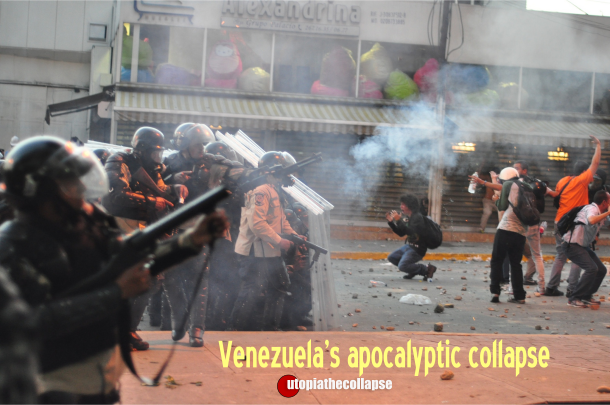
Mobs in Venezuela have stolen flour,
chicken and even underwear this week as looting increases across the
crisis-hit OPEC nation where many basic products have run short, and the
U.S. officials said this could spiral into widespread unrest. Soldiers
fired tear gas at stone-throwing protesters on Wednesday as Venezuela’s
opposition marched to pressure electoral authorities into allowing a
recall referendum against Maduro. –Reuters
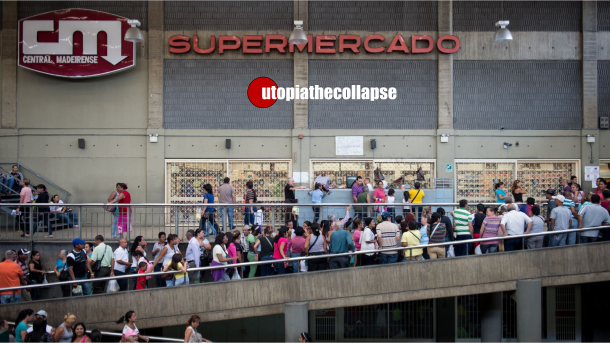
Running out of food:
Lines at supermarkets stretch for blocks on end in Venezuela. Often when
you finally make into the store, the “shelves are already barren,”
reports many residents. –AP
Over the last several years we have
documented with clockwork regularity Venezuela’s collapse into failed
state status, which was cemented several weeks ago when news hit that
“Venezuela had officially run out of money to print new money.” At that
point the best one could do was merely to step back and watch as local
society and civilization turned on itself, unleashing what would
ultimately turn into Venezuela’s own, sad apocalypse.
As we wrote then these are simply
hungry Venezuelans protesting that their children are dying from lack of
food and medicine and that they do not have enough water or
electricity. As AgainstCronyCapitalism added, this is a country with
more oil than Saudi Arabia, and the government has stolen all the money
and now they bottleneck peaceful protesters and threaten them with bombs
(or haul them to prison and torture them).
As pure desperation has set in,
crime has becomes inevitable. A man accused of mugging people in the
streets of Caracas was surrounded by a mob of onlookers, beaten and set
on fire, who published a pixeled-out but still graphic video of the man
burning as mob justice is now the supreme arbiter of who lives and who
dies: “Roberto Fuentes Bernal, 42, was reportedly caught trying to mug
passersby in the Venezuelan capital, and before police arrived at the
scene, the crowd took the law into their own hands.”
Now, in the latest shocking
development, Venezuela saw a new wave of looting this week that resulted
in at least two deaths, countless wounded, and millions of dollars in
losses and damages. According to Panampost, on Wednesday morning, a
crowd sacked the Maracay Wholesale Market in the central region of
Venezuela. According to the testimonies of merchants, the endless food
lines that Venezuelans have been enduring to do groceries could not be
organized that day.
As time went by, desperate Venezuelans
grew anxious over not being able to buy food. Then they started jumping
over the gates and stormed the supermarket. “They took milk, pasta,
flour, oil, and milk powder. There were 5,000 people” one witness told
Venezuela outlet El Estímulo. People from across the entire state came
to the supermarket because there were rumors that some products not
found anywhere else would be sold there. As a result of the massive
crowd, the authorities were unable to preserve the peace. “There were
250 people for each National Guard officer… lots of people and few
soldiers. At least one officer was beat up because he tried to stop the
crowd,” another source told El Estímulo.
Other food dispensaries run by the
government were also looted by the people. Far from the promised
socialist paradise, as the massive group of people moved, an entrance
gate collapsed under the weight of the crowd, leaving several wounded. –Info Wars
The dominoes are starting to fall in
large numbers. There are a host of other countries that are in serious
financial trouble that you may not have even heard about. Without
serious reform or aid; they are likely headed for a financial collapse.
The repercussions of their collective collapse will be nothing short of a
global financial market Armageddon. I warned of this coming nightmare
two years ago in my book, Utopia the Collapse. Prepare yourself and get ready. -Alvin Conway
The
President of France has come up with a very creative way of solving the
European debt crisis. On Sunday, a piece authored by French President
Francois Hollande suggested that the ultimate solution to the problems
currently plaguing Europe would be for every member of the eurozone to
transfer all of their sovereignty to a newly created federal
government. In other words, it would essentially be a “United States of
Europe”. This federal government would have a prime minister, a
parliament, a federal budget and a federal treasury.
Presumably, the
current national governments in Europe would continue to function much
like state governments in the U.S. do. In the end, there may be some
benefits to such a union – particularly for the weaker members of the
eurozone. But at what cost would those benefits come?
When I first learned that French President Francois Hollande had
proposed that the members of the eurozone should create their own
version of a federal government, I was quite stunned. But I shouldn’t
have been surprised. For the global elite, the answer to just about any
problem is more centralization. The following comes from a Bloomberg article that was posted on Sunday…
French President Francois Hollande said that the 19
countries using the euro need their own government complete with a
budget and parliament to cooperate better and overcome the Greek crisis. “Circumstances are leading us to accelerate,” Hollande said in an
opinion piece published by the Journal du Dimanche on Sunday. “What threatens us is not too much Europe, but a lack of it.”
“I have proposed taking up Jacques Delors’ idea about euro government, with the addition of a specific budget and a parliament to ensure democratic control,” Hollande said. His remarks touched on what analysts have seen as a major flaw in the euro.
Under the 1992 Treaty of Maastricht, countries which share a common currency must obey rules on borrowing and deficit spending. But the Greek crisis saw one of the 19 eurozone members notch up
successive worsening deficits and amass a mountain of debt. The problems
were only addressed by bailouts from the European institutions and the
International Monetary Fund (IMF). Critics say the problem stems from a lack of centralised control over
national fiscal policies, which today are jealously guarded areas of
sovereignty.
In addition, this eurozone government would have its own prime
minister. In essence, he would be the European version of the president
of the United States. The following comes from the Independent…
There would be a eurozone government with its own prime minister,
the officials said. This government would have its own budget –
separate from the EU budget – to aid and invest in more fragile
countries, It would try to harmonise corporation and pay-roll taxes to
ensure fair competition in the eurozone.
Of course Hollande is not the only one calling for more
centralization. Last month, European Central Bank President Mario
Draghi, European Commission President Jean-Claude Juncker and Eurogroup
President Jeroen Dijsselbloem proposed a plan that would create a shared European treasury…
Draghi called for the creation of a shared treasury
within 10 years in a joint proposal with politicians including European
Commission President Jean-Claude Juncker and Eurogroup President Jeroen
Dijsselbloem last month.
I don’t anticipate that we will see any of these things implemented immediately. However, what is important is the fact that this is where the
European elite plan to take Europe. And when the next great European
financial crisis erupts, these proposals will be offered as the
“solutions” necessary to end the crisis. During times of emergency, the elite are often able to push things
through that they would never be able to accomplish under normal
circumstances. At the moment, it would be extremely difficult to get
everyone to agree to a full-blown “United States of Europe”. But if
things were to start spinning wildly out of control and people were
suddenly desperately clamoring for solutions, the environment would be
quite different.
What that time arrives, the key will be to get Germany and France to
agree on what a “United States of Europe” should look like. If Germany
and France can agree, it is inevitable that most of the other members of
the eurozone would ultimately fall in line. One potential hurdle for the creation of this new government would be
the euro. The current treaty agreements concerning the euro are quite
complicated and quite restrictive. If Germany and France decided that
they did want to create a “United States of Europe”, they might have to
create an entirely new currency in order to accomplish that.
I know that sounds kind of crazy right now, but at one time the concept of “the euro” sounded really crazy too. For the moment, the debt crisis in Europe just continues to get even worse.
Greece, Portugal, Ireland, Italy, Spain, Belgium and France are all
drowning in debt. Whether or not we see a “Grexit” in the short-term, I
fully expect that European bond yields will continue to rise and
European stocks will take quite a tumble in the months ahead.
I believe that we are right on the verge of a very significant
European financial crisis. In particular, keep on eye on the big
banks. Just like in the United States, the “too big to fail” banks in Europe are massively overleveraged and are tremendously exposed to derivatives. In fact, the bank with the most exposure to derivatives on the entire
planet is Deutsche Bank. It has been reported that Deutsche Bank has a
whopping 75 trillion dollars
worth of exposure to derivatives, their co-CEOs were recently forced to
resign, and there are all sorts of rumblings about troubles going on
behind the scenes at the bank.
What do you think would happen if the biggest and most important bank in Germany suddenly became the next Lehman Brothers? That is something to think about.
Meanwhile, the euro continues to fall. For a long time, I have been
repeating my prediction that the euro would fall to parity with the U.S.
dollar. One year ago, the EUR/USD was sitting at 1.35. Today, it has come all the way down to 1.08.
There will be more ups and downs, but we are almost there. A time of great chaos is coming to Europe, and the eurozone will be deeply shaken. But whether or not there is a break up of the eurozone in the
short-term, in the long-term the goal of the European elite is even more
integration and even more centralization. So even though there will be significant bumps in the road, I fully
expect to see the “United States of Europe” that French President
Francois Hollande has proposed. Do you agree? What do you think the future holds for Europe? Please feel free to join the discussion by posting a comment below…


 By Michael Snyder, on July 19th, 2015
