What the Bible says about light and seed

The True Light "In him, (the Lord Jesus) was life, and that life was the light of men. The light shines in the darkness, but the darkness has not understood it. The true light that gives light to every man was coming into the world,…the world didn’t recognize him." John 1:4,9.

The Good Seed and the Weeds “The kingdom of heaven is like a man who sowed good seeds in his field. But while everyone was sleeping, his enemy came and sowed weeds among the wheat and went away. Matthew 13:24,25.
Showing posts with label ENGLISH - Christian Living. Show all posts

Saturday, March 23, 2013

Adorned in Christ, how should we dress for Holy Week?

Reblogged from Elizabeth Prata: the-end-time.blogspot.com

I have a quandary. I never know how much or how little to dress up for church.

With Palm Sunday and Easter coming up, I'm thinking about it more than ever.

By nature, I like simple clothing, no makeup and little to no jewelry. However, for church, I like to make an effort to dress distinctively. It is a different day than the work-a-day weekdays, and errands-busy Saturday. It is the Lord's Day. I want to look my best to show God His value to me.

However, the verse in 1 Timothy 2:9 says
"likewise also that women should adorn themselves in respectable apparel, with modesty and self-control, not with braided hair and gold or pearls or costly attire,"
First, I need to discover what this means in context. Is there a historical reason for this? We know that the richer people of the times wore purple. (Acts 16:14, Luke 16:19). It was the most expensive kind of garment because it was the most expensive kind of dye. It had to be processed from tiny mollusks. Wearing purple in those days was a deliberate statement of "I'm rich," rather than a personal choice of "I like purple." Do we do that today? Make clothing purchases that deliberately show our wealth and status, rather than having been purchased simply because it was a nice garment?
"Tyrian Purple,” the purple dye of the ancients mentioned in texts dating back to about 1600 B.C., was produced from the mucus of the hypobranchial gland of various species of marine mollusks, notably Murex. It took some 12,000 shellfish to extract 1.5 grams of the pure dye." (source History, Shellfish, Royalty, and the Color Purple)
As for other adornments, the women used to treat their hair with fine curls and interweave jewels or pearls into them. The hair of a Roman woman or lady was dressed in plaited braids and worn at the back of the head as shown.


Roman women also wore headdresses especially if they had an important position in society. The image below shows the headdresses worn by Roman empresses.

Ladies would interweave jewels, pearls, or gold into their hair in complicated patterns-
Source
Barnes Notes:
That women adorn themselves - The apostle by the use of the word "adorn" (κοσμεῖν kosmein), shows that he is not opposed to ornament or adorning, provided it be of the right kind. The world, as God has made it, is full of beauty, and he has shown in each flower that he is not opposed to true ornament. There are multitudes of things which, so far as we can see, appear to be designed for mere ornament, or are made merely because they are beautiful. Religion does not forbid true adorning. It differs from the world only on the question what "is" true ornament.
Hmmm. So true. God loves beauty. Barnes continues:
"Not with broidered hair - Margin, "plaited." Females in the East pay much more attention to the hair than is commonly done with us. It is plaited with great care, and arranged in various forms, according to the prevailing fashion, and often ornamented with spangles or with silver wire or tissue interwoven; see the notes on Isaiah 3:24. The sense here is, that Christian females are not to imitate those of the world in their careful attention to the ornaments of the head. It cannot be supposed that the mere braiding of the hair is forbidden, but only that careful attention to the manner of doing it, and to the ornaments usually worn in it, which characterized worldly females."
OK, so the message seems to be 'don't go overboard.' I can understand that. At some point, a lengthy bout in front of the mirror will begin to transfer attraction for the self instead of the One who is being dressed for. More Barnes:
Any external decoration which occupies the mind more than the virtues of the heart, and which engrosses the time and attention more, we may be certain is wrong. The apparel should be such as not to attract attention. It is a poor ambition to decorate a dying body with gold and pearls. It should not be forgotten that the body thus adorned will soon need other habiliments, and will occupy a position where gold and pearls would be a mockery. When the heart is right; when there is true and supreme love for religion, it is usually not difficult to regulate the subject of dress.
That is why Peter says,
"Do not let your adorning be external—the braiding of hair and the putting on of gold jewelry, or the clothing you wear" (1 Peter 3:3)

For the holy days, Palm Sunday and Easter, and all the Sabbath days, I think we should dress in clothes that match the occasion and the place. We should never dress like the world. Of course we understand that means not so casually and also not so formally that we are rarified dandies, but modestly and separate from how the world dresses.

I have church clothes but they aren't all that fancy. My personal tastes and my personal finances do not allow for finery such as I used to wear in the days when I was flush but unsaved. I've sold much of my jewelry to pay the bills and what I do still have I rarely wear. I just feel funny about putting it all on. I certainly don't wear clothes that show my body immodestly. But I am sure that there are some who think I don't dress up enough.

If I wear finery and my jewelry, am I consumed with how it makes me look? Am I trying to be an object of attention rather than blending in so that Jesus would stand out in the church service more than the flash of my jewelry? Or should I wear it so that I am dressing for my groom on a holy day that is separate from the days I dress for work, my boss, and my peers?

I think the happy medium is to dress in a way that doesn't cause anyone to stumble, that is modest, and reflects Jesus in my heart rather than adorning an empty shell. This goes for men, too. He knows the heart. Christ is the adornment. I loved what Barnes said above, "It is a poor ambition to decorate a dying body with gold and pearls. It should not be forgotten that the body thus adorned will soon need other habiliments, and will occupy a position where gold and pearls would be a mockery."

Dress for Holy week with Him in mind. As GotQuestions advises,
"We would all benefit from a "spiritual bath" to confess and get rid of sin before we go to church. This is making ourselves pure. For some people, clean is their "best." For others, their heart tells them that wearing their best is showing God His value to them. For still others, there needs to be a caution that their best isn't merely showing off.
It is always the heart God is looking at, rather than the exterior. However, what we wear to worship our holy, pure God may be an indication of where our hearts are. If you have never considered it before, ask yourself, "Does it matter to me how I look when I am going to worship the King of Kings and Lord of Lords? More importantly, does it matter to Him?" We must all be the judge of that for ourselves. It's a personal choice, keeping in mind that having a proper attitude toward God Himself is important preparation for worship at church.

Thursday, February 7, 2013

Of Pottery and Christian living, honor and beauty

Reblogged from Elizabeth Prata´s the-end-time.blogspot.com


When I visited Italy with a friend, we went to Deruta, a town near Perugia. It is a pottery town, where the major 'majolica' comes from. Somehow we ended up at the 13th oldest family run business in the world: U. Grazia Maioliche.
Ubaldo Grazia was on hand and we were personally escorted by him around the facility. When I say 'facility' picture a 16th century Umbrian rambling farmhouse. However the age of the place can't hide the fact that they make high-end pottery in both traditional and cutting edge designs and the world's top importers clamor for Grazia maiolica. Williams Sonoma, Neiman Marcus, and Tiffany import from Grazia, who is one of the better ceramics producers.

We were allowed to take photos, so here are some that I took and others are from the Grazia website.

"But now, O Lord, you are our Father; we are the clay, and you are our potter; we are all the work of your hand." (Isaiah 64:6)

The LORD formed Adam from the dust of the ground and His breath (Genesis 2:7). To heal the blind man, Jesus "spat on the ground and made mud with the saliva. Then he anointed the man’s eyes with the mud." (John 9:6)
He is sovereign and He makes us as He wills. Can the clay speak back to the Potter? No, we are depraved, unfit for any use!

"We have all become like one who is unclean, and all our righteous deeds are like a polluted garment." (Isaiah 64:6).

Yet our Father, who is holy, makes us useful for His glory. He cleans us. Then He uses us. This is a privilege. He doesn't need to use us, as He is perfectly self-sufficient. But He does use us and what an honor it is.

Grazia workers hand painting the vessels


We are cleaned inside when we become born-again. And as we work out our salvation with fear and trembling, (Philippians 2:12) we become brighter on the outside too. Slowly the Potter's hand adorns us with righteousness as the Spirit's sanctification process saturates us even more each day.

"But we all, with unveiled face, beholding as in a mirror the glory of the Lord, are being transformed into the same image from glory to glory, just as from the Lord, the Spirit." (2 Corinthians 3:18)

While here on earth, we can see the progression of a person's sanctification, dimly. We see the transformation of their lives in their speech, and their acts, and in their countenance. They shine.

But imagine what shining countenances and trophies of grace we will see in each other when we are fully glorified! We will see Him as He is.

"Beloved, we are God’s children now, and what we will be has not yet appeared; but we know that when he appears we shall be like him, because we shall see him as he is." (1 John 3:2)

Like the unfinished pottery above, the Potter's hand is always at work upon us. The dish is pretty, its design is nice and the color is sweet. However, not until we get to heaven will we see the full effect of His work upon the formerly shapeless lump which He formed, and made, and decided for which use, and then adorned with good works. (1 Timothy 2:8-10).

Jesus's life, death and resurrection; the Spirit's ministrations, the Father's creation of us work together to make a vessel which has been made holy and beautiful. In all eternity, I will never comprehend the Goodness of a Savior who redeems polluted lumps of clay to His very bosom, and then spends our lifetimes making us beautiful.

Someday the work will be complete, and we shall see Him, and we shall be like Him...


"For those whom he foreknew he also predestined to be conformed to the image of his Son, in order that he might be the firstborn among many brothers." (Romans 8:29)

We will adorn His table at the Marriage Supper of the Lamb. (Matthew 22:2; Revelation 19:9). All praise the Lamb who was slain!

"Then I looked, and I heard around the throne and the living creatures and the elders the voice of many angels, numbering myriads of myriads and thousands of thousands, saying with a loud voice, “Worthy is the Lamb who was slain, to receive power and wealth and wisdom and might and honor and glory and blessing!” (Revelation 5:11-12)

Thank you, Jesus. Just...thank you.

Saturday, October 27, 2012

Are you futilely carrying water in a sieve? Read here for the answer


Saturday, October 27, 2012
http://the-end-time.blogspot.com
Israel is a dry land. It is verdant in some areas where it is close to the humid Mediterranean, and in the north rain does fall between November and March. More than 70% of the average rainfall in Israel falls between those months. June through September are usually rainless, however. For the most part it is a dry country. The Jordan rift valley is the the lowest place on earth (1300 feet below sea level) where where only one to two inches of rain fall annually.

Egypt, where major portions of the bible events take place, of course is also dry, with rainfall averaging from 8 inches per year in the north to 2-4 the further south one travels.

It is dry there. Water is an issue.

The first time a well is mentioned in the bible is in Genesis 16:14, where as so often a well is the major landmark- "Wherefore the well was called Beerlahairoi; behold, it is between Kadesh and Bered."

David longed for a sip of water from the well at Bethlehem. (2 Samuel 23:15)

Famously, when the Israelites were wandering in the desert, and they got thirsty, they grumbled and clamored for water. So Moses inquired of God what to do and God said to strike the rock and when Moses did a flow of water gushed out. (Exodus 17:1-7).

Think of how many times in the bible Jesus (or The Angel of the LORD) met someone by a well or a spring.

When Abraham and Sarah put out the slave girl Hagar that had begotten Ishmael, Abraham gave her a skin of water and sent her on her way with the boy. They wandered, but the water ran out. She put the boy Ishmael under a bush and sat weeping a little ways off so she would not have to watch the boy die. The Angel of the Lord (Jesus?) heard Hagar weeping, and comforted her with His words and when she opened her eyes there was a well of water. (Genesis 21:8-21).

I've mentioned before that the Woman at the Well is my favorite story in the bible. John 4 has the story. A woman who seems to have been marginalized came to the well at midday (hot!) to draw water by herself (unusual- wells were the original water cooler place for talk and gathering). Jesus was there, being tired and thirsty. He was sitting. He told the woman to draw water for Him, and this was also unusual because it broke a gender and race taboo- men did not speak to women alone and Jews did not speak to the hated Samarians. She exclaimed in surprise.

"Jesus answered her, “If you knew the gift of God, and who it is that is saying to you, ‘Give me a drink,’ you would have asked him, and he would have given you living water.”"

Living water? He seemed to her to be an unusual man speaking of an unusual thing. And indeed He is an unusual Person and the Living Water is the everflowing Holy Spirit. He said in John 7 in the section titled Rivers of Living Water:
On the last day of the feast, the great day, Jesus stood up and cried out, “If anyone thirsts, let him come to me and drink. Whoever believes in me, as the Scripture has said, ‘Out of his heart will flow rivers of living water.’” Now this he said about the Spirit, whom those who believed in him were to receive, for as yet the Spirit had not been given, because Jesus was not yet glorified. (John 7:37-39)
Of course the enemy hates that the people have water. Wells were often targets of the enemy to plug up.

"For all the wells which his father's servants had digged in the days of Abraham his father, the Philistines had stopped them, and filled them with earth. (Genesis 26:15)

"And ye shall smite every fenced city, and every choice city, and shall fell every good tree, and stop all wells of water, and mar every good piece of land with stones." (2 Kings 3:19).

In the bible, water is a symbol for Salvation, Holy Spirit Truth, and Everlasting Life.
  • "Therefore with joy shall ye draw water out of the wells of salvation." (Isaiah 12:3).
  • "Understanding is a well-spring of life unto him that hath it; ..." (Proverbs 16:22a)
  • "But whosoever drinketh of the water that I shall give him shall never thirst; but the water that I shall give him shall be in him a well of water springing up into everlasting life." (John 4:14)
Peter likens false teachers and false prophets to dry and empty wells, hypocrites offering a pretense of Christian life but having no water at all: "These are wells without water, clouds that are carried with a tempest; to whom the mist of darkness is reserved for ever." (2 Peter 2:17)

Can you imagine if Hagar, for example, had wandered alone with her son in the desert, her skin empty and the sun beating down, knowing life would end for herself and her boy if she didn't find water, spotted a well. Eagerly moving the rock so as to draw water, she lets down the bucket, only to come up with nothing but sand and earth. Her wailing would have been all the worse for this bitter disappointment, having had the glimmer of hope only to have been fooled by the pretense of life giving water.

There is nothing worse than pretense! There is nothing more disappointing to sit under a teacher only to discover they were only offering dry earth and vain hope all along! (Colossians 2:8). They were a dry well and a broken cistern!

In Jeremiah 3:10 God says that He hated the pretense Judah was putting forth in their devotion to Him. Matthew Henry Commentary explains:

"Josiah went further in destroying idolatry than the best of his predecessors had done, and for his own part he turned to the Lord with all his heart and with all his soul; so it is said of him, 2 Ki. 23:25. The people were forced to an external compliance with him, and joined with him in keeping a very solemn passover and in renewing their covenants with God (2 Chr. 34:32, 35:17); but they were not sincere in it, nor were their hearts right with God. For this reason God at that very time said, I will remove Judah out of my sight, as I removed Israel (2 Ki. 23:27), because Judah was not removed from their sin by the sight of Israel's removal from their land. Hypocritical and ineffectual reformations bode ill to a people. We deceive ourselves if we think to deceive God by a feigned return to him."

"for my people have committed two evils: they have forsaken me, the fountain of living waters, and hewed out cisterns for themselves, broken cisterns that can hold no water." (Jeremiah 2:13)

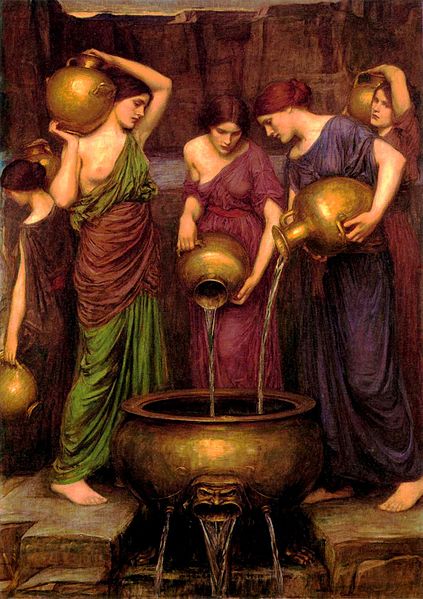
Have you heard the phrase "carrying water in a sieve?" That comes from Greek Mythology. "In Greek mythology, the Daughters of Danaus were the fifty daughters of Danaus. They were to marry the fifty sons of Danaus's twin brother Aegyptus, a mythical king of Egypt. In the most common version of the myth, all but one of them kill their husbands on their wedding night, and are condemned to spend eternity carrying water in a sieve or perforated device. In the classical tradition, they come to represent the futility of a repetitive task that can never be completed." (Wikipedia)

John William Waterhouse
The Danaides, 1903
You cannot earn your own salvation. If you are not complete in Christ (Colossians 2:9-10) you are no better off than the Danaides daughters, carrying water to fill an endlessly leaking well. If you're in church and you believe that to be enough, it isn't. Filling a leaking cistern in a church is just as leaky and incomplete as it would be in any other place.

Whenever you're reading the bible and you see a reference to a spring or a well or a fountain, then think of these symbols of water and what they mean.

"Christ loved the Church and gave himself for it; that he might sanctify and cleanse it with the washing of water by the word." (Ephesians 5:25-26)

"Whosoever drinks of the water that I shall give him shall never thirst; but the water that I shall give him shall be in him a well of water springing up into everlasting life." (John 4:14)

How might you get some of this living water? Christian blogger and author Joel C. Rosenberg linked to a simple Gospel web animation that explains why we need Jesus and how to be saved. It is here. Please share it widely and often. And I pray you are saved and partaking of the Living Water daily.

Thursday, September 27, 2012

CEDRO DO LÍBANO (Sl 92:12-15)

 
CEDRO DO LÍBANO (Sl 92:12-15)
Found in Face book.


Quero compartilhar com vocês a respeito de um tipo de árvore: " O cedro do Líbano".

O cedro do Líbano é uma árvore majestosa que encontramos especialmente nas regiões montanhosas do Líbano, Síria e Turquia. Essa árvore vive centenas de anos, e é considerada um símbolo de força e eternidade. Os fenícios usavam o cedro do Líbano para construir embarcações. Salomão u...
sou cedro do Líbano para construir o templo.

1-Processo Lento

O cedro do Líbano cresce devagar, mas chega a atingir a altura de até 40 metros. Nos primeiros três anos de vida, as raízes crescem até um metro e meio de profundidade, enquanto a planta tem somente cerca de cinco centímetros. Somente a partir do quarto ano é que a árvore começa a crescer.

O Cristão é como o cedro do Líbano e, portanto, tem a promessa de crescer. Ainda que o seu crescimento seja lento conforme a experiência do cedro, ele acontecerá e se tornará visível a todos. O objetivo dos filhos de Deus, principalmente nos primeiros anos da vida cristã, não deve estar no crescimento em si, mas no lançar das suas raízes.

Nos três primeiros anos o cedro do Líbano possui uma raiz de 1,5m de profundidade, e uma planta comum tem a raiz de cinco centímetros de profundidade.

Quantas pessoas entram na Igreja e já querem pregar igual ao pastor? Quantas pessoas entram na igreja e o desejo delas é mostrar trabalho, ao invés de lançar raízes? Hoje temos pessoas preocupadas porque estão percebendo que não tem crescido espiritualmente. Talvez seja porque essas pessoas esperam algo visível, externo, um ministério como o ministério de música.

Precisamos aprofundar nossas raízes. E como fazemos isso? Com oração, leitura da Bíblia, com prática das disciplinas espirituais. Quanto mais formos atraídos por Deus mais firmes ficarão nossas raízes, e no tempo certo o crescimento será visível, será externo. As raízes vão ser tão firmes, que não nos importará se vou estar aqui no púlpito aparecendo ou não, o que vai importar é que minhas raízes estão firmadas em Deus.

Além do cedro do Líbano ter um processo lento, ele tem:

2. Raízes bastante profundas

O cedro do Líbano suporta muito calor e muito vento, suas raízes não dependem nada da chuva porque suas raízes vão buscar águas nos lençóis freáticos (que é o lugar nas profundezas que tem água potável).

Assim deve ser a nossa vida, não podemos ficar dependendo de fatos externos, devemos agir como a música que diz: Eu vivo do que creio e não do que vejo. Temos que suportar as dificuldades que aparecem na nossa vida, e não ficarmos fugindo.

Tem gente que diz que não cresce porque a Igreja está passando um momento difícil, porque os irmãos não ajudam. Se não tomarmos cuidado sempre vamos dar uma desculpa para o que acontece conosco. Devemos fazer como as raízes do cedro, sem chuva, pode vir o que for, eu vou o máximo que puder e vou encontrar águas profundas, mesmo quando a situação está desfavorável.

Sabemos que temos 3 inimigos: A carne, o diabo e o mundo. Muita gente vive colocando culpa no diabo, ou no mundo, na maioria das vezes o erro está em nós mesmos.

Quantas vezes olhamos para as circunstâncias? Agimos de acordo com que estamos vendo. Muitas vezes ficamos desesperados por alguma situação que está acontecendo, temos que buscar forças no Senhor pra firmarmos nossas raízes. Temos que buscar, buscar e buscar. Aproveitar enquanto há tempo.


Além de o processo ser lento, as raízes serem profundas, as raízes do cedro do Líbano também:

3. Abraçam as pedras

Tem muitas plantas que quando suas raízes alcançam as pedras, as raízes param de crescer e em alguns casos as plantas chegam até a morrer. Já no caso do cedro do Líbano quando suas raízes encontram as pedras, ao invés delas pararem de crescer elas dão um verdadeiro abraço nas pedras e continuam crescendo. E quanto mais as raízes abraçam a rocha, mais as raízes vão ficando firmes.

Assim é a vida dos justos, não para de crescer, pode vir a pedra, pode vir o que for, qualquer empecilho, o justo vai sempre crescer, mesmo que as pessoas não estejam enxergando.

Verso 13

Plantados na casa do Senhor, florescerão nos átrios do nosso Deus.

Aqui o salmista faz referência a casa do Senhor que nesse período era o templo. Aqui temos a importância e a necessidade de congregarmos no Templo.

Algumas lições podemos aprender com esse texto:

1 – O lugar do justo é na Casa de Deus, junto com o povo de Deus.

2- Somente congregando que o justo florescerá, pois é nos átrios do Senhor que ele recebe a ministração da Palavra de Deus.

3 – É na igreja, como o povo de Deus, que somos alvos da graça de Deus, da benção e do fortalecimento.

4 – Você foi plantado na igreja que você estar agora, nesses átrios, é aí que você deve florescer, crescer para a glória de Deus.

5 – Floresça onde você foi plantado.

Quantos deixam de crescer, mudando constantemente de igreja, aparece um empecilho e logo trocam de igreja. Trocam de igreja como trocam de roupa. Nunca floresceram como a palmeira e não crescerão como o cedro do Líbano.

O Resultado de quem congrega na Casa de Deus (v. 14-15)

“Na velhice darão ainda frutos, serão cheios de seiva e de verdor, para anunciar que o Senhor é reto. Ele é a minha rocha, e nele não há injustiça.”


Ao Senhor seja todo Louvor!
Tome posse desta promessa....Crescer espiritualmente em 2012!

Monday, July 23, 2012

Thorns in the Flesh-

Thorns in the Flesh- Jack Kinsella - Omega Letter Editor - http://www.omegaletter.com/articles/articles.asp?ArticleID=7268

The word 'holy' comes from a Greek word that means 'separated' -- in this context, it means 'separated' from the world of sin. In context, Peter and Paul were therefore two of the twelve holiest men who ever lived.
They were Personally 'separated' from the world by Jesus Christ! But neither went on to live a sinless life. Peter fell back into some legalistic Judaic practices and had to be publicly upbraided by Paul. (see Galatians 2: 11-21)

Paul approached the Lord three times, requesting the Lord remove a "thorn in his flesh," a "messenger of Satan sent to buffet me" -- complaining that this infirmity hindered his ability to minister effectively.
Paul wasn't lying when he said he was chief among sinners back then. And I am not lying when I say that I am chief among sinners today. I don't know every sinner. But I am certain that I am the worst sinner that I do know.
Thus it is with each of us, if we are honest. I may know of a Christian who commits more obvious sins than I do -- but I cannot honestly name somebody who sins MORE than I do.
The only sins that I know others commit are the sins I actually see them commit. I am with ME every time.
I am with me when I get cut off in traffic. I am with me when I think bad thoughts. I am with me when I do things I wouldn't do if I was with my pastor.
I am with me when I am uncaring for strangers, unkind to loved ones, unreasonable, unthankful, unholy, disobedient . . . the list goes on.
To be brutally honest, I don't know ANYBODY who sins more than me. (And if you are honest, I suspect you can probably say the same thing about you.)

Peter was called out and separated by Jesus Christ to serve the Gospel. But Jesus did not drop him like a hot rock after Peter said, "I don't know Him."
Jesus called out Paul on the road to Damascus and separated by Jesus Christ to serve the Gospel. He told Paul to stop worrying about his problems with the messenger of Satan.
"And He said unto me, My grace is sufficient for thee: for My strength is made perfect in weakness. . ." (2nd Corinthians 12:9)

I was called out and separated by Jesus Christ one winter night in 1975 to serve the Gospel. That is what salvation is all about -- being separated for the Great Commission.
But it isn't YOU that does the separating. It is Jesus Christ. If it is you that is the one doing the separating, then how would you go about it?
The answer would seem to be obvious. You avoid places where sin is going on. You stay away from people that might lead you into sin.
You surround yourself with other like-minded Christians and you separate yourself from the world. That's what Paul said to do. Didn't he?
"Be ye not unequally yoked together with unbelievers: for what fellowship hath righteousness with unrighteousness? and what communion hath light with darkness? And what concord hath Christ with Belial? or what part hath he that believeth with an infidel? Wherefore come out from among them, and be ye separate, saith the Lord, and touch not the unclean thing; and I will receive you." (2nd Corinthians 6:14-15)
But clearly, that seems contradictory. When Jesus was criticized for mingling with sinners, He replied, "It isn't the healthy that need a Physician."

So what is Paul talking about? Paul's letter was addressed to the body of believers at Corinth who had fallen into all kinds of pagan practices.
He was speaking to the Corinthian church's practice of mingling idol worship and depraved parties masquerading as the Lord's Supper with some sins "such are are not even named among the Gentiles."

Individual believers are, by virtue of their salvation, already called out and made separate (holy) and righteous (by imputation). It is accomplished;
"Not by works of righteousness that we have done, but by the washing of regeneration and renewing of the Holy Ghost." (Titus 3:5)

The New Covenant with the Church Age is not a corporate agreement between God and a specific people, but rather is individual relationship between Jesus Christ and just ONE person -- you.

That is why God does NOT punish believers. He chastises them. And God does NOT visit the sins of the fathers upon the children unto the third and fourth generation. The children have their own accounts to settle. Individually.
"My son, despise not thou the chastening of the Lord, nor faint when thou art rebuked of Him: For whom the Lord loveth He chasteneth, and scourgeth every son whom He receiveth." (Hebrews 12:5-6)
This is a good place to stop and examine the difference between chastisement (chastening) and punishment.
Chastisement is correction -- parents correct their children by chastising them until they fall back into line. The chastisement stops when the behavior is corrected.
Punishment is different. It is retribution -- punishment continues whether the offender changes his ways or not. If you are serving a life sentence, changing your ways is nice, but it has no effect on the sentence.

I don't know about you, but while I loved them all equally, all my children were different. Although the rules were the same, it was necessary to set different boundaries with each one of them.
I had a different way of dealing with the kid who tried a puff off a cigarette (and didn't like it) than I did with the kid who had a pack of butts hidden in his bedroom.
Same rules, same offense. But it was a greater threat to one of them than it was the other and so one of them needed a firmer form of correction than the other.

Is God not as good a parent as you or I?
The Lord doesn't have one set of rules for one Christian and a different set of rules for another. The rules are the same for us all.
"Jesus said unto him, Thou shalt love the Lord thy God with all thy heart, and with all thy soul, and with all thy mind. This is the first and great commandment. And the second is like unto it, Thou shalt love thy neighbor as thyself. On these two commandments hang ALL the law and the prophets." (Matthew 22:27)

Don't let the enemy steal your victory. Nobody is perfect except God and He made you the way you are for His glory and according to His purpose.
His strength is made perfect in weakness, the Lord told Paul. Paul didn't argue with the Lord and demand that God change Paul into the kind of Christian that Paul thought he ought to be.

Paul didn't get mad at God for his afflictions. Instead, Paul responded this way;
"Most gladly therefore will I rather glory in my infirmities, that the power of Christ may rest upon me." (2 Corinthians 12:9)
So, you think you are weak and ineffective at your calling and unworthy of your salvation? You think you are too big a sinner to be used of God? Then you're just the one He's looking for.
Has He got a job for you!

Friday, July 20, 2012

PRESENTE DE DEUS OU PROPRIEDADE DE DEUS?

PRESENTE DE DEUS OU PROPRIEDADE DE DEUS?
http://www.pulpitocristao.com/


Por Isaltino Gomes Coelho Filho
Um dia desses vi uma pintura num veículo: “Foi Deus quem deu!”. Entendi a mensagem que o proprietário queria transmitir. Ele reconhecia que Deus lhe proporcionara uma bênção material. No caso, aquele carro.

Mais tarde pus-me a meditar no caso. Respeitosamente, não me soa o reconhecimento correto. Na realidade, há mais de mundano que de espiritual na frase. Ela não expressa apenas o reconhecimento de que foi uma bênção, mas traz certo ufanismo.

Afinal, conheço bem o movimento evangélico de hoje e sei da ênfase que ele coloca em bens materiais como sinal da aprovação divina. Quem é suficientemente bom aos olhos de Deus recebe bênçãos materiais. A doutrina da graça tem sido varrida para longe pelo neopentecostalismo. É um tal de “declarar”, “exigir seus direitos”, “reivindicar” que se vê uma total ignorância do que seja graça. Consequentemente, do que seja o evangelho. Quando alguém diz “Foi Deus quem me deu” pode muito bem estar dizendo: “Viu? Fui um bom menino, e Papai do Céu me deu de presente!”. Vejo tanto ufanismo com bens materiais! Muitos evangélicos parecem mais ligados em Mamom, o pseudo-deus das riquezas, que em Jesus Cristo.

O correto não é “Foi Deus quem deu!”. Porque se somos mesmo cristãos, nada é nosso, e tudo é dele. As coisas que nos vêm às nossas mãos, na realidade não são nossas, mas dele. Estão conosco para nosso uso, mas prestaremos contas delas, porque não somos proprietários, mas servos e mordomos (Lc 12.37 e 42) e despenseiros (1Pe 4.10). Alguns acham que são donos e assim dão migalhas dos bens, do tempo, das emoções e dos afetos para Deus. Amam os bens e dizem que Deus lhes deu.

Se você realmente é uma pessoa que entregou a vida (e não apenas o louvor) a Jesus, nada do que você tem é seu, mas é dele. As pessoas se lembram do Salmo 24.1 quando querem reivindicar coisas como “filhas do Rei”. Se tudo é dele, somos dele e nossas coisas são dele.

Sua vida é dele? Então seu carro não foi presente dele, mas é dele. Sua casa é dele. Seus filhos são dele. Sua carreira é dele. Se ainda não entendeu isso, cante o hino 422 do Hinário Para o Culto Cristão: “Tudo o que sou e o que vier a ser eu ofereço a Deus”. Em um ato de culto ofereça a Deus o que é dele por direito. Que seja de fato.

Nada seu é seu. Tudo seu é dele. Reconheça isso e viva isso antes que ele, insatisfeito com sua visão, dê a outro: “Tirai-lhe, pois, o talento e dai-o ao que tem os dez talentos” (Mt 25.28). Lembra-se desta história? Aconteceu quando o senhor chegou e chamou os servos à prestação de contas (Mt 25.19). Demorou, mas veio. Você é apenas servo, e não senhor. Quando ele vier, que não chame você de “servo inútil”.
***
Fonte: Isaltino Gomes Coelho Filho. Compartilhado do Ministério Beréia. Divulgação: Púlpito Cristão.

Wednesday, May 30, 2012

Ecumenism never works, Interfaith is not what it seems

Ecumenism never works, Interfaith is not what it seems


Listen to this. This is a good story. From Ezra 4:1-5, a one act play in three parts, with application for today.

Pt 1: Question
"Now when the adversaries of Judah and Benjamin heard that the returned exiles were building a temple to the LORD, the God of Israel, they approached Zerubbabel and the heads of fathers’ houses and said to them, "Let us build with you, for we worship your God as you do, and we have been sacrificing to him ever since the days of Esarhaddon king of Assyria who brought us here."

Pt 2: Answer
"But Zerubbabel, Jeshua, and the rest of the heads of fathers’ houses in Israel said to them, "You have nothing to do with us in building a house to our God; but we alone will build to the LORD, the God of Israel, as King Cyrus the king of Persia has commanded us."

Pt 3: Reaction
"Then the people of the land discouraged the people of Judah and made them afraid to build and bribed counselors against them to frustrate their purpose, all the days of Cyrus king of Persia, even until the reign of Darius king of Persia."

Note that the first verse states that these were enemies of Judah and Benjamin. Every translation uses the word enemies or adversaries. These people who showed up undoubtedly had heard the shouts of praise and weeping as recorded in the previous verse (Ezra 3:13). And no one could miss 50,000 or so people tramping back with all their families, servants and animals. Their arrival was noted. And not appreciated. What to do? What to do? Well, if you can't beat 'em, join 'em!

"Let us help you!" they said. They were all nicey-nice. They asked politely. They said that they respected the Israelites' God. For gosh sakes, we worship Him, even sacrifice! We're like you!

The two tribes said ... drumroll please ... NO.

By today's standards, we'd say that the Israelites were being mean, impolite, "exclusive", "intolerant", and "haters" by refusing the offer. After all, weren't the would-be helpers seeking? Wouldn't it achieve a dual common goal by getting the temple finished earlier and offering the seekers the opportunity to dazzle them with their wonderful personalities before setting the bait-and-switch of ... ta-DA! ... sharing the knowledge of the LORD?

No it would not. First, the Jews knew that the LORD had placed it upon their hearts to do the work, He had not placed it upon the Gentiles's hearts and therefore they were respecting the decree of the LORD by working exclusively toward fulfilling His command. Second, they were respecting the decree of the King to be the ones who built it. And third, we knew then and we know now that there is never a common spiritual goal when pairing with Gentiles. They promote satan's goals, we promote Jesus's. There is between them a great gulf fixed.

Sure enough, their true colors came out. And right away too. They immediately began a multi-pronged approach to thwarting the goal of rebuilding the temple and thus of God's work. They were doing satan's work. It had only been a ruse in that first prong approach of joining them. When that didn't work, right away began to bribe the officials, appeal to the king, discourage the Jews, frustrate them, and bully them. They kept this up for fifteen years. Fifteen years. As we can see by their persistence, their goal was never to help get the temple built, it was only to prevent the temple from being built.

See? Ecumenism never works. The seeker's goals are not the same as ours, and their true colors will come out soon enough.

We can see by one of satan's methods that he sows tares among the wheat, something undoubtedly the pagans had wanted to do. The Jews would have naturally relaxed their guard by being in daily proximity to the pagans, and satan would have started sowing the tares. Intermarriage, friendliness, social mixing or melding their different religions, pollution would have begun. Just ask Solomon how that works out.

Note I'm talking about maintaining separateness when setting out to accomplish a purpose of God, or a consecrated thing, not that we never mix with unbelievers. The fact is, though, the bible is replete with warnings not to mix holy and profane:

"Do not be yoked together with unbelievers. For what do righteousness and wickedness have in common? Or what fellowship can light have with darkness?" (2 Corinthians 6:14)

The Greek lexicon defines this unequal yoking as "used figuratively of Christians wrongly committed to a partner holding very different values (priorities), i.e. that run contrary to faith (the kingdom of God). Scripture uses symbols to teach about the importance of keeping spiritually pure. Along this line, Scripture prohibited partnering with the apistos, or the unfaithful, by evoking the picture of two different animals yoked together. Would the field get plowed if you yoked a bull and a goat together?.

"...but while his men were sleeping, his enemy came and sowed weeds among the wheat and went away...(Matthew 13:25)
Félicien Rops, Satan Sowing Seeds, pencil, c. 1872.

I've used this pencil drawing before recently. I like it. Why? I'm amazed at the accuracy the drawing evokes of satan's activity and methods. It reminds me of so many different verses. The wheat and the tares is one. The verse where God asks satan where he has been and satan says he has been roaming through the earth and going back and forth in it. (Job 1:7). Another verse is good to remember here, satan is god of this world, (2 Corinthians 4:4) and he has been given power to deliver kingdoms to all he chooses (Matthew 4:8-9).

We must resist the world because satan is the god of it. "But you are a chosen race, a royal priesthood, a holy nation, a people for his own possession, that you may proclaim the excellencies of him who called you out of darkness into his marvelous light." (1 Peter 2:9).

We should not combine with unbelievers, or even with those who say they worship the same God as we do but obviously do not. Let not the political, cultural, or social desires get in the way of the biblical desire to remain dedicated to being pure and bringing glory to Jesus. Ecumenism, or interfaith, is not what it seems. This is evidenced by the immediate reaction of the rejected pagans who had asked to "help" build the temple but only wanted to allow satan to go back and forth on it, sowing tares.

Friday, May 18, 2012

CONVERSA CORAJOSA

CONVERSA CORAJOSA

http://teachervjcpjoani.blogspot.com.br/
Será que os avanços tecnológicos na comunicação nos deixaram incapazes de confrontar as pessoas adequadamente? Afinal de contas, agora os empregadores podem enviar cartas de demissão por e-mail. E as pessoas podem criticar outras no Facebook e no Twitter, em vez de falar face a face. Talvez seja melhor colocar tudo isso de lado e imitar a maneira como Paulo se comunicou com Pedro quando eles discordaram.
 
Paulo teve de confrontar Pedro por ter comprometido a graça (Gálatas 2:11-16). Pedro vinha tendo comunhão com os gentios, mas, quando chegaram os judaizantes (que criam que os pecadores são salvos através de Jesus e da obediência à lei de Moisés), Pedro separou-se dos gentios. Ele os deixou no ostracismo, embora professasse ter união com eles. Vendo essa hipocrisia, Paulo, em amor e com entusiasmo, confrontou Pedro face a face por este se acovardar diante de um sistema legalista incapaz de transformar vidas. Com vigor, ele lembrou Pedro de que a graça leva à libertação da escravidão do pecado e à obediência a Deus.
 
Ter conversas corajosas com outros cristãos pode ser difícil, mas elas promoverão a pureza e a unidade. Podemos exercitar nossa responsabilidade mútua de falar a verdade em amor (Efésios 4:15) andando no poder do Espírito Santo.

Uma palavra bem escolhida pode ser muito eloquente. (RBC)


Wednesday, May 9, 2012

Arranging Deck Chairs or Plugging the Hole?

Arranging Deck Chairs or Plugging the Hole?
by Heidi Swander May 9, 2012 www.olivetreeviews.org  Join us on Facebook

"The motivation for Christians working to delay the coming collapse of our nation is not to preserve our way of life, but to buy more time to share the life-changing gospel of Jesus Christ with as many people as possible before America is swept away by God's judgment," (emphasis mine). Read that again. This statement by Pastor Robert Jeffress in his book, Twilight's Last Gleaming: How America's Last Days Can Be Your Best Days, revolutionized my thinking on the important matter of actively affecting the culture around us during these days of moral decline.


As we catapult toward this fall's coming election, the debate will grow more heated. "Many Christians equate efforts to stop the murder of the unborn, uphold the biblical principles of morality, and elect godly leaders with rearranging the deck chairs on the Titanic. 'If we are going down anyway, why bother?' people wonder." Pastor Jeffress isn't at all sure about that way of thinking, and having read his explanation about why he is unsure, I'm inclined to agree.


"I have a different perspective today. While our responsibility to delay our culture's decay is not our primary mission here on earth, it is a necessary prerequisite if we are to fulfill our ultimate calling of pointing people to Jesus Christ," (emphasis mine). Point well taken! I was motivated by Pastor Jeffress' position here.


If the purpose of standing up against abortion or battling the incessant encroachment of homosexuality or trying to bring our culture back from the brink of all-out socialism is simply, "a better America," then that does nothing to inspire me. I would have to throw my hat in the ring with those who say, "Let the ship sink." But if the rationale behind running for office or fighting to put people of principle in positions of leadership or working to defeat an ungodly congressional bill is the eternal goal of, "redeeming the time," in order to provide ample opportunity for as many souls as possible to come to eternal life, that is a goal I can thoroughly stand behind!


And then he poses this question: "How do you balance your primary calling to share the gospel with the calling to stand up against ungodliness in our nation?" That was the premise for the book. It's more than a fair question and it's one that demands an answer from each of us.


He talks about being salt and light in our world as Jesus admonishes us. "Most Evangelical Christians understand (even if they don't obey) the mandate to serve as lights in this dark world, pointing people to Christ's offer of salvation to all who believe. But I have discovered that many Christians do not comprehend Jesus' command to delay the decay of our culture by acting as salt in the world," (emphasis mine).


One important issue Pastor Jeffress points to in regard to this is the relativism that is engulfing not just our society but, more disastrously, the community of those who call themselves, "e
Evangelical Christians."

<><> <><> <><> <><> <><>

Purchase this encouraging and englightening book in our online store for $19 + S/H!.

We become tasteless salt and a diminished light." And he warns, "When Christians lose their motivation to be restrainers of evil, it is only a matter of time until society crumbles under the weight of its own sin." That observation reminds me of Paul's teaching about the Holy Spirit restraining evil through the vessels He indwells (us), and our understanding that once we are taken Home all hell will, quite literally, break loose. We must not abdicate our responsibility in advance.
Let's get practical. How does this book's premise relate to this fall's election and our responsibility to participate in it? At the very least it means we should plan to vote. I have heard some opine that they won't even vote this time around. I remember reading an article by a fairly well-known Christian editor who actually suggested that the last time around. I don't know how many took heed to his advice, but you can clearly see that the results were not advantageous to the cause of the gospel.
Additionally, we must be informed when we vote. That means we must know as much as we can about the individuals we are voting for and the issues that will be on the ballot so that we make a well-informed decision. That is the kind of voting that will honor our Father and will, if God chooses, allow more time for souls to come to Jesus.
That's just one example. It certainly doesn't stand alone. But if we, as children of God, take seriously Jesus' mandate to be salt and light in every area of our life, you can see how it could affect the culture we live in and provide more time for the lost to be drawn to the Savior.
"Sometimes God judges without delay," Pastor Jeffress writes. "However other times there is a delay between explosive choices a society makes and the natural collapse that comes from removing the spiritual and moral support structures of a society, just as there is with an implosion.
"You and I are living in that pause in history between explosion and implosion," he says. "Our future hope is that the coming darkness that will engulf America and every other nation in the world will be followed by the dawn of Christ's return, when He will establish a new heaven and a new earth. But until that time, God has left us on earth during these twilight years for a very specific purpose."
May we continue to act as salt and light until the day Jesus calls us Home.

Wednesday, March 7, 2012

The Most Precious Fruit

http://www.midnightcall.com/articles/messages/item/462-the-most-precious-fruit

Spiritually speaking, we are all farmers. The Bible often uses examples from the world of agriculture. We are all working in the field, the place where God has put us.
The New International Version says, See how the farmer waits…. Spiritually speaking, we are all farmers. The Bible often uses examples from the world of agriculture. We are all working in the field, the place where God has put us. We “sow” and “reap,” we “plant” and "water,” we “weed” and “tend” the plants, whether it be within the family, marriage, the bringing up of children or in our contact with other people. And we live in hope of a good harvest at the end of our lives.

James also uses in his letter a picture from the world of agriculture,Be patient therefore, brethren, unto the coming of the Lord. Behold, the husbandman waiteth for the precious fruit of the earth, and hath long patience for it, until he receive the early and latter rain. Be ye also patient; stablish your hearts: for the coming of the Lord draweth nigh. Grudge not one against another, brethren, lest ye be condemned: behold, the judge standeth before the door. Take, my brethren, the prophets, who have spoken in the name of the Lord, for an example of suffering affliction, and of patience. Behold, we count them happy which endure. Ye have heard of the patience of Job, and have seen the end of the Lord; that the Lord is very pitiful, and of tender mercy (James 5:7-11).
Three things are passed on to the Church through James’s allegory:

1.The proximity of the return of Jesus.
2.The inner preparation for His return.
3.The practical application in view of His return.


1.THE PROXIMITY OF THE RETURN OF JESUS

It is certainly significant that our relatively short text speaks three times of the immediate return of the Lord:
James 5:7, Be patient therefore, brethren, unto the coming of the Lord.James 5:8, Be ye also patient; stablish your hearts: for the coming of the Lord draweth nigh.James 5:9, Behold, the judge standeth before the door.
The apostle and half-brother of Jesus tells his readers to await the coming of the Lord and not to wait for any preceding signs. The next great sign that the Church has to expect is the return of the Lord for His Church, to take her home. We must be clear that the Rapture can take place suddenly and completely unexpectedly. If the Holy Spirit inspired James to write that the Lord could come during his lifetime 2,000 years ago, this emphasizes the proximity of the Rapture as the next event we have to await.

Let us consider these three quotations from verses 7, 8 and 9, which refer to the imminent return, one after another: Be patient therefore, brethren, unto the coming of the Lord(verse 7).

What is true waiting?
To await a promised event means that I have a fixation on it, that I am awaiting this event and not something else. This tells us that the Church is not waiting for the signs of the return of Jesus in glory, not for the Great Tribulation, not the Antichrist nor the wrath of God which will be poured out in judgments, but for the Lord’s coming for the Church.My nephew trained to be a chef. When he had taken all his exams, he was told that he could soon await the result of them, and he would receive them by mail. Every time I spoke to my nephew we spoke about the imminent results. He and his family were waiting expectantly. His mother told me how he went to the mailbox first thing every morning hoping to find the results of his exams in it. Nobody would have thought of waiting for anything else, like a pre-result. It would have been possible for something else to be in the mailbox, but not necessarily. It would also have been possible for it to take a few more days, but it didn’t need to. He was waiting for nothing other than his examination results. In this way the generations before ours waited for the Lord and not signs, and He really could have come, …for the coming of the Lord draweth nigh”, or …the Lord’s coming is near,” as it says in the New International Version.

What does “nigh” or “near” mean?
It means a close proximity of something. If the Rapture could have been before James’s time, and if other signs had to be fulfilled first, the Holy Spirit would not have inspired James to write these words. From this statement we also see that the Holy Spirit is speaking of the Rapture, for the visible return of Jesus in glory is preceded by definite events as signs, but James does not mention these. He speaks to “brethren” (verse 7), that is, to the Church, and of the return of the Lord for the Church, the Rapture. Behold, the judge standeth [at] the door (verse 9).

What does it mean that Jesus is standing at the door as judge?
 If an expected visitor is already at the door, there is no other event that is nearer than this visit. What else are we to expect than that He could come at any moment? Who or what could come between Him and the door? After Pentecost and the building of the Church, the Rapture with the following judgements is the next spiritual event. Therefore, with the coming of Jesus the judge is also standing at the door.

In 2 Corinthians 5 we find a clear parallel to and explanation of this. First, Paul speaks of the Rapture and uses the picture of being “clothed.” For while we are in this tent, we groan and are burdened, because we do not wish to be unclothed but to be clothed with our heavenly dwelling, so that what is mortal may be swallowed up by life. Now it is God who has made us for this very purpose and has given us the Spirit as a deposit… For we must all appear before the judgment seat of Christ, that each one may receive what is due him for the things done while in the body, whether good or bad (2 Corinthians 5:4-5 & 10). Paul is speaking here of three relevant things:

1. “We do not wish to be unclothed,” meaning we do not want to die,“…but to be clothed,” transformed at the Rapture, whereby what is mortal is “swallowed up by life.”
2. We have the Holy Spirit as a deposit (a down-payment, a guarantee) of this. He will take the Church to heaven, like Pentecost in reverse, at the Rapture (2 Thessalonians 2:6-7).
3. After the Rapture comes the appearing before the judgment seat of Christ.

Are you waiting for Jesus? Are you waiting for Him to appear at any time? Are you expecting Him to come today? It is one of the great failures within the Church that this attitude of expectancy has disappeared, and therefore she is lukewarm where other Biblical truths and sanctification are concerned. I heard of a man who so lived in the expectancy of the return of Jesus that he always ate the dessert first! This may seem exaggerated, but why should we not exaggerate if it helps us?


2.THE INNER EXPECTANCY OF HIS RETURN.


The abovementioned example of this man, even if it is an extreme example, is a lovely picture of the inner attitude we should adopt where the return of the Lord is concerned. We should love His appearing. Love does not tolerate anything coming between us and the object of our love. Recently one of our daughters said to us at dinner, “I have not seen my husband for 14 hours now. I hope he comes soon!” The return of Jesus at the Rapture is the greatest historical and political event of the future. All natural phenomena, all scientific discoveries, everything will be nothing in comparison to this. The Church should be doing everything to express her hope of the coming of Jesus. And this is just what God is putting His finger on through James. We should be patient and strengthen our hearts, Be patient therefore, brethren, unto the coming of the Lord. Behold, the husbandman [the farmer] waiteth for the precious fruit of the earth, and hath long patience for it, until he receive the early and latter rain. Be ye also patient; stablish your hearts: for the coming of the Lord draweth nigh (James 5:7-8).

The emphasis is on the term “patient” in this allegory and strengthening our hearts in expectation of the return of Jesus.
What does the farmer do as far as his work is concerned? He waits patiently for the precious fruit and does not let himself be discouraged. He works for this fruit, he lives for it, he invests in it. He knows the work is hard, and the possibility of bad weather, pests, drought, etc., and yet he waits patiently for the fruit. This example is used in connection with our expectation of the return of Jesus. We should overcome all unpleasant things, all setbacks—“bad weather,” “pests” or even persecution where our vision of the return of the Lord is concerned. We should look beyond everything to Jesus and His return. Patience means that the Lord Jesus Christ does not have to come today, but he could come and He will come one day. It is a “precious fruit” to wait for the return of Jesus. This is not an exaggeration, something outlandish, but something precious.

Patience (endurance) produces inner stability,Be ye also patient; stablish your hearts: for the coming of the Lord draweth nigh (verse 8). What is a good foundation for inner stability, for conquering and persevering, for strengthening and comfort? To be convinced of the return of Jesus. In the passage concerning the Rapture in 1 Thessalonians 4, the Bible tells us a similar thing to James, Wherefore comfort one another with these words (1 Thessalonians 4:18).


3. THE PRACTICAL EFFECTS IN VIEW OF HIS RETURN.


Every inner attitude also has a practical effect. What are the practical effects?

Lay aside anger:
 Grudge not one against another, brethren, lest ye be condemned: behold, the judge standeth before the door (James 5:9). Here too I would like to quote the New International Version, Don’t grumble against each other, brothers, or you will be judged. The Judge is standing at the door!
Is not this statement interesting in view of the return of Jesus? Here it is not the so-called “grave sins” that are spoken of, like lying, occultism, immorality or theft. We should give no room to negative thoughts concerning our brothers and sisters in the faith. We should not be annoyed, nor even grumble. Why does the Lord demand this? Because annoyance costs us strength, possesses us and devours us. It divides, distracts us from what is relevant and makes us incapable of doing really fruitful things. He that observeth the wind shall not sow; and he that regardeth the clouds shall not reap (Ecclesiastes 11:4).

It is interesting that no reason for grumbling is given here, because grumbling is already in itself wrong. If we are annoyed with someone who is, spiritually speaking, our brother or sister, then the discussion of who is right or wrong is irrelevant. Being annoyed is wrong and unspiritual. Paul wrote, And grieve not the holy Spirit of God, whereby ye are sealed unto the day of redemption. Let all bitterness, and wrath, and anger, and clamour, and evil speaking, be put away from you, with all malice: and be ye kind one to another, tenderhearted, forgiving one another, even as God for Christ’s sake hath forgiven you (Ephesians 4:30-32).]

John Wesley once said, “I have often regretted judging too harshly, but seldom of being too kind.” How we can get upset over another person, inwardly complaining about him or her, hinting at our feelings or even causing a violent quarrel. It is often our own discontent, the lack of the working of the Holy Spirit in our lives, which expresses itself in criticism and seeking fault in others. The Bible does not say anything about who is right or wrong in this text, but simply says, Grudge not one against another, brethren, lest ye be condemned. Christians who accuse one another are all under the judgment of God.
…Behold, the judge standeth [at] the door.

The Judge who is standing at the door will have the last word. He will pronounce the judgment. And instead of us devouring one another, we should be working in the fields in the expectation of our Lord. We should notice thereby that each one has his own field that he is put in and for which he is responsible. We should not force our way into another person’s field with bad intentions, but see that our own is cultivated.

Suffering sorrow:
Take, my brethren, the prophets, who have spoken in the name of the Lord, for an example of suffering affliction, and of patience. Behold, we count them happy which endure (verses 10-11). We praise the suffering prophets today, like Isaiah, Jeremiah or Daniel. We call them blessed.

- Isaiah was sawn in half at the command of Manasseh, according to tradition.
- Jeremiah was probably stoned by his own people.
- Daniel was thrown into the lions’ den, but was preserved by God.

We need to persevere and endure in a hard and unpleasant time. We must not give up but carry on, continue to pray, to believe and to trust. In spite of all unpleasantness, we must fulfill the service we have been called to. Are you about to give up, to resign and throw in the towel? God wants to encourage us not to do this through this text from the epistle of James.

Look at the end:
 Ye have heard of the patience of Job, and have seen the end of the Lord; that the Lord is very pitiful, and of tender mercy (James 5:11).
We know that Job had his weaknesses, faults and laments, but ultimately he remained firm in his faith. He was faced with family and material losses, cruelty in various forms, attacks of Satan, sickness, criticism, and isolation. But we also see the end that the Lord had prepared for him. Only the end counts, only the goal. The Greek word for end that is used here is telos, and means goal. Job was given more at the end than he lost at the beginning. His story is eternal in the Bible and is a blessing for millions of people on all continents. Your and my life has a goal. This is what counts. Let us not let it become dark through impatience, complaining or fleeing.

Job’s sufferings show us, moreover, not a cruel God but His pity and mercy. God did not let go of Job. He turned everything into blessing and let him experience His pity and mercy. We will also be able to see at the end of our lives, when we reach the goal, that it was God’s pity that brought us through. Let us therefore persevere until He returns. Then we will be amazed!